


 Contact Us
 Appliances
 Agri Inputs
 Auto Components & Accessories
 Beauty & Personal Care
 Electronics
 Fashion
 Grocery
 Gift Cards
 Home & kitchen
 Health & Wellness
 Vehicles & Automotives
 Books & Stationary
 Pet Care
 Toys & Games
10 Best WhatsApp Commerce Solutions for Shopify Sellers in India
WhatsApp Commerce
Key Takeaways
- WhatsApp commerce can help Shopify sellers turn conversations into product discovery, cart recovery, support, and repeat sales.
- For Shopify sellers, the key is to choose a Shopify WhatsApp integration that connects catalogue, orders, campaigns, AI, and support instead of adding another isolated messaging tool.
- Platforms differ significantly in scope: some focus on messaging and automation, while options such as Mystore connect WhatsApp with a wider ecommerce setup.
- Shopify sellers planning to scale should look beyond campaign features and choose a setup that can support more channels and workflows without adding disconnected tools.
For businesses looking forward to integrate WhatsApp with Shopify, the right solution should offer more than adding just a chat interface or sending order updates. A strong Shopify WhatsApp integration should help you turn WhatsApp into a connected sales, marketing, and support channel.
Shopify sellers in India can enable product discovery, catalogue browsing, campaigns, abandoned-cart recovery, order notifications, customer support, and even checkout journeys through WhatsApp commerce. But, the challenge is that different platforms solve very different parts of that journey.
Some focus mainly on messaging and automation. Others support deeper WhatsApp ecommerce with catalogue sync, orders, AI assistants, payments, and broader commerce workflows. This means that the best WhatsApp Commerce solution for a brand depends on its unique business model.
This guide compares the top 10 WhatsApp commerce solutions for Shopify sellers in India, including Mystore, AiSensy, Interakt, WATI, Zoko, and more. It looks at how each solution performs across key areas such as Shopify integration, WhatsApp Store capabilities, catalogue management, campaigns, notifications, AI features, order handling, ease of use, and the additional tools or workflows sellers may need.
Table of Contents
- How WhatsApp Integration with Shopify Can Support Business Growth
- Why WhatsApp Commerce Matters for Ecommerce Businesses in India
- 10 Best WhatsApp Commerce Solutions for Shopify Sellers in India 2027
- WhatsApp Commerce Solutions for Shopify: Quick Comparison
- What Shopify Sellers Should Look for in a WhatsApp Commerce Solution
- Conclusion
- FAQs on WhatsApp Commerce for Shopify
How WhatsApp Integration with Shopify Can Support Business Growth
A well-connected Shopify WhatsApp integration can help sellers meet customers where they already spend time, while keeping product discovery, conversations, orders, and post-purchase communication closer together.
For Shopify sellers, WhatsApp commerce can support growth at different stages of the customer journey:
- Open up another sales channel by letting customers discover products, ask questions, and move closer to purchase within WhatsApp.
- Bring back interested shoppers with abandoned-cart reminders, relevant offers, and timely follow-ups.
- Keep customers updated with order confirmations, payment alerts, shipping updates, and delivery notifications.
- Make support easier to access by handling product, order, return, and delivery queries on a channel customers already use.
- Encourage repeat purchases through personalised campaigns, product recommendations, and continued customer engagement.
Why WhatsApp Commerce Matters for Ecommerce Businesses in India
Indian buyers are already using WhatsApp to discover products, interact with businesses, and make purchase decisions. For ecommerce brands, the opportunity goes much beyond messaging to how WhatsApp can influence discovery, improve conversion outcomes, and increasingly use AI to scale personalised commerce and support.
1. WhatsApp Is Already a High-Intent Commerce Channel
Customers are not just chatting on WhatsApp. They are discovering products, engaging with businesses, and showing purchase intent there.
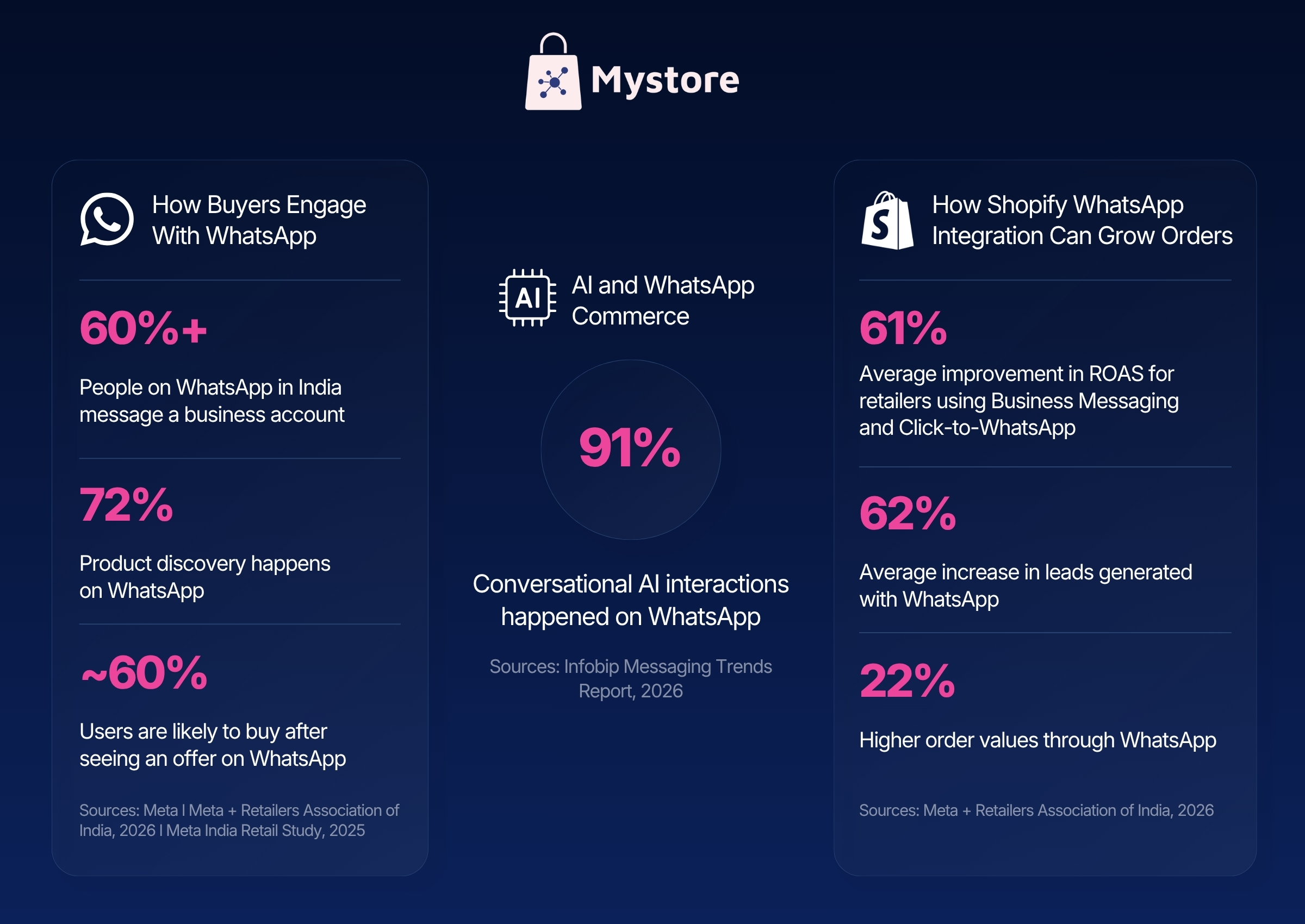
How Buyers Engage With WhatsApp
- 60%+ of people on WhatsApp in India message a business account
- 72% of product discovery happens on WhatsApp
- ~60% of users are likely to buy after seeing an offer on WhatsApp
Source: Meta, Meta + Retailers Association of India, 2026, Meta India Retail Study, 2025
What this means: Shopify sellers can use WhatsApp much earlier in the buying journey, from product discovery and offers to purchase consideration.
2. WhatsApp Can Drive Measurable Commerce Outcomes
When messaging is directly connected to campaigns and buying journeys, the impact can show up directly in leads, return on ad spend, and order value.
How Shopify WhatsApp Integration Can Grow Orders
- 61% average improvement in ROAS for retailers using Business Messaging and Click-to-WhatsApp
- 62% average increase in leads generated with WhatsApp
- 22% higher order values through WhatsApp
Source: Meta + Retailers Association of India, 2026
What this means: A strong Shopify WhatsApp integration can support more than notifications. It can become part of the acquisition, conversion, and repeat-purchase engine.
3. AI Is Making WhatsApp Commerce More Scalable
The next shift is from manual conversations to AI-assisted product discovery, support, and commerce workflows.
AI and WhatsApp Commerce
- 91% of conversational AI interactions happened on WhatsApp Source:Infobip Messaging Trends Report 2026
What this means: WhatsApp commerce is increasingly becoming AI-led, giving sellers a way to handle more conversations, personalise journeys, and support customers without scaling teams at the same pace.
For brands planning to integrate WhatsApp with Shopify, the key is to choose a WhatsApp commerce solution that goes beyond messaging and notifications to support product discovery, campaigns, customer support, and sales.
10 Best WhatsApp Commerce Solutions for Shopify Sellers in India 2027
The best Shopify WhatsApp integration depends on how far you want to take the channel. Some tools focus mainly on campaigns, notifications, or support, while others enable deeper WhatsApp commerce with catalogue sync, product discovery, carts, orders, AI, and connected customer journeys.
Here are 10 WhatsApp ecommerce solutions Shopify sellers in India can evaluate based on commerce capabilities, AI, catalogue sync, ease of use, and how well they extend beyond basic messaging.
1. Mystore
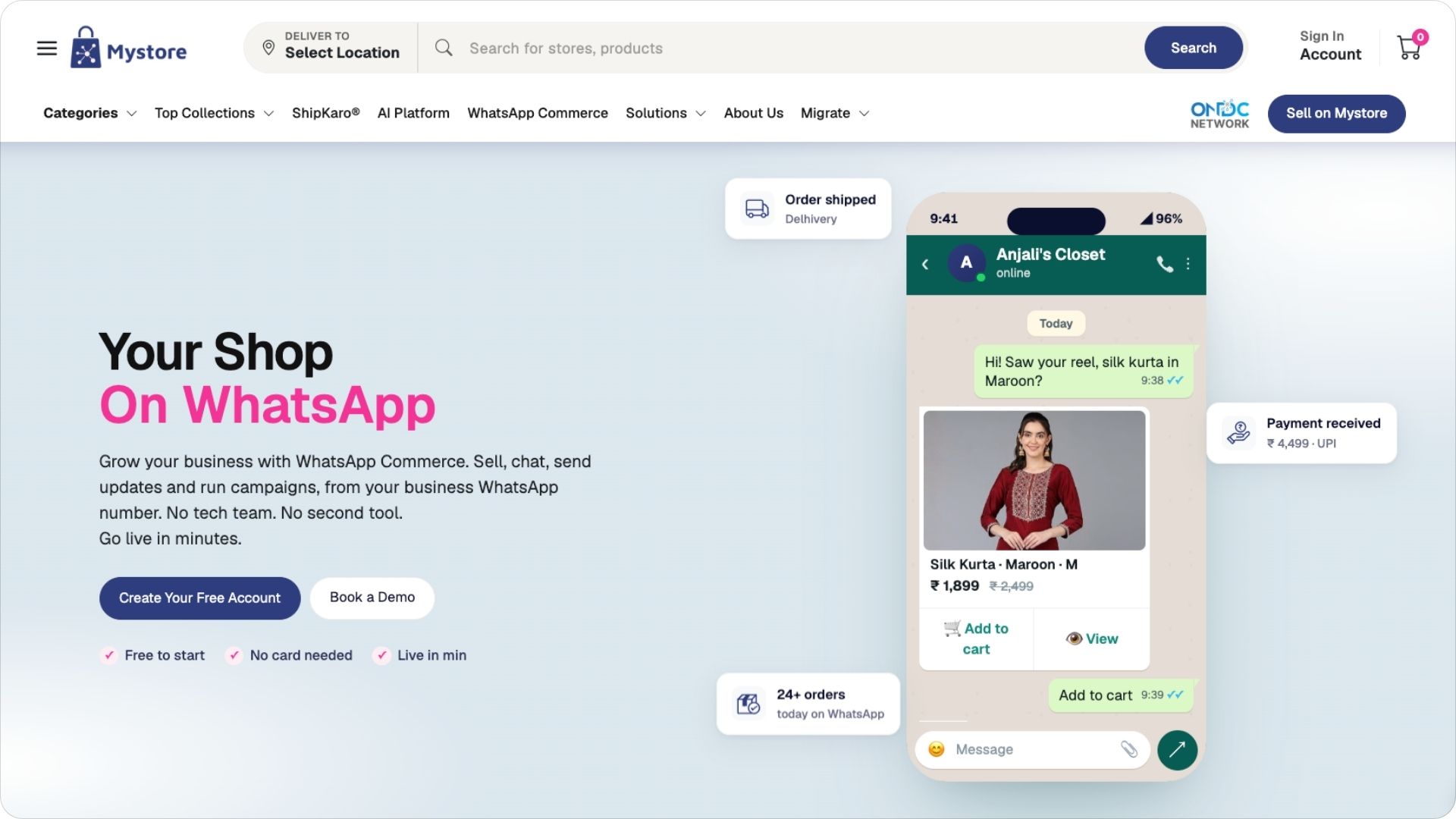
Mystore is an AI-powered, fully hosted and managed ecommerce ecosystem that helps sellers integrate WhatsApp with Shopify while keeping catalogue, orders, customer engagement, and other sales channels connected.
Best For: Shopify sellers looking for broader WhatsApp ecommerce capabilities without adding another standalone tool.
- WhatsApp Store: Product discovery, cart, checkout journey, order updates, and repeat buying through WhatsApp.
- Catalogue & Shopify Sync: Sync Shopify products, inventory, prices, and orders with Mystore.
- Campaigns & Notifications: Broadcasts, cart recovery, scheduled campaigns, payment updates, order alerts, and 50+ message templates.
- AI & Automation: AI shopping assistance, bots, automated replies, customer support, and human handoffs.
- QR Codes & Catalogues: Share brand and product QR codes plus digital catalogues across WhatsApp and other channels.
What Sets It Apart: Mystore offers quick, no-code WhatsApp commerce setup while connecting WhatsApp with a broader ecommerce ecosystem that includes storefronts, Android and iOS apps, AI shopping, ONDC Network integration, logistics, and other built-in commerce tools.
2. AiSensy

AiSensy is a WhatsApp Business API platform that adds a dedicated WhatsApp marketing, engagement, and automation layer to Shopify. Its Shopify WhatsApp integration helps sellers run campaigns, recover carts, automate COD and order communication, and manage customer conversations on WhatsApp.
Best For: Shopify sellers looking to add WhatsApp commerce marketing, automation, and conversational selling to their existing Shopify store.
- WhatsApp Store: Supports WhatsApp catalogues, product browsing, carts, and conversational selling, but does not replace the main Shopify storefront or provide a broader ecommerce store setup.
- Catalogue & Shopify Sync: Connects Shopify product and order data with WhatsApp workflows for cart recovery, notifications, campaigns, and customer engagement.
- Campaigns & Notifications: Broadcasts, abandoned-cart reminders, COD verification, order confirmations, shipping updates, offers, and repeat-purchase campaigns.
- AI & Automation: AI agents, chatbots, automated journeys, segmentation, live chat, and support workflows.
- QR Codes & Catalogues: Supports WhatsApp catalogues and QR codes that bring customers into WhatsApp conversations, campaigns, or catalogue journeys.
What Sets It Apart: AiSensy is a WhatsApp commerce layer for Shopify rather than a full ecommerce ecosystem. It works alongside the existing Shopify store to add WhatsApp-led marketing, automation, support, and conversational selling.
3. Interakt

Interakt is a WhatsApp sales, marketing, and support platform with direct Shopify WhatsApp integration. It helps sellers bring Shopify catalogue, carts, orders, campaigns, and customer conversations into WhatsApp while continuing to use Shopify as their primary ecommerce store.
Best For: Shopify sellers looking to add a stronger WhatsApp commerce sales and engagement layer to their existing store.
- WhatsApp Store: Supports catalogue browsing, product discovery, cart journeys, checkout links, native WhatsApp payments, and order interactions.
- Catalogue & Shopify Sync: Auto-syncs Shopify products and collections, with price and stock changes reflected in the WhatsApp catalogue.
- Campaigns & Notifications: Cart recovery, order and shipping updates, COD workflows, promotions, win-back campaigns, and segmented broadcasts.
- AI & Automation: AI agents for product recommendations, order management and support, along with automated workflows and customer conversations.
- QR Codes & Catalogues: Supports WhatsApp catalogue sharing and QR-led customer entry into WhatsApp conversations and buying journeys.
What Sets It Apart: Interakt offers WhatsApp ecommerce capabilities, including catalogue sync, payments, order workflows, campaigns, and AI agents. It works alongside Shopify as a dedicated WhatsApp sales and engagement layer rather than providing a broader hosted ecommerce ecosystem across multiple selling channels.
4. WATI
 WATI is a WhatsApp Business API platform built around automation, campaigns, support, and Shopify WhatsApp integration. It connects Shopify with WhatsApp so sellers can automate customer communication, recover carts, showcase products, and manage conversations without changing their main ecommerce setup.
Best For: Shopify sellers looking to add structured WhatsApp commerce automation, campaigns, and team-based customer engagement to their existing Shopify store.
- WhatsApp Store: Supports Shopify product catalogues on WhatsApp, product browsing, order collection, and Shopify-led checkout flows.
- Catalogue & Shopify Sync: Connects Shopify catalogue and customer data with WhatsApp workflows, while customer profiles can sync between Shopify and WATI.
- Campaigns & Notifications: Cart and checkout recovery, COD confirmations, order and shipping updates, follow-ups, promotions, and automated campaigns.
- AI & Automation: Chatbots, automated workflows, AI-assisted conversations, and advanced automation rules across customer journeys.
- QR Codes & Catalogues: Supports WhatsApp catalogues and QR-led entry into WhatsApp conversations and product journeys.
What Sets It Apart: WATI adds a WhatsApp automation and engagement layer to Shopify, with strong workflows for campaigns, support, cart recovery, and customer communication. It works alongside the Shopify store rather than providing a wider hosted ecommerce ecosystem across storefronts and selling channels.
5. Zoko
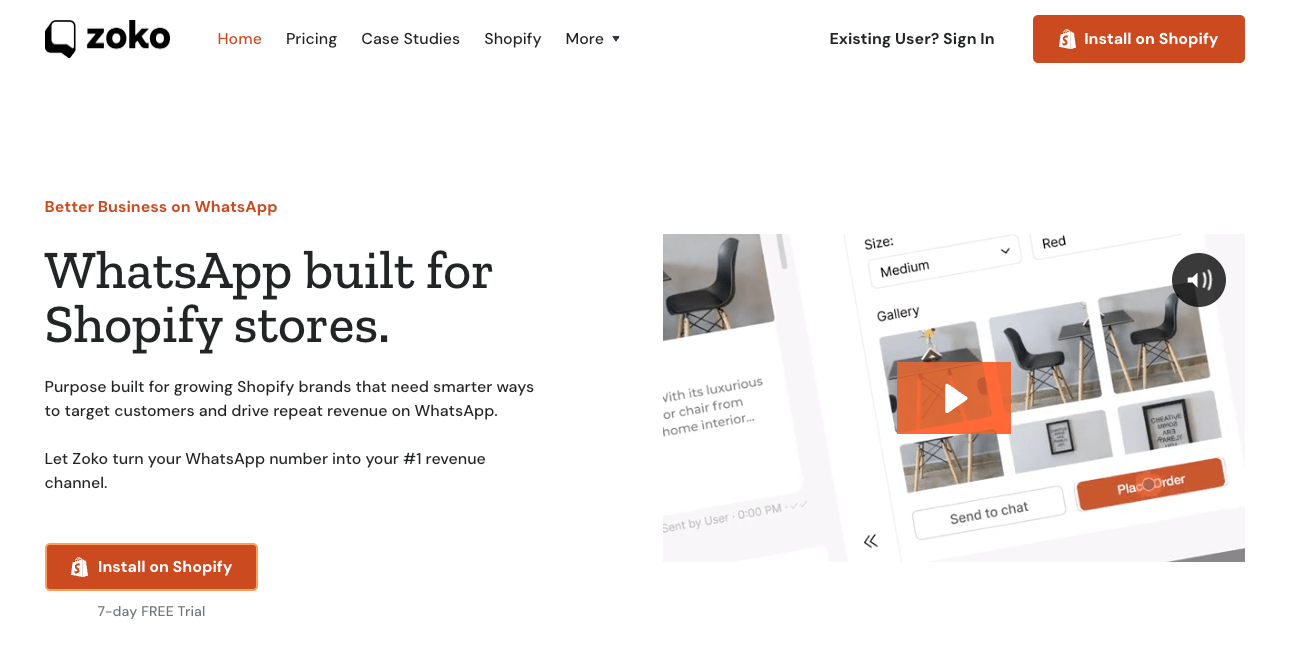 Zoko is a Shopify-focused WhatsApp commerce platform built around selling, marketing, support, and repeat revenue. Its Shopify WhatsApp integration brings catalogue, checkout, orders, payments, and customer conversations into WhatsApp while Shopify remains the core ecommerce store.
Best For: Shopify sellers looking to make WhatsApp a stronger sales and repeat-purchase channel.
- WhatsApp Store: Supports product discovery, cart, Shopify checkout, payments, shipping options, order tracking, and buying journeys within WhatsApp.
- Catalogue & Shopify Sync: Directly syncs Shopify catalogue data with WhatsApp and keeps products updated without manual exports.
- Campaigns & Notifications: Broadcasts, abandoned-cart recovery, COD confirmations, shipping updates, reorder reminders, reviews, and repeat-purchase campaigns.
- AI & Automation: AI chatbots, automated flows, product assistance, FAQs, order-status support, and customer service workflows.
- QR Codes & Catalogues: Supports WhatsApp catalogue-led selling and shareable product journeys; QR codes can be used to bring customers into WhatsApp conversations.
What Sets It Apart: Zoko goes deeper into WhatsApp ecommerce than many messaging-led tools, with Shopify catalogue sync, checkout, payments, and order workflows built into the WhatsApp journey. It is still designed primarily as a WhatsApp sales layer for Shopify rather than a broader hosted ecommerce ecosystem spanning multiple storefronts and commerce channels.
6. BiteSpeed
 BiteSpeed is an AI-native marketing, sales, and support platform for ecommerce brands. Its Shopify WhatsApp integration uses Shopify store and customer data to power personalised campaigns, cart recovery, product recommendations, support, and automated conversations on WhatsApp.
Best For: Shopify sellers looking to add AI-led WhatsApp commerce, retention, and customer engagement to their existing ecommerce setup.
- WhatsApp Store: Supports product recommendations, shopping conversations, order tracking, and checkout links through WhatsApp.
- Catalogue & Shopify Sync: Uses Shopify product, customer, browsing, and purchase data to personalise WhatsApp campaigns and conversations.
- Campaigns & Notifications: Cart recovery, broadcasts, upsell, cross-sell, order updates, and personalised customer journeys.
- AI & Automation: AI marketing agents, WhatsApp chatbots, segmentation, automated journeys, product recommendations, and support automation.
- QR Codes & Catalogues: WhatsApp is used mainly through conversational and campaign-led journeys; BiteSpeed does not appear to position QR-led commerce or digital catalogues as a core capability.
What Sets It Apart: BiteSpeed brings a strong AI and retention layer to Shopify, with WhatsApp ecommerce sitting alongside email, SMS, voice, Instagram, and web engagement. It is built more around marketing, support, and customer lifecycle automation than providing a broader hosted ecommerce ecosystem.
7. DelightChat
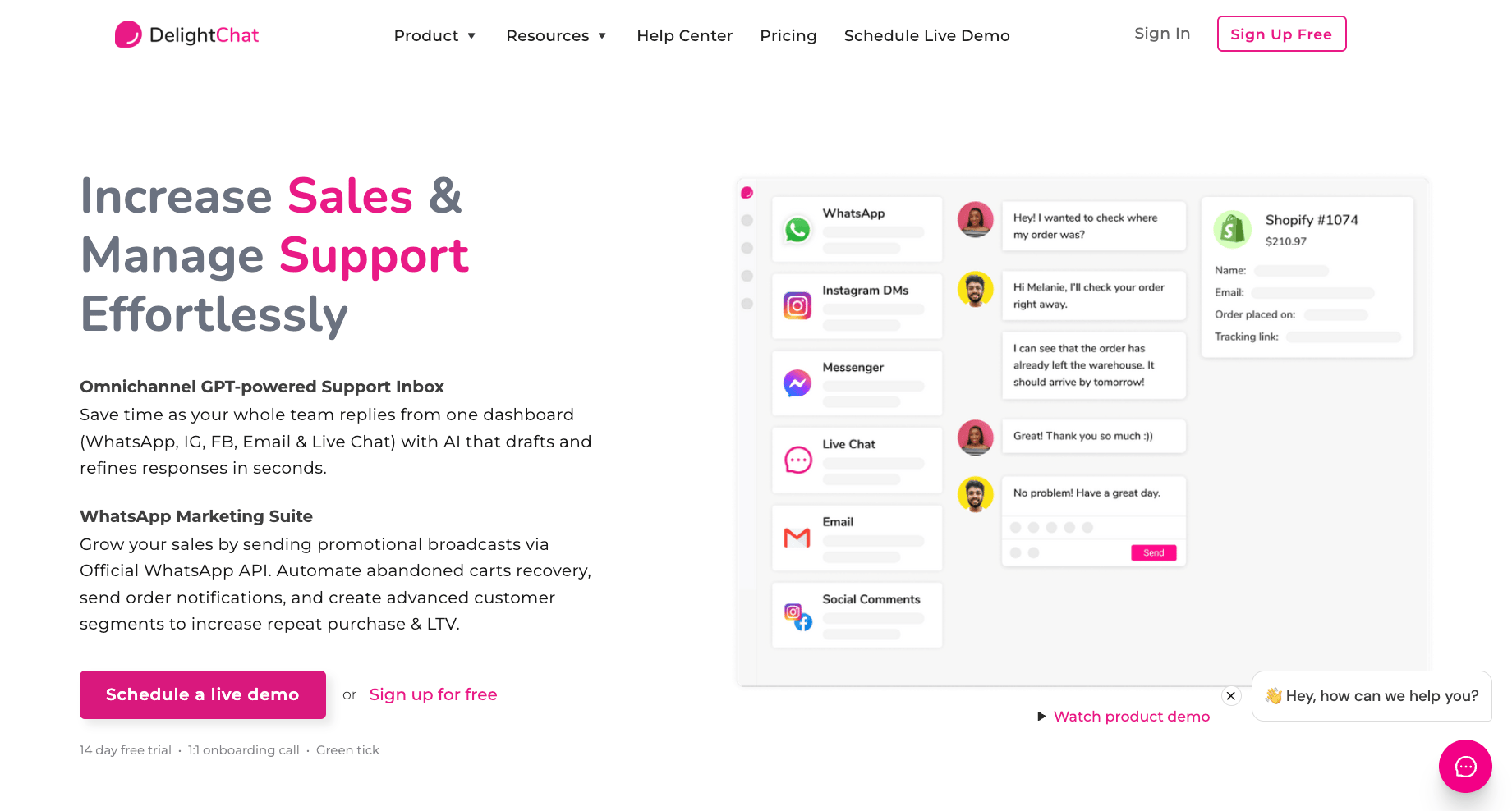 DelightChat combines WhatsApp marketing with omnichannel customer support for Shopify brands. It helps sellers integrate WhatsApp with Shopify for catalogue selling, cart recovery, order communication, support, and automated customer journeys while Shopify remains the main ecommerce store.
Best For: Shopify sellers looking to bring WhatsApp commerce marketing and customer support into one engagement layer.
- WhatsApp Store: Supports WhatsApp catalogue browsing, cart creation, Shopify-linked checkout, product sharing, and order-related interactions.
- Catalogue & Shopify Sync: Connects Shopify products with WhatsApp and supports real-time stock sync, along with access to customer and order data.
- Campaigns & Notifications: Broadcasts, abandoned-cart recovery, COD verification, order confirmations, tracking updates, promotions, and automated follow-ups.
- AI & Automation: AI agents, chatbots, automated support, product recommendations, order-status assistance, and human escalation when needed.
- QR Codes & Catalogues: Supports WhatsApp catalogues and product-led sharing, while QR-led commerce does not appear to be a major part of its current positioning.
What Sets It Apart: DelightChat brings WhatsApp ecommerce, marketing, and customer support together around the existing Shopify store. It is designed primarily as a customer engagement and support layer across WhatsApp and other messaging channels rather than as a broader hosted ecommerce ecosystem.
8. Gallabox
 Gallabox is a no-code WhatsApp commerce and automation platform for sales, support, and customer engagement. Its Shopify integration helps sellers connect WhatsApp with product, customer, payment, and order-related workflows while continuing to use Shopify as their main ecommerce store.
Best For: Shopify sellers looking to add no-code WhatsApp ecommerce automation, conversational selling, and customer engagement to their existing store.
- WhatsApp Store: Supports product catalogues, conversational buying journeys, payment links, checkout flows, and order-related interactions on WhatsApp.
- Catalogue & Shopify Sync: Connects Shopify and customer data with WhatsApp workflows for notifications, campaigns, cart recovery, and support.
- Campaigns & Notifications: Broadcasts, drip campaigns, abandoned-cart nudges, reminders, order updates, promotions, and automated follow-ups.
- AI & Automation: No-code AI agents, chatbots, workflow automation, intent detection, support routing, and human handoffs.
- QR Codes & Catalogues: Supports WhatsApp catalogues and QR codes that can bring customers directly into WhatsApp conversations and buying journeys.
What Sets It Apart: Gallabox is designed primarily as a no-code conversational automation layer for WhatsApp and other engagement channels. It works alongside Shopify to add AI agents, campaigns, payments, support, and selling workflows rather than providing a wider hosted ecommerce ecosystem.
9. QuickReply.ai
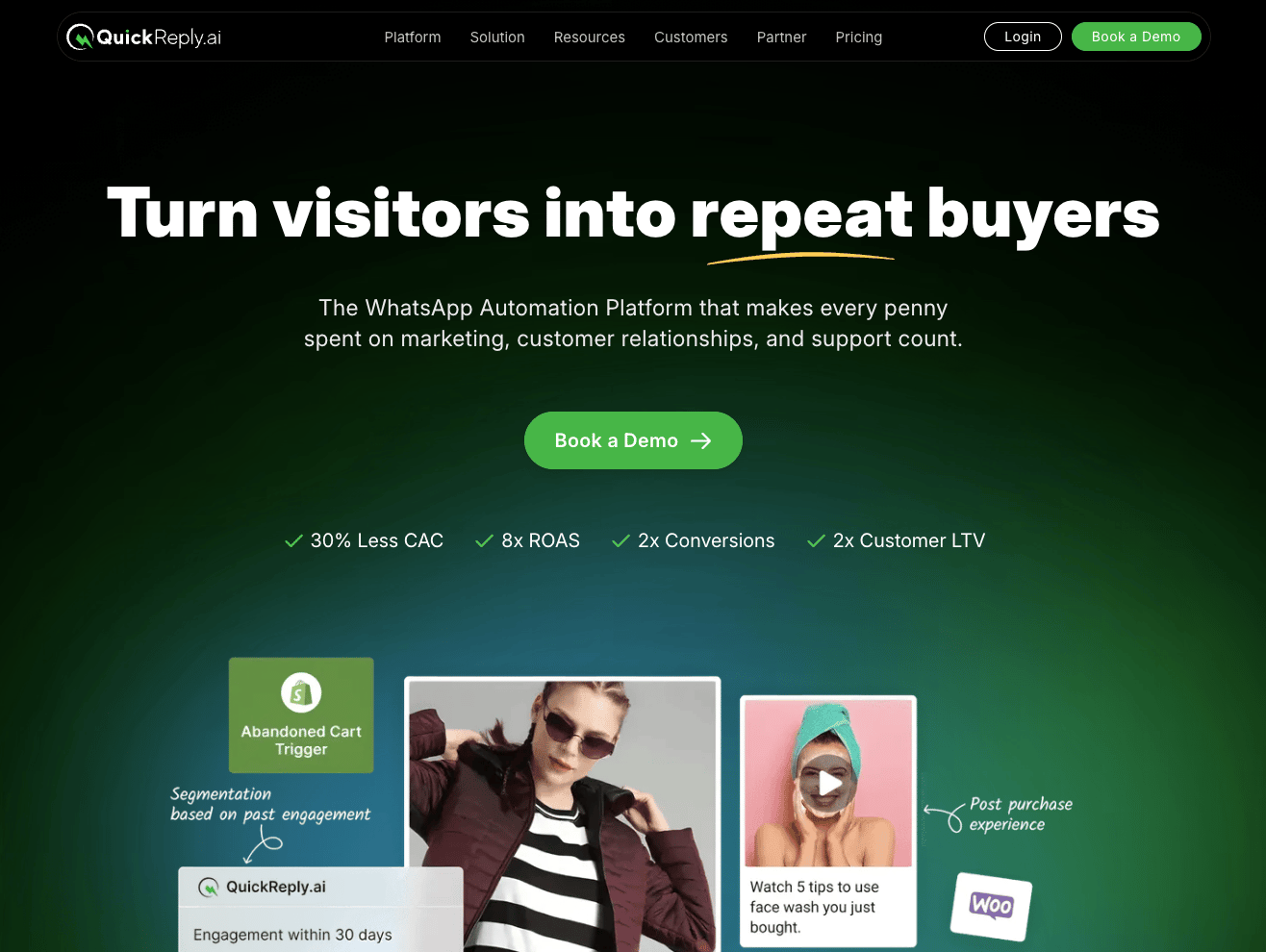 QuickReply.ai is a WhatsApp marketing and automation platform built for ecommerce brands. Its Shopify WhatsApp integration connects customer behaviour, carts, orders, and product interactions with WhatsApp campaigns, recovery flows, and automated conversations.
Best For: Shopify sellers focused on WhatsApp commerce retargeting, cart recovery, and conversion-led customer journeys.
- WhatsApp Store: Supports product-led conversations, recommendations, catalogue interactions, checkout prompts, and order-related journeys through WhatsApp.
- Catalogue & Shopify Sync: Uses Shopify product, cart, order, and customer behaviour to trigger personalised WhatsApp campaigns and follow-ups.
- Campaigns & Notifications: Abandoned-cart recovery, broadcasts, order alerts, retargeting, upsell, cross-sell, feedback, and repeat-purchase campaigns.
- AI & Automation: AI assistants, chatbots, shared inbox, no-code workflows, automated support, routing, and human handoffs.
- QR Codes & Catalogues: Supports QR-led entry into WhatsApp conversations and catalogue-led campaigns, though these are not the main focus of the platform.
What Sets It Apart: QuickReply.ai is built around turning Shopify customer behaviour into timely WhatsApp ecommerce campaigns and recovery journeys. It works alongside Shopify as a conversion, retention, and engagement layer rather than providing a broader hosted ecommerce setup across multiple selling channels.
10. LimeChat
 LimeChat is an AI-powered WhatsApp commerce platform for sales, marketing, retention, and customer support. It helps brands integrate WhatsApp with Shopify and use store, customer, cart, and order data to power personalised buying journeys and automated conversations.
Best For: Shopify sellers looking to add AI-led WhatsApp ecommerce, conversational selling, retention, and support to their existing store.
- WhatsApp Store: Supports product discovery, catalogue-led journeys, cart, in-chat checkout, payments, reorders, and conversational buying on WhatsApp.
- Catalogue & Shopify Sync: Uses Shopify catalogue, customer, cart, and order data to personalise WhatsApp shopping, recovery, and support journeys.
- Campaigns & Notifications: Supports cart recovery, retargeting, reorders, COD verification, broadcasts, drop-off reminders, and personalised follow-ups.
- AI & Automation: AI growth and support agents, GPT-powered bots, automated journeys, AI Copilot, segmentation, support automation, and human handoffs.
- QR Codes & Catalogues: Supports QR-led entry into WhatsApp shopping journeys and catalogue-based product discovery.
What Sets It Apart: LimeChat brings strong AI-led selling, retention, and support capabilities to Shopify, with WhatsApp commerce designed as an active conversion channel. It works alongside the existing ecommerce stack as a conversational growth and support layer rather than providing a broader hosted ecommerce ecosystem across multiple selling channels.
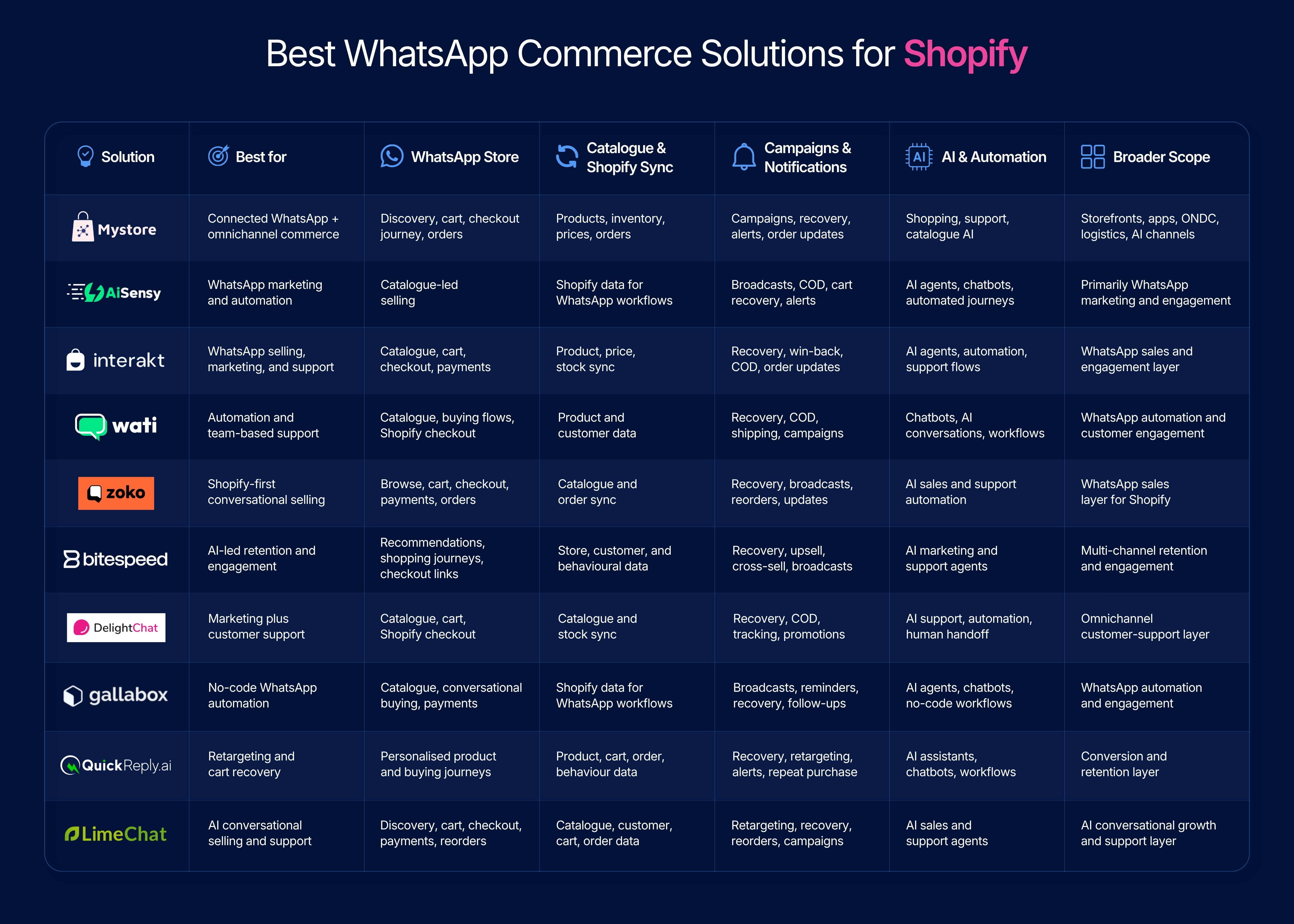
WhatsApp Commerce Solutions for Shopify: Quick Comparison
This comparison is for Shopify sellers in India evaluating WhatsApp tools for marketing, support, catalogue selling, automation, and conversational commerce. It highlights how leading Shopify WhatsApp integration options differ across the capabilities that matter as stores grow.
The right Shopify WhatsApp integration depends on whether you need a focused messaging tool or a broader WhatsApp commerce setup connected to catalogue, orders, AI, support, and other sales channels. For Shopify sellers in India, the stronger long-term choice is one that can support today’s WhatsApp needs without creating another disconnected layer as the business grows.
What Shopify Sellers Should Look for in a WhatsApp Commerce Solution
Across the platforms evaluated above, the strongest WhatsApp commerce setups go well beyond basic chat or order notifications. The more of these capabilities a solution brings together, the more value it can create across discovery, conversion, support, and repeat purchases.
- Connected Product Discovery: Synced catalogues, live product information, recommendations, and conversational browsing that help customers move from enquiry to purchase faster.
- Campaigns That Drive Action: Broadcasts, cart recovery, win-back journeys, offers, and personalised messages linked to customer behaviour rather than standalone promotions.
- Commerce Inside the Conversation: Cart creation, checkout journeys, payments, order tracking, and other buying actions that reduce the gap between conversation and conversion.
- AI-Powered Customer Journeys: AI assistants and automation for product discovery, recommendations, FAQs, support, and routine customer interactions.
- Connected Orders and Support: Access to customer, order, payment, shipping, and return context so conversations do not sit separately from the actual commerce journey.
- Less Operational Fragmentation: Fewer standalone apps, dashboards, and disconnected workflows as WhatsApp becomes a larger part of the business.
- Room to Grow Beyond WhatsApp: The ability to connect WhatsApp with other sales channels, fulfilment, customer data, and broader ecommerce operations as requirements expand.
For Shopify sellers, the goal should therefore be to choose a Shopify WhatsApp integration that covers as much of the customer journey as possible without creating unnecessary new layers to manage.
Conclusion
The right WhatsApp commerce solution should do more than add another communication channel to Shopify. It should help you connect discovery, campaigns, conversations, orders, support, and automation in a way that is easy to manage today and flexible enough to support how your business grows.
A practical way to evaluate these platforms is to see them in action against your own use cases. Start with the top solution on this list and explore how Mystore connects Shopify with WhatsApp commerce, AI, orders, and wider selling channels.
Explore Mystore WhatsApp Commerce integration for Shopify - Book a demo now.
FAQs on WhatsApp Commerce for Shopify
1. Can I integrate WhatsApp with Shopify in India?
Yes. Shopify sellers in India can integrate WhatsApp with Shopify using dedicated apps, WhatsApp Business API platforms, or broader ecommerce platforms such as Mystore. Depending on the solution, the integration can connect product catalogues, orders, campaigns, support, cart recovery, and other WhatsApp commerce workflows.
2. What can a Shopify WhatsApp integration be used for?
A Shopify WhatsApp integration can support product discovery, catalogue sharing, abandoned-cart recovery, promotional campaigns, order updates, customer support, COD verification, payment journeys, and repeat-purchase communication. The depth of these capabilities varies by platform.
3. Can customers browse Shopify products directly on WhatsApp?
Yes. Many WhatsApp ecommerce solutions can connect Shopify product data with WhatsApp, allowing customers to browse catalogues, view products, ask questions, receive recommendations, and continue the buying journey through WhatsApp.
4. Can I recover abandoned Shopify carts through WhatsApp?
Yes. Many WhatsApp commerce platforms use Shopify cart activity to trigger abandoned-cart reminders, personalised messages, offers, and automated follow-ups. Some also support segmentation and AI-led recovery journeys.
5. Can Shopify order updates be sent through WhatsApp?
Yes. A Shopify WhatsApp integration can send order confirmations, payment updates, COD verification messages, shipping alerts, tracking information, and delivery notifications. The level of automation and order visibility depends on the platform.
6. Can WhatsApp commerce support AI-powered shopping and customer support?
Yes. Some WhatsApp commerce platforms use AI for product recommendations, conversational discovery, sales assistance, FAQs, order queries, and automated support. Platforms such as Mystore also connect AI with broader commerce data and workflows beyond WhatsApp.
7. Do I need separate tools for WhatsApp campaigns, support, and ecommerce?
Not always. Some tools specialise in campaigns or support, while others combine marketing, catalogue, orders, automation, and WhatsApp ecommerce in one setup. Mystore, for example, connects WhatsApp with a wider ecommerce ecosystem, reducing the need to manage multiple standalone tools.
8. Can I manage Shopify and WhatsApp orders from one platform?
It depends on the solution. Some platforms mainly use Shopify data for messaging and campaigns, while others provide a more connected commerce setup. If unified order handling is important, check whether the platform can connect WhatsApp, Shopify, catalogue, inventory, and order workflows in one place.
9. What should I look for in a WhatsApp commerce solution for Shopify?
Look for Shopify catalogue sync, inventory and order connectivity, WhatsApp Store capabilities, campaigns, cart recovery, AI, automation, customer support, analytics, and ease of setup. Also compare whether the platform is mainly a WhatsApp layer or supports wider ecommerce requirements as your business grows.
10. Which WhatsApp commerce solution is best for Shopify sellers in India?
The right solution depends on your needs. Some platforms focus mainly on campaigns, messaging, or support, while others offer deeper WhatsApp commerce or broader ecommerce capabilities. For sellers looking beyond a standalone WhatsApp tool, platforms such as Mystore can connect WhatsApp with Shopify, storefronts, logistics, AI, and additional sales channels.