


 Contact Us
 Appliances
 Agri Inputs
 Auto Components & Accessories
 Beauty & Personal Care
 Electronics
 Fashion
 Grocery
 Gift Cards
 Home & kitchen
 Health & Wellness
 Vehicles & Automotives
 Books & Stationary
 Pet Care
 Toys & Games
How Enterprise Brands Fast-Track Conversions with WhatsApp for Ecommerce
ONDC Network for Enterprises
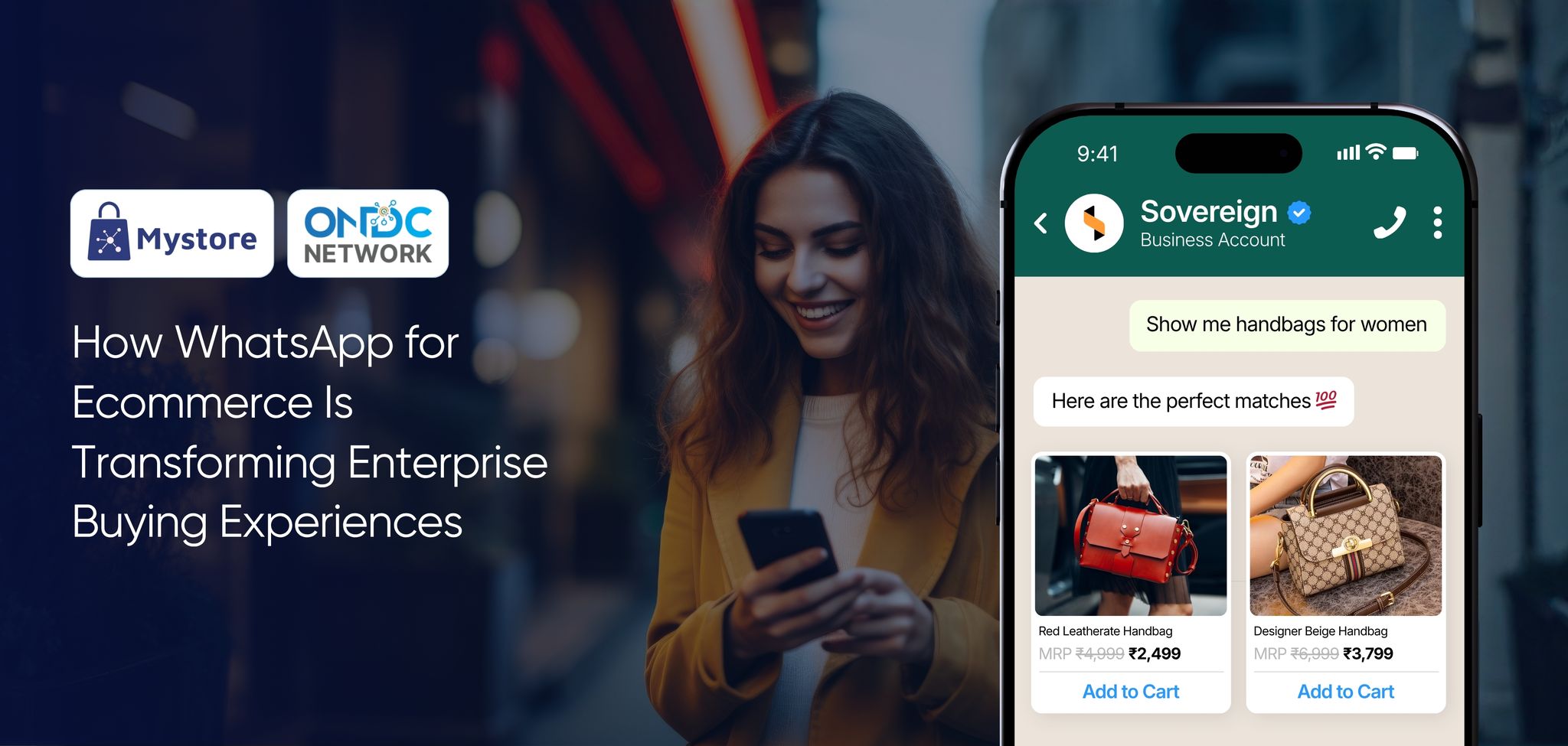
Key Takeaways
- WhatsApp for ecommerce is helping enterprise brands reduce buying friction and convert customers faster through real-time conversations.
- Enterprise businesses are using WhatsApp sales channels to recover abandoned carts, automate support, and personalise customer engagement.
- A connected WhatsApp ecommerce shop helps brands create seamless omnichannel shopping experiences across mobile, web, and social channels.
- By integrating a WhatsApp Business Account with Mystore Seller App, brands can manage conversations, campaigns, order updates, and customer journeys from one platform.
Modern ecommerce buyers expect fast responses, simple journeys, and instant support before making a purchase. Delays in communication or complex checkout flows often lead to abandoned carts and lost conversions.
This shift in behaviour is driving enterprise brands to adopt WhatsApp for ecommerce as a core engagement and sales channel.
Since customers already spend significant time on WhatsApp, businesses are bringing product discovery, support, order communication, and updates into a single conversation channel.
Instead of managing multiple disconnected tools, brands are building faster, more direct buying experiences through WhatsApp.
With Mystore Seller App, enterprise businesses can connect their WhatsApp Business Account with their ecommerce operations and manage conversations, catalogues, campaigns, and order updates from one unified system.
Table of Contents
The Conversational Commerce Advantage: WhatsApp vs Traditionalvs. Traditiona Channels
WhatsApp integration alone is not what improves enterprise ecommerce conversions. The real advantage comes when conversations, customer intent, product discovery, and order journeys work together inside a connected commerce system.
Here’s how traditional communication channels compare with WhatsApp-driven conversational commerce and why enterprises are rapidly shifting toward real-time buying experiences: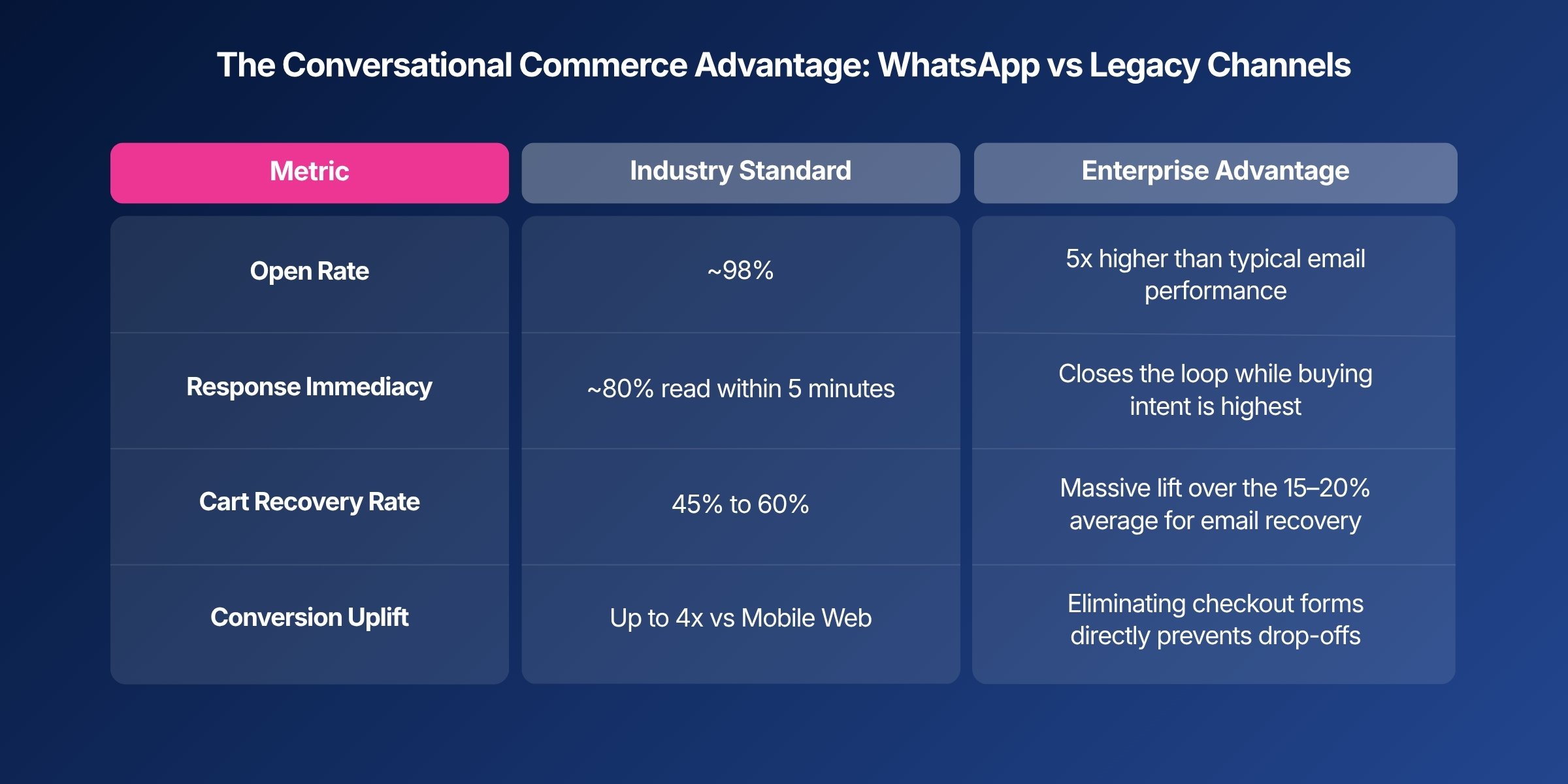
These engagement metrics clearly show why enterprises are rapidly shifting toward conversational commerce strategies. Faster interactions and simplified customer journeys are helping brands reduce drop-offs and improve purchase completion rates.
8 Ways Enterprise Brands Can Use WhatsApp to Drive Faster Buyer Conversions
Buyer journeys have become conversational, real-time, and channel-agnostic. Enterprise brands now need commerce experiences that reduce friction, shorten decision cycles, and keep customer interactions connected across every touchpoint.
Here are 8 ways WhatsApp ecommerce enables enterprises to improve customer engagement, simplify buying journeys, and drive faster conversions at scale: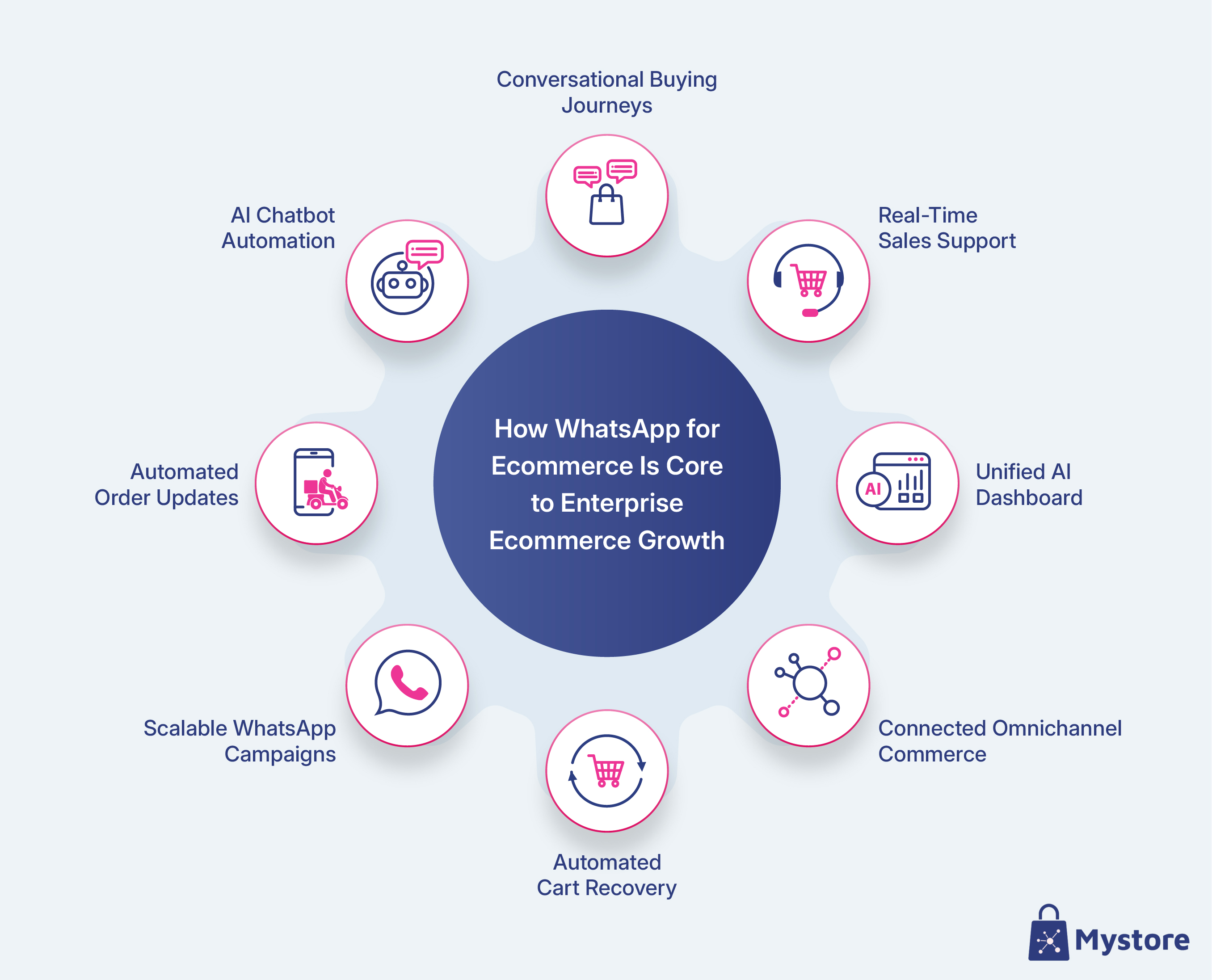
1. Turn Conversations into Buying Journeys
Today’s buyers don’t want to browse longer or follow multiple steps to shop online. They prefer simple, chat-based experiences where they can ask, decide, and purchase in one place. WhatsApp for ecommerce helps brands do exactly that by bringing the entire buying journey into a single conversation.
For example, a fashion brand running a festive sale can engage customers directly on their WhatsApp business account. Once inside the chat, customers can browse the products, ask about sizes, check availability, and place an order without switching apps or opening a website. It feels more direct and faster buying journeys for the buyer.
To make the journey more seamless and smooth, Mystore enables brands to bring their entire online shop to WhatsApp through WABA(WhatsApp Business Account) integration. Buyers can directly browse their catalogues on WhatsApp and shop from live product listings inside chat. Mystore automatically syncs WhatsApp orders within its system, updates inventory in real time, and helps brands manage orders smoothly from one central dashboard.
2. Use WhatsApp as a Real-Time Sales Channel
In modern ecommerce, speed of response often determines whether a customer converts or drops off. If a customer has a question but doesn’t get an answer quickly, they often move on. WhatsApp for ecommerce enables brands to respond instantly and maintain customer engagement during the most critical decision-making moments.
For example, a customer browsing a dress may ask whether the brand has the dress in medium size, what colours are available, or how fast the brand can deliver it. The brand can instantly reply on WhatsApp with product images, size availability, pricing, and ordering details. This quick interaction helps the customer make a faster purchase decision without leaving the conversation.
Mystore enables enterprises to manage these real-time conversations directly on WhatsApp by connecting their WhatsApp business account and offering automated responses. This allows teams to respond faster, share product details instantly, and guide customers through the buying process using live catalogue data.
3. Build Connected Omnichannel Commerce
Today’s buyers move across multiple channels before making a purchase, and they expect every interaction to feel connected and consistent. Enterprises can no longer treat websites, mobile apps, WhatsApp, marketplaces, and social channels as separate commerce experiences.
Let’s look at the latest omnichannel ecommerce trends that highlight why connected buying journeys have become critical for enterprise growth.
Omnichannel Ecommerce Trends
- 4-6 channels explored by buyers before finalising a product
- 76% of shoppers expect a consistent experience across channels
- 62% of all retail sales are expected to be mobile-led by 2027
- 82% of consumers use social media for product research.
- 28% of shoppers now find AI shopping assistants valuable
Source Trengo, GoKwik, Pragma
Customers don’t shop on a single channel anymore. They may discover a product on social media, check details on a website, ask questions on WhatsApp, and complete the purchase on a mobile app. If these experiences are not connected, it often leads to confusion, repeated information, and drop-offs.
For example, a consumer electronics brand runs ads on social media and its website. Customers click on a product ad, move to WhatsApp to ask questions about features and availability, and later complete the purchase on the brand’s website. The brand continues sharing order updates and support on WhatsApp, creating a smooth and connected shopping experience across every channel.
With the Mystore Seller App, enterprises can deliver a truly connected shopping experience across every channel from one unified system. Mystore enables enterprises to sell across multiple channels, including online storefront, mobile apps, ONDC Network buyer apps, WhatsApp ecommerce shop and AI chat interface Genie, while keeping products, pricing, and inventory consistent inreal time across every touchpoint.
This helps brands avoid disconnected experiences, reduce operational confusion, and manage all customer interactions, orders, and inventory smoothly from a single platform.
4. Unified Dashboard with AI Support
When customer messages come from different touchpoints, it becomes difficult for teams to keep track and respond properly. A unified dashboard helps businesses bring all conversations into one place so nothing gets missed and teams can respond faster and more effectively.
For example, a support agent handling a customer query can instantly view their chat history, active cart, past orders, and previous interactions in one place. This enables the agent to resolve issues quickly and even suggest relevant products based on customer behaviour during the conversation.
With the Mystore Seller App, enterprises can manage WhatsApp, chatbot, and email conversations from a single unified dashboard. Teams can instantly view buyer identity, cart details, and order history, which helps them respond faster and resolve queries more accurately. Mystore’s AI-powered unified dashboard provides smart response suggestions, prioritise queries, and improves overall resolution efficiency while ensuring smooth handoffs between automated and human support.
5. Recover Abandoned Carts
A significant number of ecommerce drop-offs happen when customers add products to their cart but leave without completing the checkout process. This often occurs due to distractions, hesitation, or comparison with other options. WhatsApp helps brands re-engage these customers at the right moment with timely reminders that bring them back into the purchase journey.
For example, a beauty and personal care brand may notice that customers frequently add skincare products during browsing but do not complete checkout. A WhatsApp reminder sent shortly after cart abandonment, along with product details or a limited-time offer, can encourage customers to return and complete their purchase.
With Mystore Seller App, cart recovery becomes part of an automated workflow. Businesses can trigger WhatsApp messages based on customer behaviour and send personalised cart reminders, ensuring brands don’t have to follow up manually.
6. Run Promotions and Offers at Scale
Brands often want to reach a large number of customers with offers or updates, especially during sales or festivals, but reaching customers at scale with relevant messages can be challenging. WhatsApp sales channel makes this easier by enabling businesses to send messages directly to targeted customer groups.
For example, during a festive season, a home décor brand can send curated product collections, limited-time discounts, and category-based offers to different customer segments. Customers who receive these messages can immediately respond, explore products, and make purchases within the same chat flow, reducing the gap between marketing and conversion.
Mystore supports WhatsApp campaign management by allowing businesses to create, schedule, and broadcast messages from a unified dashboard. Brands can create and schedule messages, target specific customer groups based on their shopping behaviour, and send personalised campaigns that directly connect buyers to live product listings.
7. Send Automated Order Updates
Once a customer places an order, they expect timely updates without having to repeatedly ask for them. Poor communication at this stage often creates uncertainty and increases support queries. WhatsApp business account helps brands keep customers informed automatically at every stage of the order.
For example, after a customer places an order for apparel, they automatically receive updates such as order confirmation, payment update, shipping details, and delivery notification directly on WhatsApp. This creates a transparent and predictable post-purchase experience.
With the Mystore Seller App, these updates are automatically triggered based on order status changes within the system. Brands can ensure that every stage of the order lifecycle is communicated to customers in real time without manual intervention.
8. Build Custom Chatbot
As ecommerce businesses scale, they receive a large volume of repetitive customer queries related to product availability, order tracking, delivery timelines, and general support. Without automation, responding to each query manually can slow down operations and affect customer satisfaction. WhatsApp chatbots can help answer these questions instantly, without making customers wait.
For instance, during a flash sale, thousands of customers may simultaneously ask about stock availability or delivery timelines. Instead of handling each message manually, a chatbot can quickly respond with product details, catalogue links, or order tracking information, while sending complex issues to human agents.
Mystore enables brands to create custom WhatsApp ecommerce chatbots using an intuitive visual flow builder. Businesses can design personalised customer journeys for product discovery, catalogue browsing, FAQs, order tracking, lead generation, and customer support without any coding or technical expertise.
The chatbot works with real-time ecommerce data, including product catalogues, pricing, inventory, and order information, ensuring customers receive accurate and relevant responses. For complex queries, conversations can be seamlessly transferred to support teams along with complete customer context, helping brands combine automation with personalised service on a single platform.
Conclusion
WhatsApp is no longer just a customer communication channel for ecommerce businesses. It has become a powerful conversion channel that helps enterprise brands create faster, simpler, and more connected buying experiences.
From conversational shopping journeys and personalised promotions to automated support and cart recovery, enterprise businesses are using WhatsApp to reduce friction across the customer journey and improve conversion rates at scale.
As buyers increasingly prefer real-time and mobile-first interactions, WhatsApp sales channels will continue playing a bigger role in ecommerce growth strategies.
With Mystore Seller App, enterprise brands can connect their WhatsApp Business Account with ecommerce operations, automate customer engagement, manage conversations efficiently, and build seamless omnichannel shopping experiences from one platform.
Ready to explore how your business can build a scalable WhatsApp ecommerce shop, automate customer journeys, and turn conversations into faster conversions?
Book a demo with Mystore now.