


 Contact Us
 Appliances
 Agri Inputs
 Auto Components & Accessories
 Beauty & Personal Care
 Electronics
 Fashion
 Grocery
 Gift Cards
 Home & kitchen
 Health & Wellness
 Vehicles & Automotives
 Books & Stationary
 Pet Care
 Toys & Games
What Enterprise Brands Should Look for in a Modern D2C Ecommerce Platform
ONDC Network for D2C Sellers
Key Takeaways
- Enterprise D2C brands need a modern ecommerce platform that goes beyond storefront management and acts as a complete growth engine.
- AI, scalability, omnichannel commerce, and automation are now core requirements for delivering personalised and efficient customer experiences.
- Plugin-free, integrated platforms reduce complexity, improve operational efficiency, and enable faster scaling across channels and markets.
- Security, compliance, and reliable infrastructure are essential for building trust and sustaining long-term enterprise growth.
D2C ecommerce in India is evolving at a rapid pace, becoming more dynamic, more fragmented, and far more competitive than ever before. New enterprise D2C brands are launching every week, while customers seamlessly switch between apps, websites, marketplaces, and social platforms.
At the same time, expectations have shifted dramatically. Speed is non-negotiable, personalisation is assumed, and seamless omnichannel experiences are the baseline, not a differentiator.
In this landscape, the difference between brands that scale and brands that stall often comes down to one critical decision: the enterprise ecommerce platform they choose.
Because today, a D2C ecommerce platform is no longer just a storefront. It is the operational backbone of discovery, engagement, fulfilment, and growth.
Let us find what enterprise D2C brands should actually look for when evaluating a modern ecommerce platform built for scale, intelligence, and long-term competitiveness.
Table of Contents
- D2C Ecommerce Market: Evolution, Trends, and Way Forward
- What Enterprise Brands Should Look for in a Modern D2C Ecommerce Platform
- 1. AI Ecommerce Capabilities Should Be Built Into the Core
- 2. Scalability Must Extend Beyond Traffic Handling
- 3. Omnichannel Commerce Is Now a Business Necessity
- 4. Plugin-free Solutions to Reduce Operational Complexity
- 5. Smarter Shipping Solutions Should For Better Reach
- 6. Advanced Marketing Tools for Scalable Customer Engagement
- 7. Security, Compliance, and Reliability Should be Prioritised
- Why Mystore Is the Best Enterprise Ecommerce Platform for Scalable D2C Growth
- Conclusion
- FAQs
D2C Ecommerce Market: Evolution, Trends, and Way Forward
D2C commerce in India has grown rapidly, and buyers are clearly responding to the freshness, variety, and direct brand experiences it brings. The market today actively leans toward discovery-led shopping, where choice and newness play a big role in purchase decisions.
To keep up, businesses need ecommerce platforms that can handle growth easily, support automation, and adjust to changing needs without slowing down.
Here is how this shift in India’s D2C ecommerce landscape is shaping up:
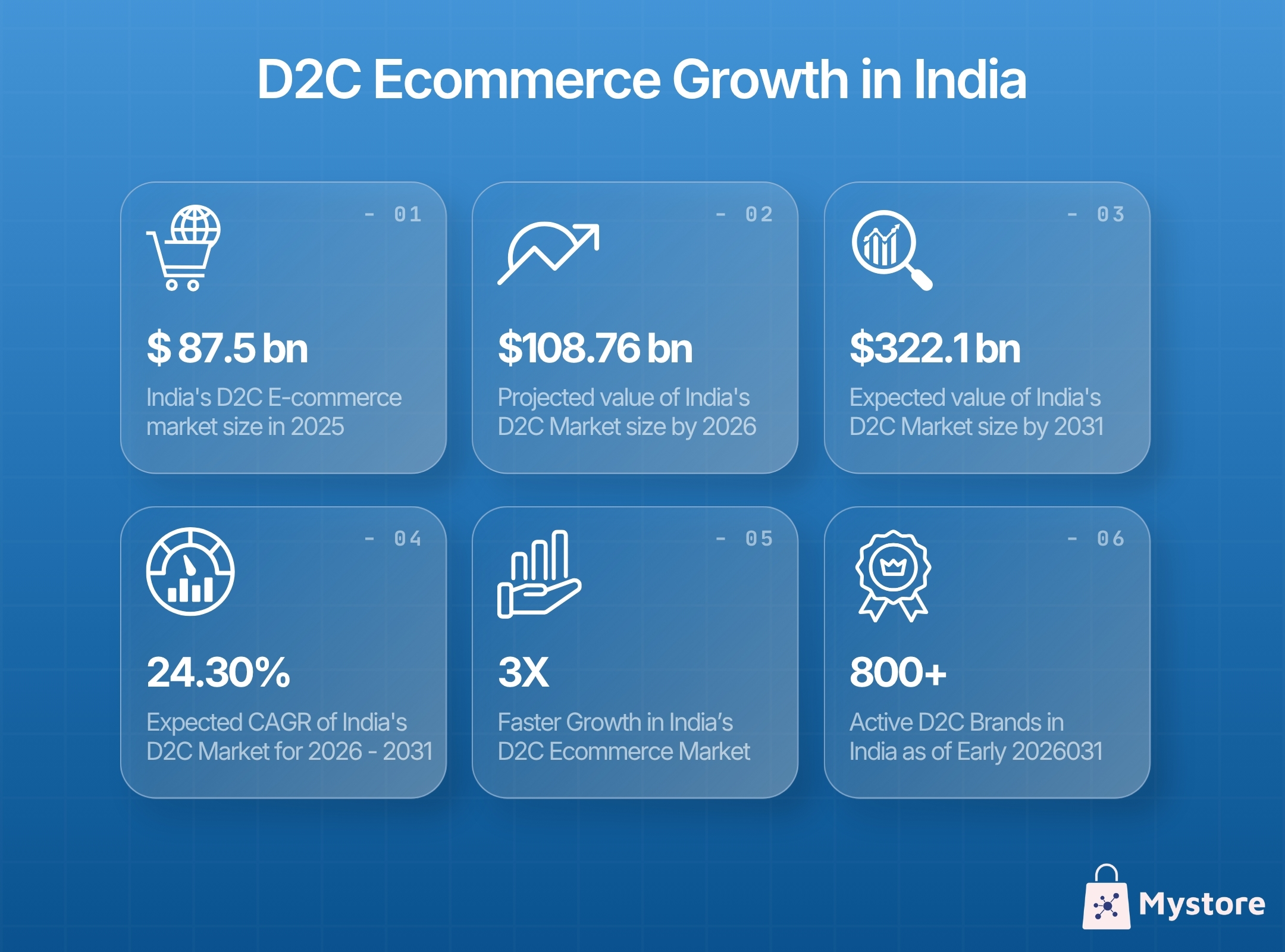
- $ 87.5 bn was India's D2C E-commerce market size in 2025
- $108.76 bn is the projected value of India's D2C Market size by 2026
- $322.1 bn is the expected value of India's D2C Market size by 2031
- 24.30% is the expected CAGR of India's D2C Market size for 2026 - 2031
- 3X Faster Growth in India’s D2C Ecommerce Market
- 800+ Active D2C Brands in India as of Early 2026
Source Mordor Intelligence , The Statesman , Forbes India
Key takeaway: India’s D2C ecosystem is scaling fast, and with more brands entering the space, success now depends on standing out, smarter strategies, and scaling faster.

- 31% of ecommerce revenue now comes from AI-driven product recommendations
- 91% of shoppers prefer buying from brands that offer personalised offers
- 5-10% higher customer satisfaction experienced by brands using AI for personalisation
- 10-12% revenue growth reported by companies adopting AI ecommerce strategies
- 63% of shoppers say AI-driven suggestions directly influence their buying decisions
Source: Precedence Research, Statista
Key takeaway: AI is now a key growth driver in ecommerce, bringing revenue, customer satisfaction, and personalised shopping experiences.
The data clearly shows that brands investing in scalable, AI-powered D2C commerce today will be better prepared to improve efficiency, offer personalised experiences, and lead the next wave of ecommerce growth.
What Enterprise Brands Should Look for in a Modern D2C Ecommerce Platform
Choosing a D2C ecommerce platform today directly shapes how your brand grows and competes in the market. The right platform helps enterprises move faster, scale smarter, and deliver experiences customers actually expect.
Let us look at what enterprise brands should look for in a modern D2C ecommerce platform. 
1. AI Ecommerce Capabilities Should Be Built Into the Core
As D2C commerce becomes more complex and experience-driven, enterprises can no longer rely on manual processes and static storefronts. Modern enterprise D2C brands need AI ecommerce capabilities built into the core platform to automate workflows, personalise customer journeys, and improve operational efficiency at scale.
Enterprises should look for AI-powered commerce platforms that enable faster decision-making across product discovery, customer engagement, and support. Instead of treating AI as an add-on feature, enterprises should prioritise platforms where AI operates as a core layer across catalogue, search, recommendations, and customer interactions.
AI Features Enterprises Should Look For:
- AI-powered product discovery and semantic search to help customers find relevant products faster and improve conversion rates
- Personalised product recommendations to deliver context-aware suggestions that increase engagement and order value
- AI-powered cataloguing to automate catalogue generation, create tagging, categorisation, etc
- AI-driven support for teams to quickly resolve queries with minimal human intervention,
- Conversational AI assistants for buyers to enable real-time, automated customer interactions across channels
2. Scalability Must Extend Beyond Traffic Handling
For enterprise brands, scalability is not limited to handling high traffic during peak sales periods; it is about growing with the latest ecommerce trends.
Modern D2C businesses need enterprise commerce platforms that can support expansion across multiple business models, product categories, regions, and customer segments without operational disruptions.
A scalable D2C ecommerce platform should offer flexible infrastructure, centralised operations, and a composable architecture that allows enterprises to adapt quickly as business requirements evolve. Large-scale D2C brands should choose platforms built on cloud-native and API-first architecture, enabling easier scaling of operations while maintaining consistent performance and customer experience.
Scalability Features Enterprises Should Look For:
- Cloud-native architecture for high performance and uptime to ensure stable operations during peak demand and large-scale growth
- Multi-store and multi-brand management capabilities to support multiple stores and brands from a unified backend
- Vendor management solutions for marketplace expansion to efficiently onboard and manage large seller ecosystems
- Centralised master catalogue management to maintain consistency and control across all product lines and channels
- Multi-model commerce support (B2B, B2C, D2C, marketplace) to easily pivot between business models through a single system for diversified revenue
- API-first and headless commerce capabilities to ensure seamless integrations and flexible frontend experiences
3. Omnichannel Commerce Is Now a Business Necessity
Today’s customers interact with brands across websites, mobile apps, marketplaces, physical stores, social media, and messaging channels. D2C enterprises must carefully evaluate the omnichannel capabilities of an enterprise ecommerce platform before making a choice, ensuring it supports seamless engagement across web, mobile, WhatsApp, social, and other key channels from a unified control system.
A strong enterprise ecommerce platform keeps inventory, orders, and customer interactions fully synchronised across all touchpoints, enabling consistent customer experiences and efficient operations at scale.
Omnichannel Features Enterprises Should Look For:
- Unified inventory management across channels to maintain real-time stock visibility and prevent overselling across multiple storefronts and marketplaces
- Centralised order management systems to streamline order processing, fulfilment, and tracking from a single dashboard
- Consistent customer experiences across touchpoints to ensure uniform branding, pricing, and engagement across web, app, and offline channels
- Robust mobile commerce support to deliver high-performance, mobile-first shopping experiences for on-the-go customers
- WhatsApp integration and digi catalogue with QR codes to enable direct selling, engagement, and support across high-conversion messaging platforms
- Agentic voice and text commerce channels to support conversational buying experiences through AI-driven assistants and voice interfaces
- Real-time syncing across business operations to ensure inventory, pricing, and order updates are instantly reflected across all systems and channels
4. Plugin-free Solutions to Reduce Operational Complexity
As D2C enterprises scale, relying on multiple third-party plugins often leads to fragmented systems, higher maintenance costs, and operational inefficiencies. Modern commerce platforms must eliminate this dependency by offering plugin-free, pre-integrated capabilities that simplify operations and ensure consistent performance across the entire commerce stack.
Enterprises should prioritise D2C ecommerce platforms that come with built-in functionality for core commerce needs instead of requiring external extensions for basic or advanced workflows. This reduces integration overhead, improves system stability, and enables faster time-to-market for new capabilities.
Plugin-free Features Enterprises Should Look For:
- End-to-end D2C ecommerce solutions to unify operations and reduce system complexity across all business functions
- Built-in catalogue management to eliminate the need for third-party product information tools
- Native marketing tools for campaigns, promotions, and customer engagement without external plugins
- Pre-integrated payment, shipping, and tax modules to ensure seamless order processing and compliance
- In-platform analytics and reporting dashboards for real-time business insights without external tools
- Seamless integrations with ERP, CRM, and accounting systems to reduce dependency on multiple middleware plugins
5. Smarter Shipping Solutions Should For Better Reach
Shipping and fulfilment are no longer backend functions; they directly influence customer satisfaction, repeat purchases, and brand trust. Enterprise businesses, therefore, can't ignore the shipping solutions an ecommerce platform offers. Enterprise must look for faster, smarter and more flexible shipping solutions that can streamline operations, improve delivery efficiency, and enhance customer experience.
Modern D2C ecommerce platforms should enable brands to automate delivery workflows, manage multi-location fulfilment, generate accurate shipping rates, and improve delivery speed across regions. Enterprises should prioritise advanced logistics capabilities in a D2C ecommerce platform that helps reduce operational costs while ensuring a more reliable and transparent delivery experience for customers.
Shipping Features Enterprises Should Look For:
- Built-in shipping solutions to offer hyperlocal, intercity and intracity deliveries
- Live shipping rate calculations to ensure transparent, real-time delivery pricing that improves checkout confidence and reduces drop-offs
- Flexible shipping rules and workflows to support complex fulfilment strategies across regions, products, and order types
- Real-time shipment tracking to provide full delivery visibility, improve customer trust, and reduce support dependencies
- Multi-location fulfilment support to enable faster delivery, better inventory allocation, and optimised shipping costs
- Smart delivery routing capabilities to improve fulfilment efficiency through intelligent route selection across logistics networks
6. Advanced Marketing Tools for Scalable Customer Engagement
As customer acquisition costs continue to rise, D2C enterprises need more than basic marketing features, they need an enterprise ecommerce platform with built-in marketing capabilities. Many platforms today only offer surface-level marketing tools, forcing brands to rely on multiple plugins and fragmented systems to run core marketing functions.
True enterprise-grade platforms unify marketing within the commerce layer itself, enabling better control over customer data, faster campaign execution, and consistent brand experiences across channels. This directly impacts how efficiently enterprises scale acquisition, retention, and engagement.
Marketing Features Enterprises Should Look For:
- Built in SEO tools and AEO optimisation tools to improve search visibility and drive organic traffic across search and AI engines
- Personalised promotions and offers to deliver targeted discounts and recommendations that increase conversions
- Reporting and analytics dashboard to track performance, understand customer behaviour, and optimise marketing ROI
- WhatsApp Commerce and engagement tools to enable direct customer communication, improve engagement, and boost retention
7. Security, Compliance, and Reliability Should be Prioritised
Enterprise D2C brands managing a large pool of customers, transactions, and business operations must be secured with robust security and data protection. Large-scale D2C brands should evaluate security protocols, certifications, and compliance frameworks in an enterprise ecommerce platform to ensure safe, reliable commerce operations and long-term business growth
Robust D2C ecommerce platforms also help enterprises maintain high uptime, protect customer trust, and enable secure payment experiences across channels and regions.
Security Features Enterprises Should Look For:
- Advanced data security protocols to ensure strong protection of customer and business data against breaches and cyber threats
- PCI-DSS compliant infrastructure to keep transactions secure and reduce the risk of fraud and data leaks
- GST-ready operations and invoicing to simplify tax compliance through automated and accurate billing processes
- Secure payment and checkout processing systems to enable safe, encrypted checkout experiences and build customer trust across channels.
Why Mystore Is the Best Enterprise Ecommerce Platform for Scalable D2C Growth
Mystore is designed as a future-ready enterprise ecommerce ecosystem built specifically for new-age D2C brands that need scalability, intelligence, and operational efficiency. Instead of relying on multiple fragmented tools, Mystore brings everything into a single AI-powered commerce ecosystem that supports end-to-end D2C operations.
Here's what Mystore offers:
1. Built-in D2C Ecommerce Solutions: Mystore offers a no-plugin architecture where most D2C capabilities are built-in and ready to use from day one, enabling enterprises to launch and scale without dependency on external extensions. You can start your AI-powered D2C storefront in minutes at zero upfront cost, own your buyers and data, and grow the way you want. Your play, your rules.
2. Built-in AI Tools: Mystore enterprise solutionsbring AI directly into the core of commerce with AI-powered cataloguing, semantic search, and intelligent product recommendations that make product discovery faster and more relevant. It also offers Magic Edit, an AI image editing tool to enhance product images and Mystore Genie, a conversational AI shopping assistant that engages buyers in real time through voice and text across multiple languages, creating a more personalised and interactive shopping experience.
3. Smarter Shipping Solutions: From hyperlocal to pan-India deliveries, Mystore enables D2C brands to streamline fulfilment with improved speed, cost efficiency, and operational control with 30+ on-network and off network partners and the flexibility to plugin your own logistics provider. Mystore offers live shipping rates, smart carrier selection, WhatsApp-based fulfilment, and flexible shipping rules to optimise delivery performance and enhance customer experience.
4. Advanced Marketing Tools: Mystore is an SEO and AEO-ready platform that equips D2C brands with powerful marketing capabilities to drive discovery, enhance engagement, and boost conversions across multiple channels. It includes QR-based product sharing, smart product cataloguing, WhatsApp commerce, and a built-in discount engine to run targeted and high-impact promotional campaigns. Mystore offers seamless integration with marketing tools, including built-in QR codes, PDF catalogue, Google feeds, schema tags, and SEO optimised themes. Built on API first architecture, Mystore also enables enterprsies to easily integrate with third-party ERP, CRM, POS, logistics and other integrations.
5. Built-in Omnichannel Solutions: Mystore enterprise solution enables enterprise D2C brands to build and manage web stores, Android and iOS mobile apps through a built-in mobile app builder, and PWA storefronts to engage buyers in low connectivity areas. Mystore also , supports WhatsApp integration (WABA) and is connected to the ONDC Network enabling wider reach across multiple ONDC Network buyer apps. Mystore also offers a conversational channel through Mystore Genie and extends reach across other multiple channels by enabling PDF catalogue sharing. Each channel is managed through a unified admin panel and synchronised in real time to deliver a consistent customer experience across all touchpoints.
6. A Secured D2C Ecommerce Platform: Mystore is built on a PCI-DSS compliant platform and is ISO-certified, ensuring enterprise-grade security that protects businesses from software breaches, data vulnerabilities, and system malfunctions through multi-level security protocols, while enabling secure payment processing and building customer trust.
Conclusion
Choosing the right D2C ecommerce platform is now a critical growth decision for enterprise brands. Modern businesses need more than just an online storefront , they need a scalable, AI-powered, and omnichannel-ready commerce infrastructure that can automate operations, unify customer experiences, and support long-term growth.
Enterprise D2C brands must look for features like AI ecommerce capabilities, integrations, scalability, automation, and operational flexibility. Choosing Mystore enterprise ecommerce solutions enables brands to streamline operations, unify commerce functions, and scale efficiently across multiple channels.
Ready to scale your brand with future-ready D2C commerce?
Book a demo with Mystore enterprise solutions today.
FAQs
1. What should enterprise D2C brands look for in a modern ecommerce platform?
Enterprise D2C brands should look for a modern enterprise ecommerce platform that offers built in AI tools, scalability, unified omnichannel commerce, automation, integrations, security, logistics and built-in marketing capabilities. The platform should simplify operations, support multiple business models and channels, deliver personalised customer experiences, and scale efficiently as the brand expands into new products, regions, markets, and customer segments.
2. How can AI help enterprise D2C brands grow their ecommerce business?
AI can help enterprise brands grow ecommerce by automating repetitive tasks, improving product discovery, personalising recommendations, and making customer interactions more relevant. It can also support faster catalogue creation, smarter and conversational shopping experiences. For large brands, these capabilities help improve operational efficiency, customer engagement, conversions, and scalability while reducing manual effort.
3. How can enterprises evaluate the scalability of a D2C ecommerce platform?
Enterprises should evaluate whether a D2C ecommerce platform can handle growing traffic, product catalogues, orders, brands, regions, and sales channels without affecting performance. They should also check for cloud-native infrastructure, API-first architecture, multi-store management, centralised operations, and support for multiple business models. These capabilities indicate whether the platform can support long-term enterprise growth.
4. Why do enterprise D2C brands need an omnichannel ecommerce strategy?
Enterprise D2C brands need an omnichannel ecommerce strategy to give customers a consistent shopping experience across websites, mobile apps, WhatsApp, and other touchpoints. It also helps brands synchronise inventory, orders, pricing, and customer data across channels, making operations more efficient while allowing them to reach customers wherever they prefer to shop.
5. What role does automation play in choosing a D2C ecommerce platform?
Automation helps enterprises reduce manual work across cataloguing, order processing, marketing, fulfilment, customer support, and reporting. When choosing a D2C ecommerce platform, brands should look for built-in automation that can handle repetitive workflows, improve operational efficiency, reduce errors, and help teams manage growing order volumes and customer interactions without increasing workload at the same pace.
6. What are the benefits of choosing a plugin-free D2C ecommerce platform for enterprises?
A plugin-free D2C ecommerce platform helps enterprises reduce dependency on multiple third-party tools and keep their commerce operations more streamlined. With core capabilities built into the platform, brands can simplify integrations, reduce maintenance, improve system stability, launch new features faster, and manage ecommerce operations through a more unified technology environment as they scale.
7. What integrations should an enterprise D2C ecommerce platform support?
An enterprise D2C ecommerce platform should support integrations with ERP, CRM, accounting, payment gateways, logistics providers, marketing tools, and other essential business systems. API-first architecture is equally important, as it allows enterprises to connect their existing business system and add new tools without disrupting core ecommerce operations.
8. How important are security and compliance when selecting a D2C ecommerce platform?
Security and compliance are extremely important when selecting a D2C ecommerce platform, as they directly affect customer trust, data protection, and business continuity. Businesses should look for platform built on PCI-DSS compliance, offers secure payment processing, strong data protection, reliable infrastructure, and GST-ready operations to protect sensitive information, maintain customer trust, and support secure long-term growth.
9. How can enterprise brands evaluate the total cost of an enterprise ecommerce platform?
Enterprise brands should look beyond the platform price and consider costs for plugins, integrations, development, maintenance, and support. They should also check how much the platform can save through built-in features and automation. This helps brands understand the actual cost of running the platform and whether it offers good value as the business grows.
10. How does Mystore support enterprise D2C ecommerce growth?
Mystore supports enterprise D2C ecommerce growth with AI-powered commerce, omnichannel capabilities, built-in marketing tools, a unified conversational dashboard, integrated logistics, mobile commerce, WhatsApp commerce, and centralised operations. Mystore enterprise solution also supports multiple business models, API-first integrations, connected on-network logistics solutions, and flexible commerce capabilities that help enterprises scale efficiently across channels.