


 Contact Us
 Appliances
 Agri Inputs
 Auto Components & Accessories
 Beauty & Personal Care
 Electronics
 Fashion
 Grocery
 Gift Cards
 Home & kitchen
 Health & Wellness
 Vehicles & Automotives
 Books & Stationary
 Pet Care
 Toys & Games
How Omnichannel Commerce is Redefining D2C Buyer Expectations
ONDC Network for D2C Sellers
D2C customers in 2026 don’t follow a straight shopping path; they move across apps, chats, websites, marketplaces, etc., before they even decide what to buy. And throughout this journey, they expect one thing to stay constant: zero friction and total continuity.
But most D2C brands still operate in disconnected systems where every channel behaves like a separate store. The result is broken journeys, lost carts, inconsistent pricing, and customers who drop off without warning.
This gap between how customers actually shop and how brands sell is exactly what is redefining enterprise commerce in 2026. Omnichannel ecommerce is no longer about being present everywhere, it’s about being connected everywhere, in real time.
Let's see how these evolving expectations are reshaping D2C growth and why modern enterprise brands need omnichannel, unified, AI-driven solutions like Mystore ecommerce solutions to keep up with the new rules of commerce.
Table of Contents
- How Omnichannel Ecommerce is Reshaping Modern D2C Ecommerce Growth
- How Omnichannel Ecommerce is Redefining D2C Buyer Expectations
- 1. One Brand, One Experience Across Channels
- 2. Seamless Cross-Channel Journeys, No Resets
- 3. Conversational Commerce as a Primary Interface
- 4. AI-Driven Discovery and Decision-Making
- 5. Unified Backend, Real-Time Accuracy
- 6. Flexible, Context-Aware Checkout Experiences
- 7. End-To-End Visibility Post Purchase
- 8. Integrated Support, not Fragmented Conversations
- 9. Hyperlocal and Fast Fulfilment Expectations
- 10. AI-Assisted Journeys as Default Infrastructure
- What Makes Mystore the Best Omnichannel Ecommerce Solution Provider for D2C Brands
- 1. Branded Online D2C Storefronts
- 2. AI Powered Core
- 3. Built-In Mobile App Builder and PWA Stores
- 4. WhatsApp Business Integration
- 5. ONDC Network Connectivity
- 6. Built-in Marketing Tools
- 7. On Network Logistics Partners
- 8. Easy Migration From Other Channels
- 9. Conversational Shopping with Mystore Genie
- 10. Mystore Mitra for Support Setting up Business
- Conclusion
- FAQs
How Omnichannel Ecommerce is Reshaping Modern D2C Ecommerce Growth
D2C buyer journeys are no longer linear, predictable, or confined to a single channel
Every interaction now connects across channels, where speed, context, and continuity shape buyer decisions.
Let’s see how omnichannel ecommerce in the D2C business model is transforming customer experiences and driving business growth.
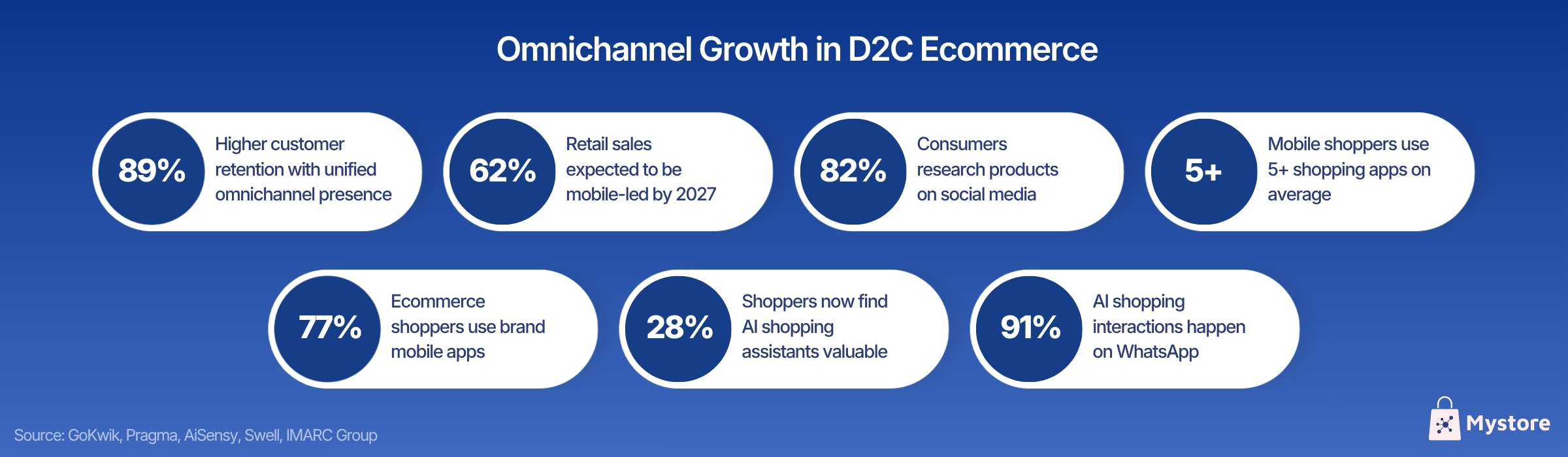
- 89% of customer retention for D2C brands with unified omnichannel presence
- 62% of all retail sales are expected to be mobile-led by 2027
- 82% of consumers use social media for product research.
- 5+ shopping apps average mobile shoppers on their phone
- 77% of e-commerce shoppers now use brand-specific mobile apps to shop
- 28% of shoppers now find AI shopping assistants valuable
- 91% of all conversational AI interactions for shopping occurred on WhatsApp
Source: GoKwik, Pragma, AiSensy, Swell, IMARC Group
The trends clearly highlight that D2C ecommerce growth is increasingly defined by how effectively brands unify fragmented interactions into a single intelligent flow.
D2C brands that connect these touchpoints in real time are better positioned to drive engagement, retention, and long-term value.
How Omnichannel Ecommerce is Redefining D2C Buyer Expectations
As omnichannel commerce becomes the core of modern D2C growth, buyer expectations are evolving far beyond basic online shopping. Customers now evaluate brands based on how connected, responsive, and effortless the entire buying experience feels across every touchpoint.
Here’s how omnichannel ecommerce is transforming the modern D2C buyer experiences: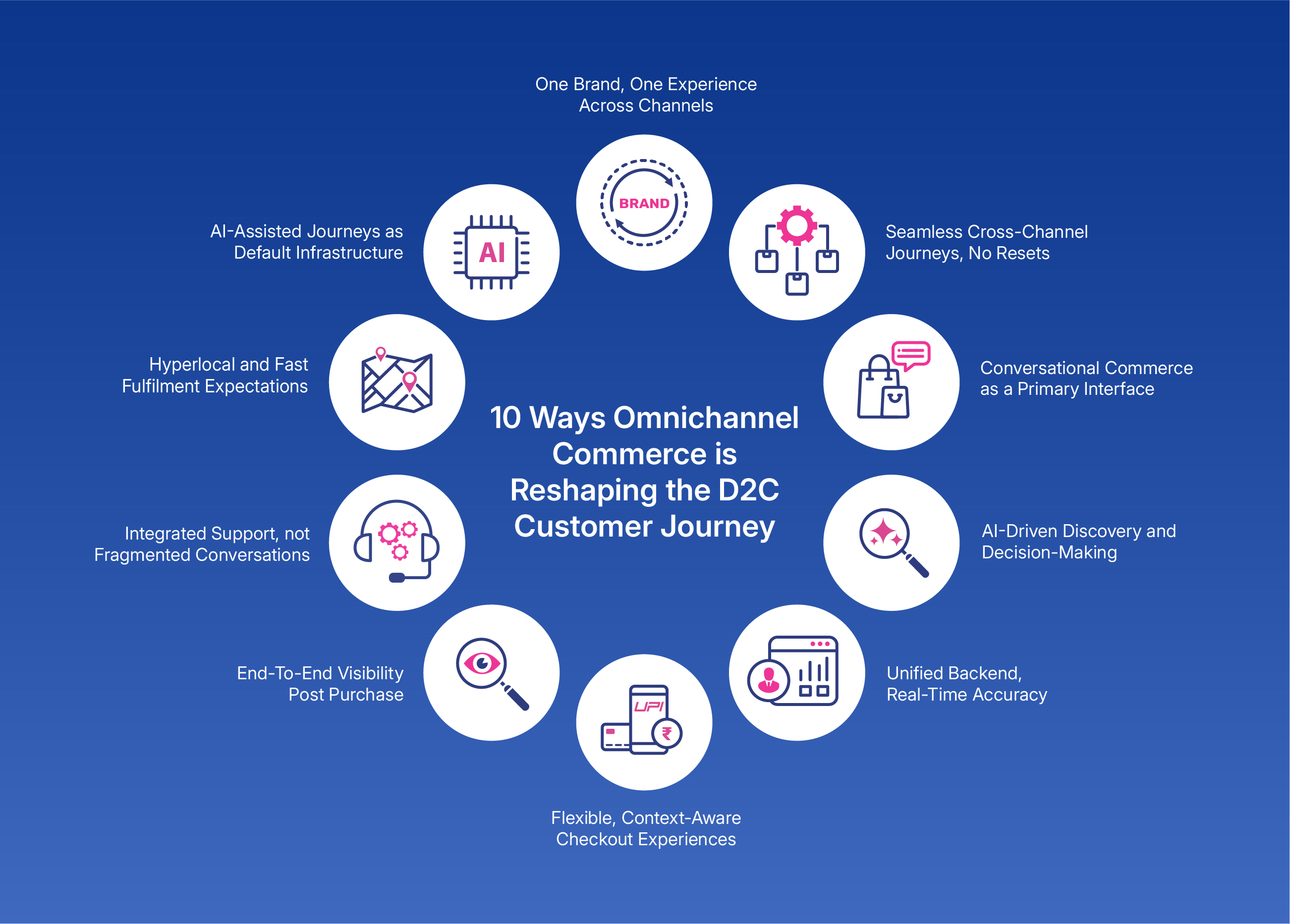
1. One Brand, One Experience Across Channels
Today, individual channel experiences are no longer enough. What truly matters is delivering one consistent brand experience across every customer touchpoint. Whether buyers browse products on a mobile app, ask questions on WhatsApp, or explore a website on their laptop, they expect the same catalogue, pricing, offers, product availability, and communication across all channels. Even a small inconsistency can instantly reduce customer trust and impact conversions.
For example, if a D2C fashion brand is running a festive sale, a ₹1,999 discounted kurta displayed on the mobile app should reflect the exact same price and offer on the website, WhatsApp storefront, and every other sales channel. Modern D2C brands need this level of unified experience to reduce friction, build credibility, and create a connected buying journey where customers feel they are interacting with one intelligent, consistent brand rather than disconnected sales channels.
2. Seamless Cross-Channel Journeys, No Resets
True omnichannel ecommerce means maintaining continuity across every customer touchpoint. Modern buyers do not want to restart their shopping journey every time they switch devices or channels. Instead, they expect to continue seamlessly from wherever they left off, whether they began browsing on a mobile app, saved products in the cart on a website, or decided to complete the purchase through another channel. If the cart disappears or the login session resets, most customers are likely to abandon the purchase altogether.
For example, a customer browsing a D2C electronics brand page during office hours may save a wireless headphone on their mobile device and later compare specifications on a laptop before making the final purchase. A seamless omnichannel experience ensures that saved carts, browsing history, preferences, and product recommendations automatically follow the customer across every channel.
Direct-to-customer brands need this level of continuity to reduce drop-offs, simplify buying journeys, and create a shopping experience that feels effortless, personalised, and connected at every step.
3. Conversational Commerce as a Primary Interface
WhatsApp is where almost every mobile user already spends their time, and now it is rapidly becoming a primary shopping interface as well. Customers increasingly prefer instant responses, quick assistance, and seamless buying experiences, making conversational commerce a major driver of modern D2C brand growth.
Buyers now expect to discover products, ask questions, compare options, and complete purchases directly within a chat window.
For example, a skincare brand can create a WhatsApp Business storefront where customers simply message queries like “best acne cream for oily skin” and instantly receive curated product recommendations, product details, and a direct “Shop Now” or checkout link within the same conversation. This conversational buying journey removes the need to browse multiple product pages, making shopping faster, simpler, and more intuitive for customers.
Modern D2C brands can also leverage an enterprise platform with an AI-powered core to build AI shopping chatbots that deliver real-time conversational experiences to buyers.
This conversational buying journey improves engagement, reduces friction, and significantly increases conversions, especially for high-consideration purchases where customers need more guidance before buying.
4. AI-Driven Discovery and Decision-Making
Shoppers today expect enterprise ecommerce brands to understand the intent behind their searches, not just match keywords. This is why AI has become a core growth driver for modern D2C brands. Businesses should choose an AI-powered ecommerce platform where AI is built into the core architecture, enabling intelligent product discovery and personalised buying journeys. This helps customers find the right products even when they are unsure of exactly what they want.
For example, when a customer searches for “comfortable shoes for long standing hours,” the D2C brand can recommend cushioned sneakers, arch-support footwear, or orthopaedic shoes based on buyer intent. Similarly, a D2C home decor brand can suggest complete product collections like neutral-toned sofas, minimalist coffee tables, soft lighting, and matching wall décor to buyers searching for a “minimalist living room setup.
This AI-driven guidance reduces decision fatigue, simplifies product discovery, and speeds up purchase decisions, especially for D2C brands managing large catalogues. The result is a shopping experience that feels more like interacting with a personal shopping assistant than browsing a traditional online store.
5. Unified Backend, Real-Time Accuracy
A major expectation in omnichannel commerce is real-time synchronisation across inventory, pricing, orders, payments, and logistics. Customers expect that if a product is visible online, it should be available for purchase without cancellations, delays, or stock-related confusion.
For example, if the last available handbag is purchased through a brand’s mobile app, the inventory should instantly update across every connected channel, including the website, WhatsApp catalog, marketplace listings, and PWA store. Within seconds, the product should automatically display as “Out of Stock” or unavailable everywhere else, preventing another customer from ordering the same item. Without this real-time synchronisation, brands risk overselling products, triggering order cancellations, refund requests, fulfilment delays, and poor customer experiences.
A true omnichannel ecommerce platform with a unified backend helps D2C brands maintain operational accuracy, reduce manual intervention, and scale smoothly across multiple sales channels while delivering a seamless customer experience.
6. Flexible, Context-Aware Checkout Experiences
Modern buyers expect brands to offer checkout experiences that match their convenience instead of forcing a single fixed buying process. Some customers prefer a quick self-checkout experience, while others may need assisted buying support through chat, call, or guided commerce before completing a purchase. Omnichannel ecommerce enables D2C brands to offer smooth and flexible checkout experiences to buyers by connecting customer journeys across channels.
For example, when a customer buys a premium laptop from a D2C electronics brand, the brand should offer EMI options and live assistance before checkout. At the same time, a repeat buyer of a skincare brand may prefer a one-click checkout with saved addresses and payment methods. Modern enterprise commerce platforms help brands deliver both experiences seamlessly across websites, apps, WhatsApp, and other sales channels. This flexibility reduces checkout friction and helps D2C brands improve conversions across different customer segments.
7. End-To-End Visibility Post Purchase
Today’s customers expect complete transparency even after placing an order. They want real-time tracking, delivery updates, and seamless communication throughout the fulfilment journey. In modern omnichannel ecommerce, buyers expect brands to keep them informed at every stage without requiring repeated follow-ups with support teams.
For example, when a customer orders skincare products from a D2C beauty brand, the brand should send updates like “order packed,” “shipped,” “out for delivery,” and “arriving today.” If delays happen, the system should automatically share revised delivery timelines before the customer reaches out for support. Omnichannel ecommerce enables brands to connect logistics, notifications, and customer communication through one unified system. Enterprise commerce platforms with true omnichannel capabilities help D2C brands deliver transparent post-purchase experiences, build stronger customer trust, and reduce support queries.
8. Integrated Support, not Fragmented Conversations
Customers no longer expect disconnected support experiences across channels. They want brands to remember conversations, order history, and previous interactions regardless of the channel through which they connect. Omnichannel ecommerce helps simplify customer support by centralising conversations, customer data, and order information into one connected system.
For example, if a customer raises a delayed delivery complaint on WhatsApp and later follows up through email, the support team should already have access to the full conversation history and order details. The customer should not have to explain the issue again or repeatedly share order IDs. Modern enterprise commerce platforms help D2C brands create connected support journeys that reduce response time, improve customer satisfaction, and eliminate fragmented communication experiences.
9. Hyperlocal and Fast Fulfilment Expectations
Fast and location-based delivery has become a major expectation in modern D2C commerce. Customers increasingly expect brands to offer hyperlocal fulfilment options such as same-day or next-day delivery based on their exact location. Omnichannel ecommerce enables this by connecting dealers, inventory systems, and logistics partners in real time.
For example, when a customer orders a birthday gift in a metro city, the brand may need to deliver it within a few hours or by the next morning. Similarly, a grocery D2C brand can display only those products that are available within the customer’s pin code to avoid cancellations and fulfilment delays. Omnichannel ecommerce platforms with built-in hyperlocal fulfilment help brands automate location-based fulfilment, improve delivery accuracy, and deliver faster buying experiences across regions. As customer expectations continue to rise, faster fulfilment has become a baseline requirement instead of an added advantage.
10. AI-Assisted Journeys as Default Infrastructure
AI is rapidly becoming the invisible infrastructure behind modern omnichannel commerce experiences. From intelligent product discovery and personalised recommendations to automated customer support and post-purchase engagement, customers now expect AI-driven experiences to work quietly in the background throughout their buying journey. Omnichannel ecommerce strengthens these capabilities by bringing together customer activity, preferences, and behaviour from every channel into one unified system.
For example, when a customer visits a D2C fashion website with an AI chat interface, the AI shopping assistant helps them search for specific products like dresses or gowns, compare different styles such as casual dresses vs party dresses or evening gowns vs cocktail gowns, recommend relevant options based on preferences, and guide them through a faster checkout process. Modern enterprise commerce platforms with built in AI chat interface help D2C brands deliver intelligent, personalised experiences at scale while simplifying customer journeys across every channel
What Makes Mystore the Best Omnichannel Ecommerce Solution Provider for D2C Brands
Mystore ecommerce solutions help brands build, manage, and scale seamless omnichannel commerce experiences with a unified, AI-powered, and mobile-first ecommerce ecosystem.
Let’s explore why modern D2C brands choose Mystore to build and scale omnichannel commerce experiences.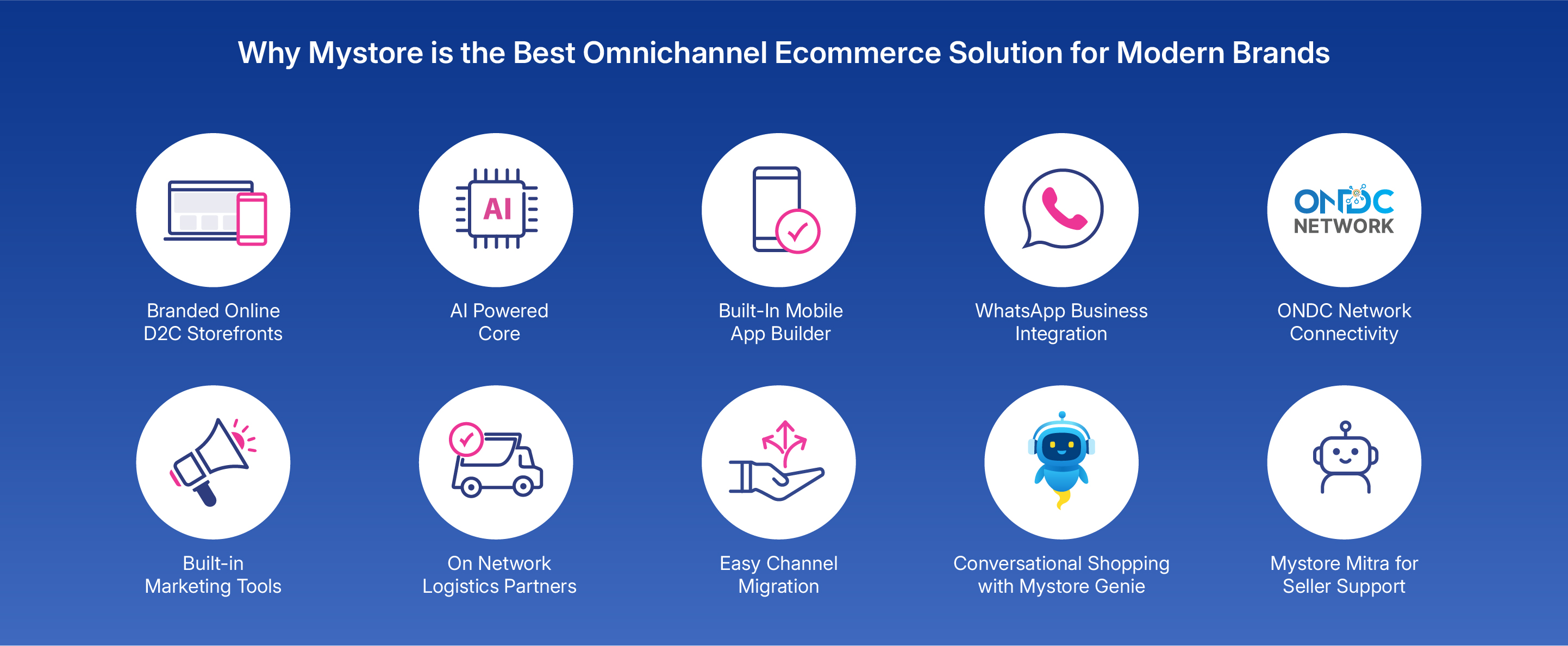
1. Branded Online D2C Storefronts
Mystore ecommerce solutions help you create fully branded online storefronts for your D2C brand. Once you register as a seller on Mystore, you can quickly launch your own AI powered store without any setup cost. You get full control over your design, banners, catalogue, pricing, offers, and overall brand experience.
This flexibility helps you build a strong brand identity, earn customer trust, and deliver consistent omnichannel ecommerce experiences across every touchpoint. It also ensures a seamless and unified buying journey that drives better engagement and conversions.
2. AI Powered Core
Mystore ecommerce ecosystem is built on AI powered core where every operational layer is designed to automate, optimise, and scale commerce operations intelligently. Your D2C brand on Mystore can leverage AI powered cataloguing to automatically generate products titles, descriptions, category, tagging, etc, directly from product images. You can also sharpen raw product images using Magic Edit to create stunning, market-ready visuals without additional design effort. Mystore’s AI-powered search and recommendation helps shoppers discover relevant products faster through personalised recommendations, intelligent search results, and behaviour-driven product discovery, improving engagement, conversions, and repeat purchases across your D2C channels.
3. Built-In Mobile App Builder and PWA Stores
Mystore offers a built-in no-code mobile app builder that helps D2C brands easily create Android and iOS apps without writing any code. It comes ready to use from day one, with no additional cost. Product catalogues, pricing, inventory, and orders stay synced in real time, ensuring a seamless and consistent experience across all channels. You can also build high-performance PWA stores to reach and engage the fastest-growing customers in Tier 3+ areas. These PWA stores work smoothly and fast, even in low network connectivity areas and entry level devices, enabling enterprises to deliver fast, app-like shopping experiences to customers in remote and low-bandwidth regions while improving engagement, retention, and conversions across mobile channels.
4. WhatsApp Business Integration
WhatsApp has now become one of the primary sales channels in omnichannel ecommerce, especially for conversational buying journeys. You can easily connect your D2C brands’ WhatsApp business account with Mystore and allow customers to browse products, place orders, and complete payments directly within the chat.
You can automatically send order updates and notifications to keep customers informed at every stage of their purchase journey. Mystore also provides ready-to-use messaging templates that you can easily customise as per your business needs. In addition, you can track message delivery, reads, and engagement to improve communication effectiveness and customer experience.
5. ONDC Network Connectivity
Mystore ecommerce solutions help you expand your brand reach through the ONDC Network. Mystore is directly connected to the ONDC Network (Open Network for Digital Commerce), so when you register on Mystore, your products don’t just appear on the Mystore Buyer App but also on multiple other buyer apps connected to the network.
This helps you increase product discoverability across a wider digital commerce ecosystem. You can improve brand visibility, reach new customer segments, and accelerate omnichannel ecommerce growth through connected commerce networks.
6. Built-in Marketing Tools
Mystore offers built-in marketing tools that help D2C brands run campaigns, improve product visibility, and boost customer engagement without external plugins. The platform is SEO and AEO-ready, helping products rank better across search engines and AI results. Mystore also offers unique QR codes for your brand and products and enables you to generate PDF catalogues to share across various channels.
You can leverage the built-in discount engine to create targeted offers, coupons, and promotions that improve conversions and repeat purchases. Mystore also supports WhatsApp commerce and offers seamless integration with Google feeds, schema tags, and SEO-optimised themes to strengthen omnichannel scaling and product discovery.
7. On Network Logistics Partners
Mystore ecommerce solutions is connected with on network as well as pre integrated ShipKaro logistics providers to enable efficient deliveries across hyperlocal, intracity, and intercity locations. You can also connect your preferred party logistics partners and seamlessly switch between ON-network and off-network delivery solutions to optimise shipping costs, improve delivery speed, expand service coverage, and ensure uninterrupted order fulfilment across different regions and business models.
Mystore also gives businesses access to real-time shipping rates from multiple logistics partners and enables automatic carrier assignment based on your delivery preferences, such as cost, speed, serviceability, location, etc. This helps enterprises streamline fulfilment operations, reduce manual effort, and ensure faster, more efficient order deliveries at scale.
8. Easy Migration From Other Channels
Mystore enables seamless migration for brands already selling on platforms like Amazon, Shopify, and other ecommerce channels, enabling them to quickly set up their D2C store on Mystore without disrupting existing operations. Brands can continue selling across all their current channels while expanding to a unified omnichannel ecosystem.
With Mystore, businesses can increase visibility across 50+ ONDC buyer apps, unlock new customer segments, and drive additional sales through a wider digital commerce network. This multi-channel approach helps brands scale faster, improve discoverability, and build a stronger omnichannel presence without operational complexity.
9. Conversational Shopping with Mystore Genie
On Mystore, you can leverage Mystore Genie, an AI-powered conversational shopping assistant that simplifies product discovery and improves customer engagement. Customers can ask questions naturally, receive intelligent recommendations, compare products, and complete purchases through conversational interfaces.
This helps you deliver more interactive, personalised, and conversion-focused experiences while simplifying the overall buying journey for customers.
10. Mystore Mitra for Support Setting up Business
Mystore Mitra is a built-in AI assistant that helps brands and sellers seamlessly start, manage, and scale their online business on Mystore. It provides guided support for onboarding, catalogue setup, order management, and everyday platform operations, all within the ecosystem.
For D2C brands handling multiple products, teams, and locations, Mystore Mitra simplifies operations by offering real-time assistance and reducing manual effort. For new sellers, it makes onboarding easier by guiding them step-by-step through platform usage without complexity.
Overall, Mystore Mitra acts as an always-available AI business assistant that enables faster onboarding, smoother operations, and more confident scaling for every brand.
Conclusion
Omnichannel ecommerce is redefining how modern D2C brands attract, engage, and retain customers. Buyers now expect seamless experiences across mobile apps, websites, WhatsApp, social commerce, and other touchpoints without interruptions or inconsistencies.
To meet these expectations, enterprise commerce brands need connected systems that combine AI-powered personalisation, conversational commerce, real-time inventory synchronisation, and mobile-first buying experiences into one unified ecosystem.
Mystore help D2C brands to build connected customer experiences and accelerate enterprise commerce growth.
Ready to transform your omnichannel ecommerce strategy?
Book your personalised demo with Mystore ecommerce solutions.
FAQs
1. Why is omnichannel ecommerce important for D2C brands in 2026?
Omnichannel ecommerce is important for D2C brands in 2026 because it connects multiple customer touchpoints into one seamless buying journey, helping brands deliver consistent experiences, reduce friction, improve conversions, and build stronger customer loyalty. It also gives brands a clearer view of customer interactions across channels.
2. What do customers expect from an omnichannel D2C shopping experience?
Customers expect a seamless and consistent experience across websites, mobile apps, WhatsApp, marketplaces, and other touchpoints, with the same product information, pricing, offers, inventory, personalised recommendations, and support throughout their buying journey. They also expect to switch between channels without having to start their journey again.
3. How does omnichannel ecommerce improve customer retention for D2C brands?
Omnichannel ecommerce improves customer retention by giving D2C brands a consistent, personalised, and convenient experience across every customer touchpoint, making it easier for buyers to shop, get support, and return for future purchases. A connected experience can also make repeat purchases more convenient and relevant.
4. How does AI improve omnichannel ecommerce experiences?
AI improves omnichannel ecommerce by enabling personalised recommendations, intelligent product discovery, conversational shopping, automated support, and consistent customer experiences across websites, mobile apps, WhatsApp, and other connected channels. It helps brands respond to customer intent more quickly at different stages of the buying journey.
5. How does real-time inventory help D2C brands deliver a smoother shopping experience?
Real-time inventory helps D2C brands keep product availability accurate across all channels, preventing overselling, order cancellations, and fulfilment delays while giving customers a more reliable and seamless shopping experience. It also helps fulfilment teams act on accurate stock information when processing orders.
6. How can D2C brands use WhatsApp to make omnichannel shopping easier?
D2C brands can use WhatsApp to help customers discover products, ask questions, get personalised recommendations, place orders, make payments, and receive updates without leaving the chat. This makes WhatsApp a convenient extension of the brand’s existing commerce experience rather than a separate channel.
7. What role does mobile commerce play in omnichannel D2C growth?
Mobile commerce helps D2C brands reach customers wherever they shop, while keeping product discovery, browsing, purchasing, and post-purchase experiences connected across apps, websites, PWA stores, and other channels. A mobile-first approach also helps brands serve customers during quick, on-the-go purchase journeys.
8. What should D2C brands look for in an omnichannel commerce platform?
D2C brands should look for an omnichannel commerce platform that offers real-time synchronisation, AI-powered personalisation, mobile commerce, conversational buying, integrated logistics, and seamless management across multiple sales channels. The platform should also make it easier to manage these touchpoints from a unified backend.
9. How can Mystore ecommerce solutions help D2C brands build omnichannel experiences?
Mystore ecommerce solutions help D2C brands build omnichannel experiences by connecting branded storefronts, mobile apps, PWA stores, WhatsApp commerce, ONDC Network, AI-powered shopping, marketing, and logistics through one unified ecosystem. This allows brands to manage multiple customer touchpoints while maintaining a consistent commerce experience.
10 How can D2C brands keep up with changing customer expectations in 2026 and beyond?
D2C brands can keep up by delivering seamless, personalised, mobile-first experiences across channels, while using AI, real-time data, conversational commerce, and flexible fulfilment to make every stage of the buying journey faster and easier. Brands that continuously connect technology with customer needs will be better positioned for long-term growth.