


 Contact Us
 Appliances
 Agri Inputs
 Auto Components & Accessories
 Beauty & Personal Care
 Electronics
 Fashion
 Grocery
 Gift Cards
 Home & kitchen
 Health & Wellness
 Vehicles & Automotives
 Books & Stationary
 Pet Care
 Toys & Games
How Mobile-First Strategy Is Transforming D2C ECommerce Brands
ONDC Network for D2C Sellers
Key Takeaways
- Mobile-first commerce is now the primary growth driver for D2C brands, reshaping discovery and purchase journeys in real time.
- AI-powered personalisation and conversational commerce are improving conversions, engagement, and average order value across mobile journeys.
- Dedicated mobile apps, PWAs, and WhatsApp commerce are emerging as critical channels for building retention, loyalty, and frictionless buying experiences.
- Enterprise D2C brands need mobile-native, scalable, and omnichannel-ready platforms to deliver consistent performance and support long-term growth.
Most D2C journeys today don’t start on a website. They start on a phone, a quick search, a shared link, a WhatsApp query, a scroll through social. And in those few seconds, the experience either moves the customer forward or loses them completely. This shift is what is driving the rapid growth of mobile commerce for modern D2C brands.
For D2C Ecommerce brands, this shift is no longer about “optimising for mobile.” It’s about building the business around it. Discovery, engagement, checkout, and even post-purchase interactions are now happening on smaller screens, faster timelines, and with far less patience for friction.
The challenge is not demand, it’s readiness. Many brands are still stitching together mobile experiences on top of web-first systems, which limits speed, consistency, and scalability as they grow.
In this environment, mobile-first is not a feature or a channel strategy. It is the foundation that determines how efficiently an enterprise can acquire, convert, and retain customers at scale.
Table of Contents
- Why Mobile First D2C Ecommerce is Critical for Enterprise Growth
- How Mobile-First Commerce Is Driving Growth for Enterprise D2C Brands
- 1. Mobile Shoppers Now Dominate Ecommerce Traffic
- 2. Faster Mobile Experiences Improve Conversions
- 3. Mobile Apps Drive Higher Customer Loyalty
- 4. AI-Powered Mobile Commerce Improves Personalisation
- 5. AI-Powered Conversational Commerce Is Reshaping Buyer Behaviour
- 6. Omnichannel Shopping Requires Mobile-First Experiences
- 7. Mobile-First Platforms Support Faster Enterprise Scalability
- Why Choose Mystore Enterprise Solutions for Mobile-First, AI-Powered Commerce Growth
- 1. Sell Directly with Mystore Buyer App
- 2. Launch a Mobile-Ready Branded Store in Minutes
- 3. Build Android and iOS Apps Without Coding
- 4. AI Commerce Assistant
- 5. Manage Customer Conversations from One Dashboard
- 6. Reach Tier 3 Markets with Fast PWA Stores
- 7. WhatsApp Commerce Integration
- 8. Expand Reach Through the ONDC Network Connectivity
- Conclusion
- FAQs
Why Mobile First D2C Ecommerce is Critical for Enterprise Growth
With rising smartphone use, mobile has become the primary sales channel for D2C brands.
From impulse-driven purchases to WhatsApp checkouts and hyper-personalised app experiences, mobile is shaping how quickly customers engage and convert. AI is accelerating this shift by making mobile journeys more personalised, predictive, and conversion-focused.
Here’s a closer look at the data behind this shift in mobile-first and AI-powered D2C growth:
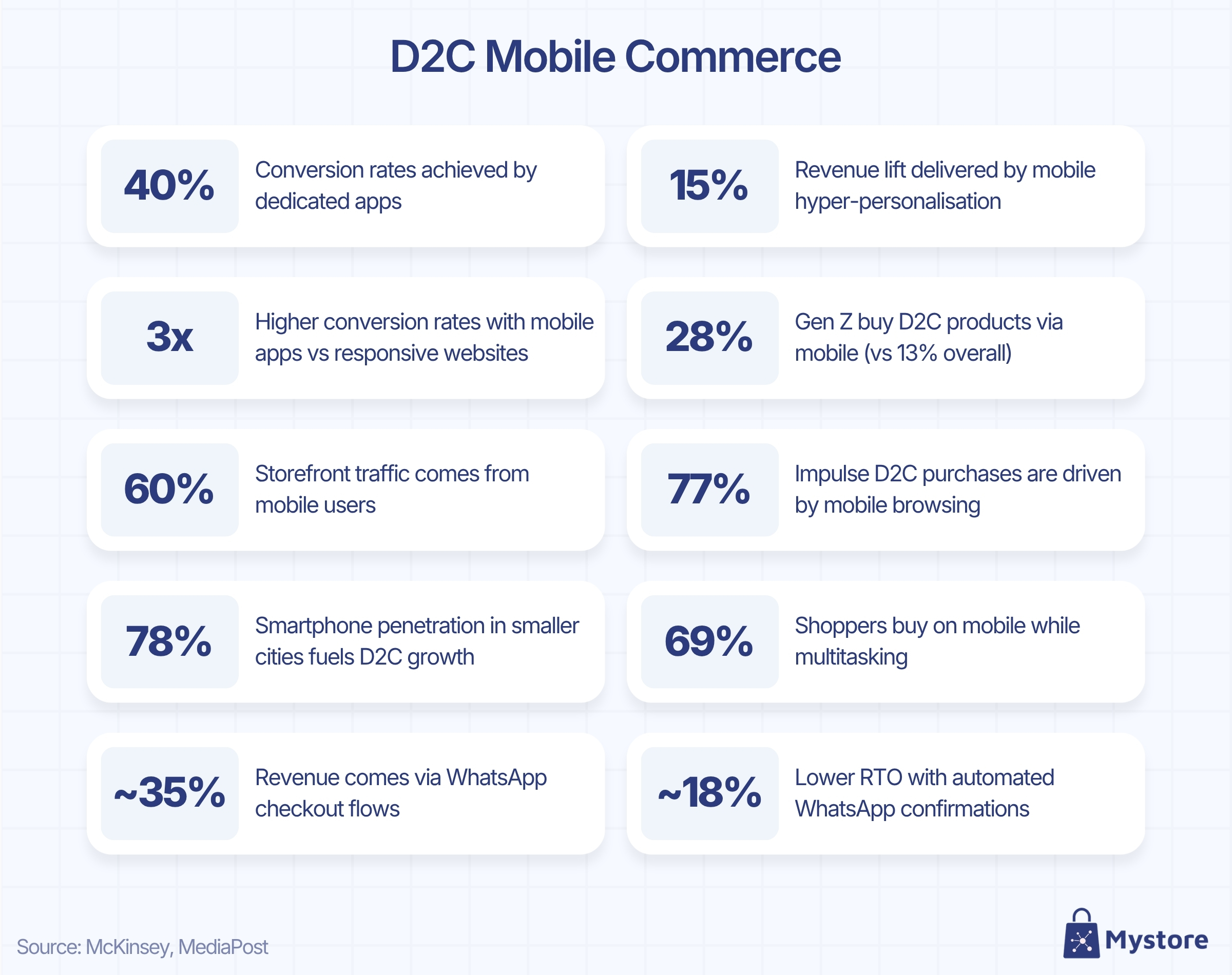
- 3x higher conversion rates for D2C brands with dedicated mobile apps vs responsive websites
- 28% of Gen Z shoppers buy from D2C brands via mobile vs 13% overall
- 40% conversion rates for D2C brands utilising dedicated apps
- 15% revenue lift for D2C brands using mobile hyper-personalisation
- ~60% of independent storefront traffic is driven by mobile users
- 77% of impulse D2C purchases are influenced by mobile browsing
- 78% smartphone penetration in smaller cities is driving D2C growth
- 69% of shoppers buy from D2C brands on mobile while multitasking
- 20%-35% of D2C ecommerce revenue now comes through WhatsApp checkout flows
- 15%-18% lower RTO rates for D2C brands using automated WhatsApp confirmations
Source: McKinsey, MediaPost
Key takeaway: Mobile has become the primary growth engine for D2C brands, driving higher conversions, impulse purchases, and revenue through apps, WhatsApp commerce, and hyper-personalised experiences.
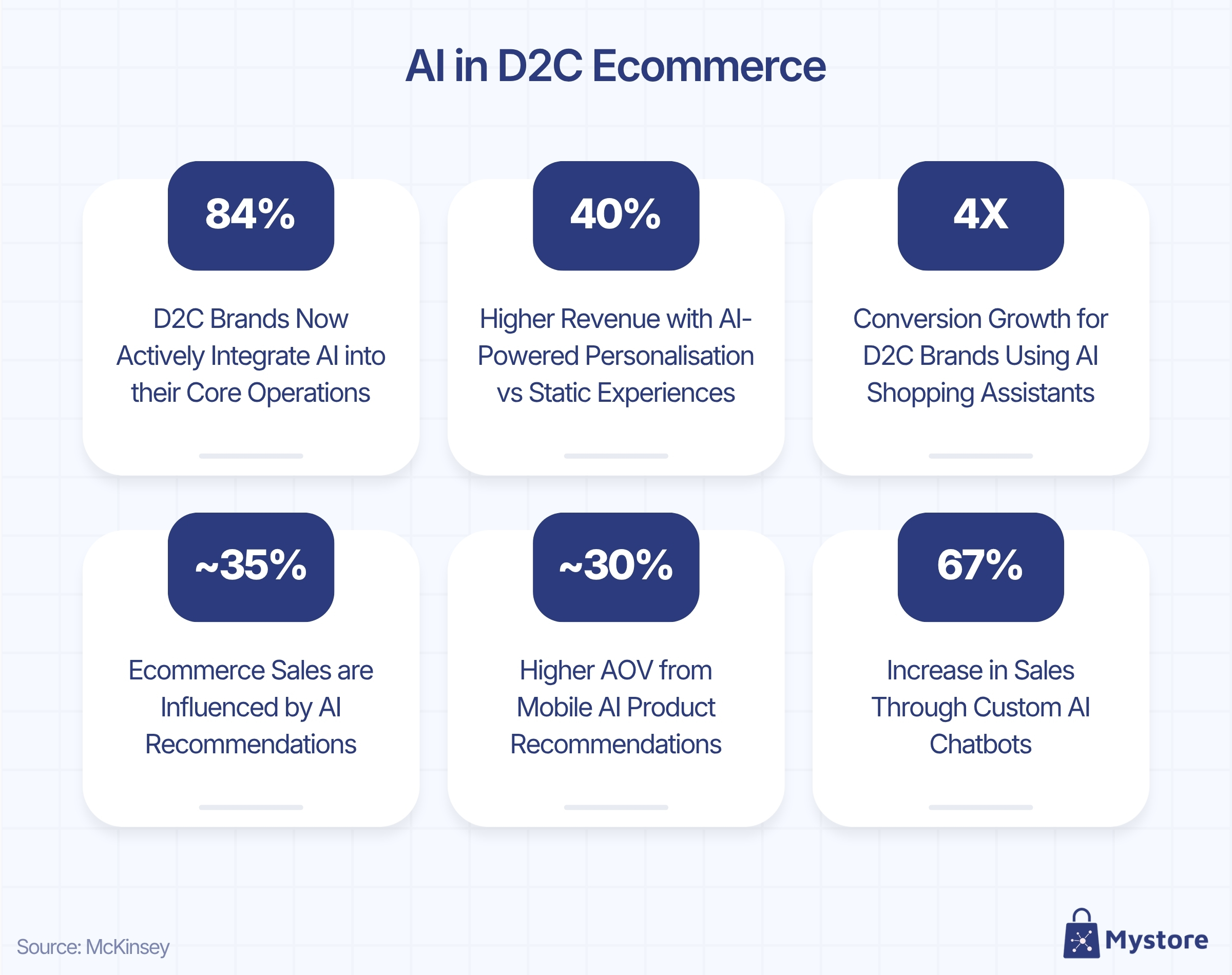
- 84% of D2C brands now actively integrate AI into their core operations.
- 40% higher revenue for D2C brands using AI-powered personalisation over static commerce experiences
- 4x conversion growth for D2C brands using AI shopping assistants
- 25%-35% of ecommerce sales are influenced by AI-powered recommendations
- 15%-30% higher AOV through mobile-tailored AI product recommendations
Source: Mckinsey
Key takeaway: AI is now a core revenue driver in D2C commerce, significantly boosting conversions, personalisation, and order value while influencing a large share of purchase decisions.
Mobile-first behaviour and AI-driven intelligence are reshaping how D2C ecommerce works, changing how customers discover, engage with, and buy from brands.
For enterprise D2C brands, this shift signals a clear direction: success will increasingly depend on building mobile-native experiences powered by an AI core that understands customer behaviour, preferences, and context in real time.
How Mobile-First Commerce Is Driving Growth for Enterprise D2C Brands
Mobile commerce is no longer just about convenience. For modern D2C ecommerce brands, it has become the core driver of discovery, engagement, and sales. As customers increasingly shop on smartphones, enterprise brands need a mobile-first ecosystem that enables them to scale faster and stay competitive in the fiercely increasing D2C ecommerce space.
Here’s how mobile-first commerce is shaping growth for modern enterprise D2C brands:
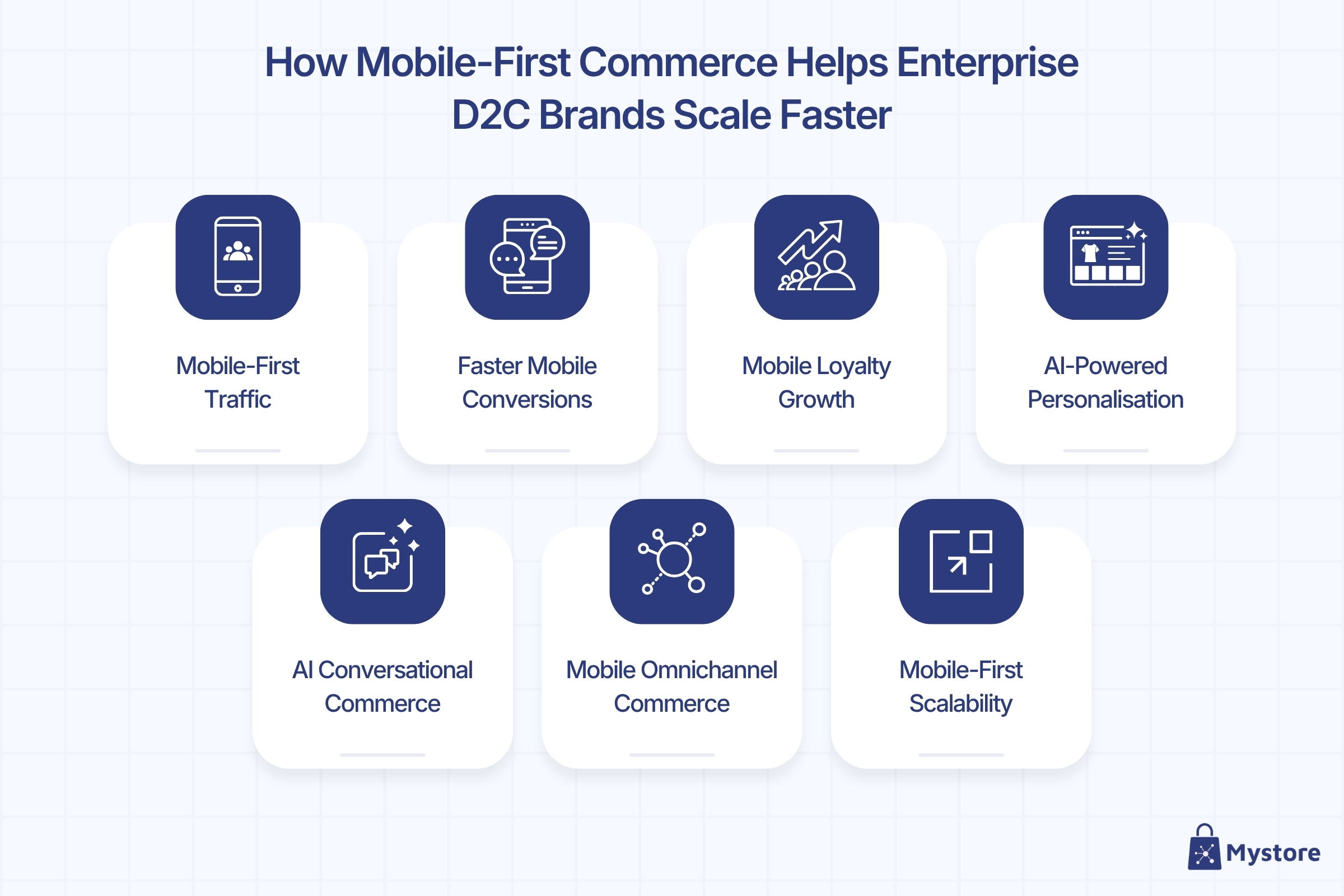
1. Mobile Shoppers Now Dominate Ecommerce Traffic
This is the mobile-first ecommerce era, where most customers use mobile devices to search, browse, compare, and buy products in real time. Shopping often happens in short moments during the day, like while travelling, taking a break, or scrolling through social media.
This shift in buying behaviour pushes D2C brands to design mobile-first experiences that match customers' behaviour. For example, a customer receives a push notification about an ongoing deal on a product through the mobile app. They tap the notification, and the product page opens instantly on their phone. The customer quickly checks product details, browses images and reviews, and completes the purchase through a fast mobile checkout within minutes.
If the experience feels smooth, they complete the purchase immediately. If it feels slow or confusing, they drop off and move to another brand within seconds. This is why enterprise D2C brands are now focusing on fast-loading mobile pages, faster checkout, and personalised product suggestions that make buying feel effortless in the moment of intent.
2. Faster Mobile Experiences Improve Conversions
When D2C ecommerce brands are built on a mobile-first solution, it makes shopping simple, fast, and always accessible. Customers don’t need to open a desktop or wait until they are free. They can just pick up their phone anytime, anywhere, and start browsing in seconds.
For example, a customer receives a push notification about an ongoing deal on any product on their mobile app. They tap the notification, and it instantly appears on their phone. The customer quickly browses the product and checks details, and completes the purchase through a fast mobile checkout within minutes.
Technologies like PWAs, optimised storefronts, and lightweight checkout flows reduce loading time and drop-offs. When users can browse and purchase without delays, bounce rates fall and conversion rates increase significantly.
This seamless experience is what improves conversions for D2C ecommerce brands, because the entire journey stays connected to the moment of interest, when the intent to buy is highest.
3. Mobile Apps Drive Higher Customer Loyalty
Mobile apps help enterprise D2C ecommerce brands turn one-time buyers into repeat customers. Instead of depending on search or ads, the brand stays easy to reach on the customer’s phone, so they can come back whenever they want without any effort.
Over time, this makes shopping feel easier. Customers don’t need to start their search again each time. If they like a brand once, they are more likely to return when they need something similar.
Dedicated mobile apps help brands build long-term customer relationships. Features like push notifications, loyalty programs, and personalised offers encourage repeat purchases. Apps also create a direct communication channel, reducing dependency on paid acquisition.
For example, a customer who bought skincare products earlier gets a notification about a restock reminder or a new product. Since the brand is already installed on their phone, they open it quickly, check the update, and complete the purchase in a few steps.
This is how mobile commerce builds loyalty for D2C ecommerce brands. It keeps customers coming back easily and reduces the need to find new customers every time.
4. AI-Powered Mobile Commerce Improves Personalisation
AI has transformed mobile shopping into a highly personalised experience. AI powered recommendations, AI semantic search, AI customer support, etc., help brands show the right product at the right time. This increases engagement and boosts both conversion rates and average order value.
For enterprise D2C ecommerce brands, this is clearly visible in how customers shop today. They don’t spend time scrolling through long lists or setting filters anymore. Instead, they land on a page and quickly see products that already match what they are looking for. This makes the experience feel faster, easier, and more relevant, which keeps them engaged and helps them decide sooner.
For example, a customer searching for skincare products on mobile is immediately shown items based on skin type, past browsing, and price preference. They quickly spot what fits their need, compare a few options, and make a decision without much effort.
This makes the entire journey smoother and more relevant. When shopping feels simple and aligned with intent, customers are more likely to complete the purchase, which directly improves performance for mobile commerce.
5. AI-Powered Conversational Commerce Is Reshaping Buyer Behaviour
Shopping is becoming more conversational on mobile. Instead of moving through multiple pages, customers now prefer asking and getting answers instantly on the same device they use every day.
New age shopping channels like WhatsApp, AI chat interfaces, and voice-based search are making this shift even stronger on mobile. Customers can check product details, compare options, and place orders without leaving the conversation or switching devices.
For example, a customer messages a fashion brand on WhatsApp asking for a shirt for a formal office event. The AI chat assistant can suggest a few options based on size, budget, and colour preference, shares images, and provides a direct link to buy. The customer picks one and completes the purchase in the same chat flow on their phone.
This makes mobile commerce feel more natural and quick. It reduces effort for the customer and helps D2C ecommerce brands close sales faster through simple, mobile-first conversations.
6. Omnichannel Shopping Requires Mobile-First Experiences
Omnichannel presence has become essential for D2C ecommerce brands as new-age customers move freely across different channels before making a purchase. Their journey is not fixed to one channel, and they expect to continue it without any break.
To meet this behaviour, brands are no longer relying only on websites. They are building connected mobile ecosystems that include Android and iOS apps for high-performance shopping, PWAs for users who want lightweight access without downloads, and web stores that keep the experience consistent across devices. This helps customers continue their journey smoothly, no matter where they start.
For example, businesses can launch Android and iOS mobile apps to give customers a fast, easy, and personalised shopping experience that stays accessible on their phones. At the same time, PWAs help users on low-network or low-storage devices to browse products and place orders without the need to download an app. This makes it easier to reach customers in smaller towns and regions with connectivity challenges.
7. Mobile-First Platforms Support Faster Enterprise Scalability
As D2C ecommerce brands grow, the challenge is not just handling more traffic, but scaling without slowing down the customer experience.
Modern mobile-first platforms built on cloud-native, API-first, and headless architecture make this easier. They allow brands to expand into new markets, launch new storefronts, and integrate systems without disrupting mobile performance.
For example, an electronics D2C brand expanding into a new city can quickly launch a localised mobile storefront with region-specific product listings, warranty details, and payment methods like EMI or local wallets. At the same time, inventory for devices like smartphones, earbuds, or laptops stays synced across warehouses, so stock availability is always accurate in real time. A customer browsing on mobile can check specs, compare models, and complete a purchase smoothly, without delays or mismatched information.
Why Choose Mystore Enterprise Solutions for Mobile-First, AI-Powered Commerce Growth
For modern D2C Ecommerce brands, growth now depends on how smoothly they connect mobile commerce, customer experience, and omnichannel ecommerce into one simple journey. Customers are not switching between channels in a structured way, they are browsing, chatting, and buying on mobile in real time.
Mystore enterprise solutions are built for this shift. Instead of treating mobile as just another sales channel, it helps brands make mobile the centre of their commerce strategy.
1. Sell Directly with Mystore Buyer App
The Mystore Buyer App gives brands a direct way to reach customers on mobile. When you register your D2C business on Mystore, your brand and products are visible on the Mystore Buyer App. Your customers can browse products, place orders, and track orders directly through the Mystore Buyer App. This creates a faster, more seamless buying journey that improves customer trust and encourages repeat purchases.
2. Launch a Mobile-Ready Branded Store in Minutes
On Mystore, you can create your own branded D2C store that is powered by AI and fully mobile responsive without needing any coding or extra setup costs.
With Mystore mobile commerce solutions, you can launch your online storefront in just a few minutes and start selling right away. It helps D2C ecommerce brands grow faster, reach more mobile shoppers, and build strong customer loyalty across new markets.
3. Build Android and iOS Apps Without Coding
Mystore enterprise ecommerce solutions offer a built-in no-code mobile app builder that helps you create mobile apps designed to attract and engage mobile users.
With this no-code mobile app builder, you can easily launch Android and iOS apps for your D2C brand directly from the admin dashboard. It does not require extra cost or a dedicated IT team, making it simple to scale your mobile commerce presence quickly.
4. AI Commerce Assistant
Mystore’s omnichannel ecommerce capabilities extend to AI-powered conversational chat experiences that make shopping more natural and interactive for customers.
Mystore offers an AI shopping assistant, Mystore Genie, which is multilingual and voice-enabled. It helps buyers discover products, compare options, get recommendations, and place orders easily through simple chat-based interactions, enabling brands to improve engagement, reduce friction in the buying journey, and drive higher conversions across mobile commerce channels.
Along with this, Mystore also provides Mystore Mitra, a built-in AI support system for brands. It helps D2C Enterprise brands resolve operational queries for internal teams, making support faster, simpler, and more efficient.
5. Manage Customer Conversations from One Dashboard
Customers often move between WhatsApp, web chat, voice, and other channels during a single buying journey. When these conversations are managed separately, support teams can lose important context and customers may have to repeat themselves.
Mystore brings conversations from WhatsApp, web, voice, email, and other connected channels into one unified, AI-powered conversation dashboard. Teams can view conversation history along with customer details, cart information, and order history in one place.
AI can handle routine queries and help draft responses using relevant business data, while complex issues can be escalated to support teams with the complete conversation history and customer context available. This helps D2C ecommerce brands deliver faster, more consistent support across their omnichannel ecommerce journey.
6. Reach Tier 3 Markets with Fast PWA Stores
Mystore also helps D2C ecommerce brands expand their reach into tier 3 and hinterland markets where internet connectivity can be limited.
With built-in support for PWAs (Progressive Web Apps), you can create fast and lightweight online stores that load smoothly even on low networks. Customers can browse products and shop without needing to download a full app, which makes the buying experience easier and more accessible.
This helps D2C ecommerce brands connect with new mobile audiences, improve engagement in emerging markets, and grow their presence beyond metro cities.
7. WhatsApp Commerce Integration
WhatsApp is where nearly 98% of mobile users are active, making it a powerful channel for enterprises to connect with customers directly.
Mystore offers WhatsApp Business for Sellers (WABA), which helps enterprises engage with buyers, share product details, send order updates, and manage customer conversations in one place.
With Mystore’s WABA solution, you can connect your D2C brands' WhatsApp Business account to Mystore and allow customers to browse products, place orders, and complete payments directly within the chat. This makes the buying journey faster, simpler, and more familiar for mobile users.
8. Expand Reach Through the ONDC Network Connectivity
Mystore is an ONDC Network (Open Network for Digital Commerce) connected marketplace that helps D2C ecommerce brands expand their reach beyond their own store.
When you register your D2C brand on Mystore, your brand and products become discoverable across multiple ONDC Network buyer apps, helping you reach more customers beyond a single platform.
This helps brands increase visibility, improve sales opportunities, and grow faster by connecting directly with buyers across different apps within the ONDC network.
Conclusion
Mobile-first commerce is no longer an emerging trend; it is the foundation of modern D2C growth. Enterprise brands that prioritise mobile experiences are seeing higher conversions, stronger customer retention, and improved scalability across channels.
As AI, conversational commerce, and omnichannel ecosystems continue to evolve, mobile will remain the central point of customer interaction. Brands that build fast, intelligent, and connected mobile experiences today will define the next phase of D2C ecommerce leadership.
Ready to transform your mobile commerce strategy?
Explore how AI-powered, mobile-first commerce can accelerate your D2C growth by booking a demo with Mystore Enterprise Solutions now.
FAQs
1. What should D2C ecommerce brands evaluate before investing in a mobile-first commerce platform?
D2C ecommerce brands should evaluate scalability, mobile performance, AI capabilities, app and PWA support, integrations, security, personalisation, and omnichannel ecommerce readiness before investing in a mobile-first commerce platform. The mobile commerce platform should not only deliver a fast mobile experience for current needs but also support new channels, growing traffic, and evolving customer expectations as the brand scales.
2. How can D2C brands measure whether their mobile-first strategy is actually delivering business value?
D2C ecommerce brands can measure business value by tracking mobile conversion rates, customer acquisition costs, repeat purchases, average order value, customer lifetime value, checkout abandonment rates, and revenue generated through mobile commerce. These metrics show whether the mobile-first strategy is improving both customer engagement and overall business performance.
3. When should a D2C ecommerce brand consider investing in a dedicated mobile app?
A D2C ecommerce brand should invest in a dedicated mobile app when its customers frequently return to shop, engage with personalised offers, or benefit from faster, more convenient buying. It is especially worthwhile for brands with strong repeat-purchase potential, loyalty programmes, and a customer base that actively prefers shopping on smartphones.
4. How can D2C ecommerce brands create consistent customer journeys across mobile, web, apps, and other touchpoints?
D2C ecommerce brands can create consistent customer journeys by connecting customer data, product catalogues, inventory, orders, and engagement across every channel. A unified omnichannel ecommerce platform helps brands maintain the same pricing, product information, personalisation, and customer experience across mobile, web, apps, and other touchpoints.
5. How can AI help D2C brands improve their mobile shopping experience?
AI can help D2C ecommerce brands make mobile shopping faster, more relevant, and easier by understanding customer intent. It can personalise recommendations, improve product discovery, power conversational shopping, and automate support, helping brands increase engagement and conversions through mobile commerce.
6. How can enterprise D2C brands scale mobile experiences without rebuilding their technology stack every few years?
Enterprise D2C ecommerce brands can scale mobile experiences by choosing a flexible, API-first commerce platform that supports new channels, integrations, apps, and customer experiences without requiring a complete technology overhaul. This gives brands the flexibility to grow their mobile commerce capabilities while keeping their core commerce infrastructure stable.
7. How can D2C ecommerce brands personalise mobile experiences without creating operational overhead?
D2C ecommerce brands can personalise mobile experiences by using a unified commerce platform that connects customer data, catalogue intelligence, AI recommendations, and engagement tools. This lets teams deliver relevant experiences at scale without managing multiple disconnected systems or adding extra operational work.
8. How can D2C ecommerce brands use mobile commerce to enter new markets?
D2C ecommerce brands can use mobile commerce to reach new markets with localised mobile storefronts, apps, PWAs, regional payment options, and personalised experiences. A scalable commerce platform also helps brands manage products, inventory, orders, and customer journeys consistently as they expand into new regions.
9. How can D2C ecommerce brands reduce mobile cart abandonment?
D2C ecommerce brands can reduce mobile cart abandonment by simplifying checkout, reducing the number of steps, offering preferred payment options, keeping product and delivery information clear, and using personalised reminders to bring customers back when they leave a purchase unfinished.
10. How can Mystore enterprise solutions help D2C brands scale for future growth?
Mystore enterprise solutions help D2C ecommerce brands scale with built-in mobile commerce, unified omnichannel ecommerce, built-in marketing tools, 30+ logistics integrations, and support for B2B, B2C, D2C, B2B2C, and quick commerce models. This gives brands the flexibility to expand channels, markets, and business models without adding multiple disconnected systems.