


 Contact Us
 Appliances
 Agri Inputs
 Auto Components & Accessories
 Beauty & Personal Care
 Electronics
 Fashion
 Grocery
 Gift Cards
 Home & kitchen
 Health & Wellness
 Vehicles & Automotives
 Books & Stationary
 Pet Care
 Toys & Games
There is a particular smell that rises when ghee hits a hot pan — warm, nutty, slightly sweet — that is one of the most recognisable smells in an Indian kitchen. It is the smell of dal getting its tadka, of rice being made into khichdi, of puran p...
Read MorePopular Categories
Support
Language
Our apps
There is a particular smell that rises when ghee hits a hot pan — warm, nutty, slightly sweet — that is one of the most recognisable smells in an Indian kitchen. It is the smell of dal getting its tadka, of rice being made into khichdi, of puran poli being pressed onto a tawa. Ghee is not just a fat used in cooking. It is the ingredient that signals that a meal is being made properly, with care, and with the intention of feeding someone well.
Most households in Maharashtra keep ghee in the kitchen as a matter of course. The question is not whether to use it, but which one to buy. The difference between mass-produced ghee and traditionally made cow ghee becomes clear the moment you open the jar — in the colour, the aroma, and the texture. Tungar Foods' Gaiche Toop is made the way ghee has always been made in Maharashtra: from cow's milk, processed slowly, and clarified until nothing remains but the pure golden fat.
The Making Process
Pure cow ghee begins with milk — full-fat cow's milk, which is first converted to curd, then churned to separate the butter, and finally slow-heated to drive off all remaining moisture and milk solids. What remains after this clarification is ghee: stable, fragrant, and ready for use.
The slow-heating stage is where traditionally made ghee differs most from commercially processed variants. When ghee is heated gradually and at the right temperature, the milk solids toast lightly before being strained out, leaving behind the characteristic nutty aroma and deep golden colour that mark a well-made batch. This is not something that can be rushed or replicated by industrial processing at scale.
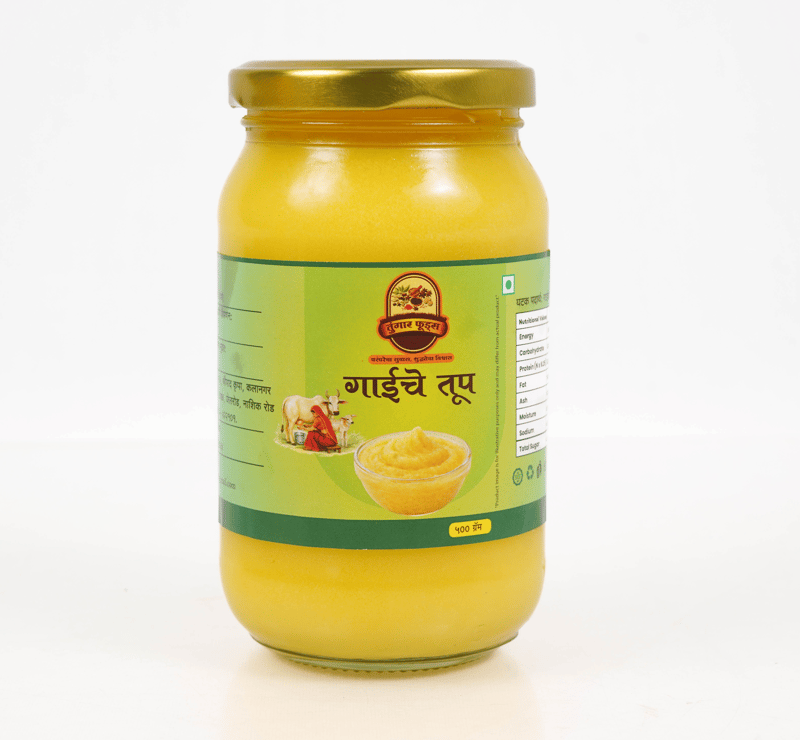
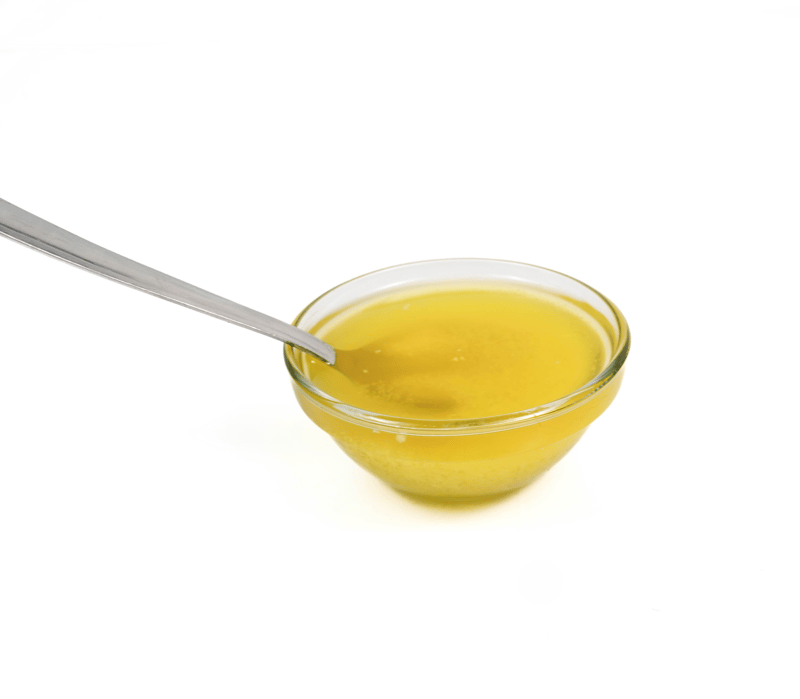
The result, visible through the glass jar in the image, is a deep amber-gold ghee with a smooth, even consistency — neither too liquid nor grainy, indicating a clean clarification and proper cooling after the process.
In the Kitchen
Ghee has a naturally high smoke point — significantly higher than butter and most refined oils — which makes it stable under the heat required for tadka, deep frying, and roasting without breaking down or producing the bitter compounds that overheated oils develop. This makes it the practical choice for the high-heat cooking that Indian food routinely involves.
A spoonful stirred into hot dal or rice changes both the flavour and the mouthfeel of the dish immediately. In sweets — halwa, ladoo, puran poli, shira — ghee is not optional; it is the ingredient that determines whether the sweet tastes homemade or institutional. In roti and bhakri, a smear of ghee applied straight from the jar after cooking adds both flavour and softness. These are uses that no substitute replicates the same way.
On Digestion and Nourishment
In Ayurvedic understanding, ghee is considered one of the most nourishing fats — supportive of digestion, gentle on the gut, and beneficial for the absorption of fat-soluble nutrients from food. Butyric acid, present naturally in cow ghee, is associated with gut lining health. Vitamins A, D, E, and K, which are fat-soluble, are better absorbed when consumed alongside fat — and ghee, added to cooked vegetables or dal, aids exactly that absorption.
Because the milk solids are removed during clarification, ghee is naturally free from lactose, making it generally better tolerated than butter by people who are sensitive to dairy.
These are not new discoveries. They are the reasons ghee has remained central to Indian cooking and Ayurvedic practice for thousands of years — not through trend or marketing, but through consistent, observed benefit across generations of daily use.
Why the Glass Jar Matters
Ghee packaged in glass does not interact with the fat the way plastic containers can over extended storage periods. Glass is inert, keeps the ghee at a stable temperature, and allows you to see the product clearly — its colour, consistency, and fill level — before and after opening. The gold-lidded glass jar used here seals tightly, protecting the ghee from moisture and odour absorption during storage.
Specifications
Ingredient: Pure cow's milk
Process: Traditional clarification — curd, churned butter, slow-heated and filtered
Colour: Deep amber gold
Texture: Smooth and even
Packaging: Sealed glass jar with metal lid
Net Weight: 500 g (packed weight 520 g with jar)
Shelf Life: 12 months from date of manufacture
Storage
Store in a cool, dry place away from direct sunlight. Ghee does not require refrigeration if used regularly — at room temperature it stays fresh within its shelf life when the lid is kept tightly closed. Use a clean, dry spoon every time to avoid introducing moisture into the jar, which can cause the ghee to go rancid earlier. If the kitchen is very warm during summer, refrigeration is acceptable — the ghee will solidify and return to its normal consistency once brought to room temperature.
About the Entrepreneur
Meera Tai makes pure desi cow ghee at home in a traditional manner. The quality of her ghee is of excellent standard. Hence she started making and selling ghee. Her ghee price is lower than the market rate. Through Mann Deshi's branding and packaging, her ghee gained a new identity and demand for her ghee also started growing.
| Country of origin | India |
|---|---|
| cancellable | yes |
| time to ship | 2 days |
| seller pickup return | yes |
| return window | 2 days |
| contact details consumer care | Vanita Shinde,[email protected],9607589078 |
| manufacturer or packer name | Mira Foods |
| manufacturer or packer address | Manndeshi Foundation. Shop no. 106, 107, Harivishva Appartment, Opposite Saint Philomena School, Jail road, Nashik Road, Nashik |
| common or generic name of commodity | Cow Ghee |
| month year of manufacture packing import | 46143 |
| imported product country of origin | IN |
Other Products from seller Mann Deshi Udyojika Private Limited
Check Estimated Delivery Date

Sold By: Mann Deshi Udyojika Private Limited
Vendor Source:Mann Deshi Udyojika Private Limited