

 Contact Us
 Appliances
 Agri Inputs
 Auto Components & Accessories
 Beauty & Personal Care
 Electronics
 Fashion
 Grocery
 Gift Cards
 Home & kitchen
 Health & Wellness
 Vehicles & Automotives
 Books & Stationary
 Pet Care
 Toys & Games
Why Enterprise D2C Brands Are Moving Away From Plugin-Based Ecommerce Solutions
ONDC Network for D2C Sellers
Key Takeaways
- Plugin-heavy ecommerce systems create operational complexity and slow down business growth at scale
- Multiple integrations and dependencies impact performance, stability, and maintenance efforts
- No-plugin ecommerce solutions simplify operations by unifying core functions into a single system
- This shift enables faster scaling, better efficiency, and more consistent customer experiences across channels
As your D2C brand grows, so does the complexity behind it. New sales channels, mobile apps, festive campaigns, loyalty workflows, and customer experiences often mean adding more plugins and extensions to your online store.
At first, it feels flexible. Over time, it becomes difficult to manage.
Plugin conflicts surface unexpectedly. Integrations break during updates. Checkout flows slow down. Teams spend more time troubleshooting systems than driving growth.
This is the reality many enterprise D2C brands face with plugin heavyenterprise ecommerce platforms. Every new feature or integration adds another layer of dependency, gradually creating a fragmented ecommerce ecosystem that becomes harder to scale, maintain, and optimise.
As operations expand, these dependencies begin impacting platform performance, business agility, customer experience, and long-term growth.
That is why enterprise brands are increasingly moving toward no-plugin ecommerce solutions built on native, scalable commerce architecture. By consolidating core ecommerce capabilities into a unified system, these platforms reduce operational complexity, improve scalability, and enable faster, seamless commerce experiences across channels.
Table of Contents
Why No-Plugin Ecommerce Solutions Are Redefining Enterprise Growth
As ecommerce operations become more complex, plugin-heavy systems are increasingly creating performance, maintenance, scalability, and security challenges for growing enterprises.
Let’s look at some key trends highlighting the limitations of plugin-based ecommerce ecosystems:
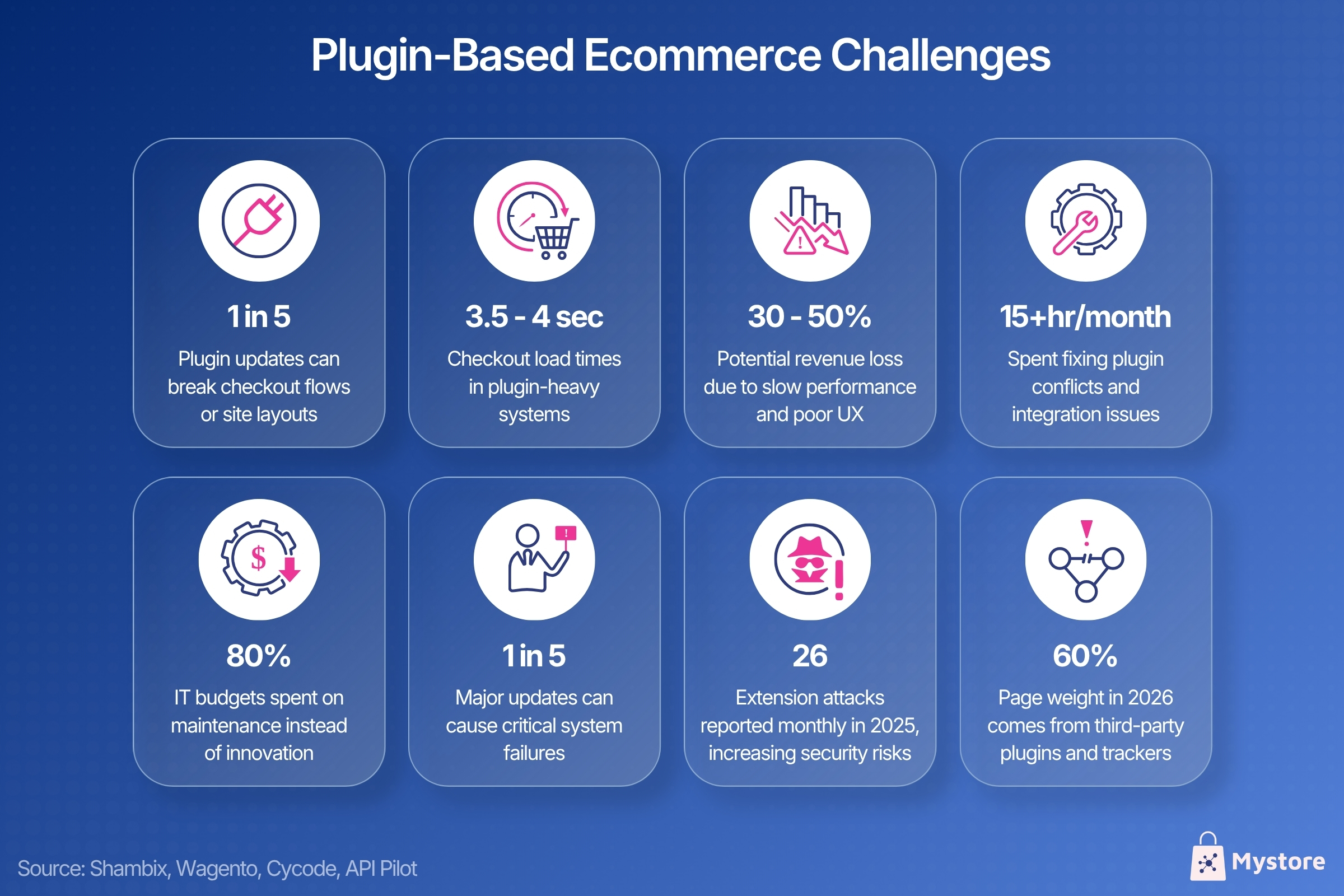
- 1 in 5 major plugin updates in open-source ecommerce systems can break checkout flows or site layouts
- 3.5-4 sec checkout load times in plugin-heavy systems vs 1-sec speeds in native solutions
- 30-50% potential revenue loss in plugin-heavy systems due to slower performance and poor user experience
- 15+ hrs/month spent by enterprise teams fixing plugin conflicts, API failures, and integration issues.
- 80% of IT budgets in plugin-based systems go into updates and maintenance, leaving only 20% for innovation
- 56% y-o-y surge in automated web attacks via third-party integrations
- 26 software supply chain attacks were reported every month in 2025, increasing security risks in plugin-based systems
- 60% of total page weight in 2026 comes from third-party trackers and legacy plugins, slowing ecommerce performance
Source: Shambix, Wagento, Cycode, API Pilot
Key takeaway: Plugin-heavy ecommerce systems increase operational complexity, slow performance, and reduce enterprise agility as brands scale across channels and business models.
Modern enterprise brands are now prioritising stability, scalability, and operational efficiency over fragmented flexibility. This is driving rapid adoption of native commerce platforms and no-plugin ecommerce solutions built to support enterprise growth at scale.
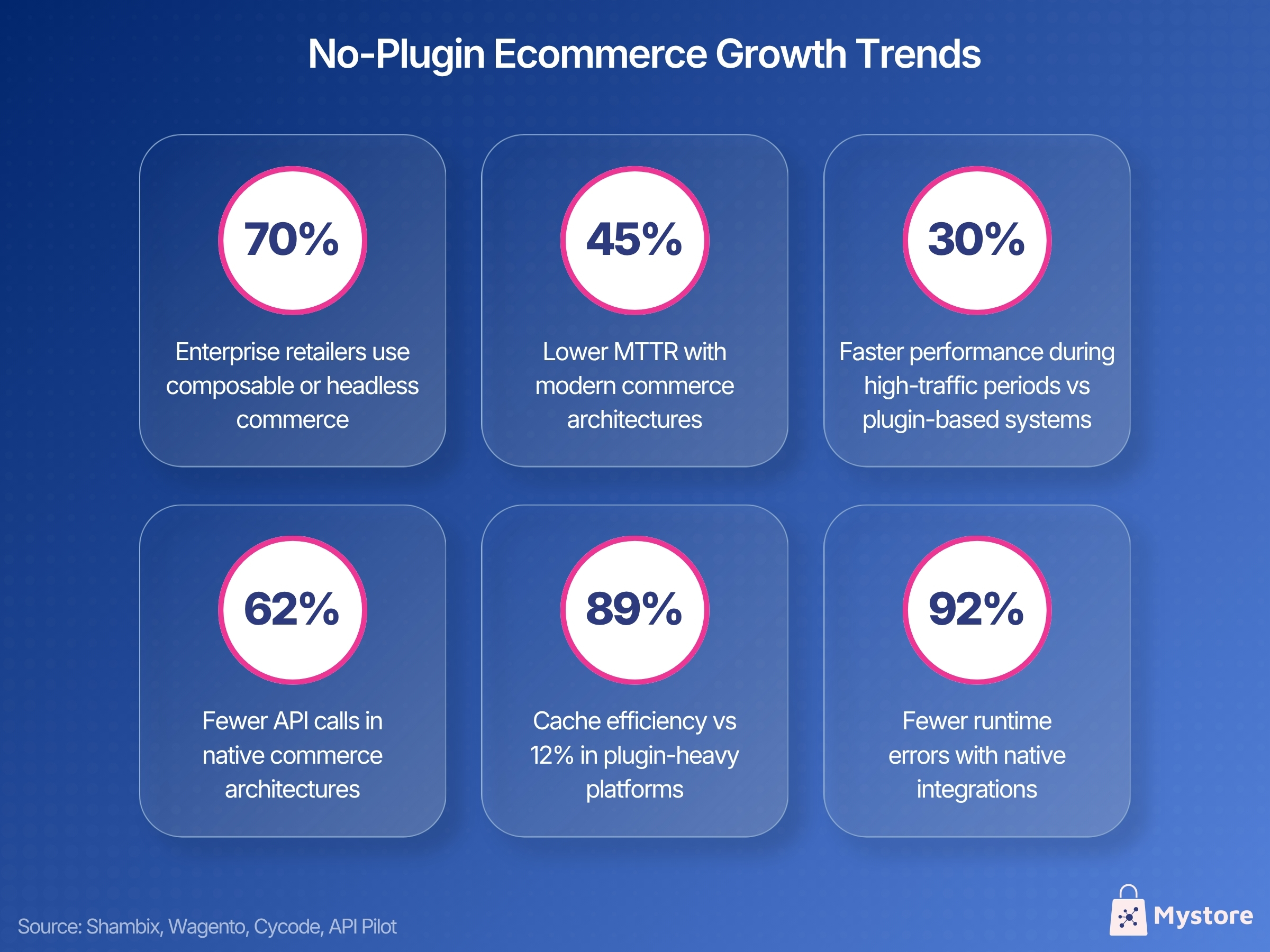
- 70% of enterprises have adopted Composable or Headless Commerce
- 45% reduction in Mean Time to Recovery (MTTR) with modern commerce architectures
- 30% improvement in speed during high-traffic periods compared to plugin-based systems.
- 62% fewer API calls in native commerce architectures compared to plugin-heavy ecommerce systems
- 89% cache efficiency in native systems vs 12% in plugin-heavy platforms, improving speed and traffic handling
- 92% fewer runtime errors with native integrations compared to plugin-based implementations
Source: MACH Alliance, Gartner, Google Cloud, Research Gate
Key takeaway: Enterprise brands adopting native and no-plugin ecommerce architectures are achieving faster performance, lower operational overhead, higher system stability, and better scalability across growing commerce ecosystems.
These trends show a clear shift in how ecommerce systems are being built and managed. Instead of relying on multiple external plugins, businesses are moving toward simpler, more connected platforms that are easier to run and maintain. No-plugin ecommerce solutions are emerging as a practical choice for enterprises looking for smoother operations and steady, long-term growth.
7 Reasons Why D2C Enterprise Brands Should Choose No-Plugin E-Commerce Solutions
As ecommerce operations become more complex, enterprise D2C brands are realising that scalable growth depends not just on adding new features, but on building a stable, unified, and future-ready commerce foundation. Here are the key reasons why brands are moving toward no-plugin ecommerce solutions:
1. Lower Total Cost of Ownership
Plugin-based enterprise ecommerce platforms may look affordable in the beginning , but costs rise quickly as enterprise brands start scaling. Every new requirement usually means adding another plugin, integrations, an API connector, or an external tool. Along with that come recurring subscription fees, maintenance expenses, developer dependency, and constant compatibility updates.
Take the example of a fast-growing fashion D2C brand built on a plugin-heavy ecommerce platform that uses separate plugins for inventory and checkout. During a festive sale, one plugin doesn’t update stock in real time. A customer places an order for a dress that is actually already sold out. The order gets cancelled later, leading to customer frustration and extra refund work for the team. With a no-plugin system, inventory and checkout are connected in one place, so stock updates instantly, and such errors don’t happen.
D2C brands should choose no-plugin ecommerce solutions to avoid any operational conflicts that might arise from fragmented systems. Enterprise ecommerce platforms with plugin-free ecommerce capabilities offer most of the enterprise-grade features in the core platform itself. Brands can manage operations, invoices, fulfilment, etc., through one unified system instead of relying on multiple third-party tools for every function. This reduces long-term operational costs, lowers technical complexity, and gives enterprise D2C brands a more stable and scalable foundation for growth.
2. Faster Go-Live and Iteration Cycles
Speed has become a defining competitive advantage in today’s fast-evolving D2C ecommerce landscape. Brands are constantly launching seasonal promotions, testing new offers, expanding into new markets, and pivoting to new business models to meet the shifting customer demand. In this environment, the ability to execute quickly often determines market success. If you are still running your D2C brand on a plugin-based enterprise ecommerce platform, it slows down the ability to scale faster, due to dependency on multiple integrations, testing cycles, and ongoing developer involvement for every change.
Imagine you are planning to launch festive season discounts, bundled offers, and gifts. On a plugin-heavy setup, you may have to depend on separate tools to handle different functions like promotions, coupon engines, banner updates, inventory sync, and customer notifications. Even a minor change, such as updating a discount rule or modifying an offer, requires testing across multiple plugins to ensure nothing breaks. This fragmented setup delays campaign rollout and reduces the ability to respond quickly to market opportunities.
This is where no-plugin ecommerce solutions create a clear advantage. With native enterprise tools built directly into the core platform, enterprise D2C brands eliminate dependency on external tools and integration layers. Teams can launch campaigns faster, modify storefront experiences in real time, test new strategies quickly, and respond to market trends without operational bottlenecks. This significantly improves agility, reduces time-to-market, and enables enterprises to continuously experiment at scale.
3. Seamless Omnichannel Commerce
Modern D2C buyers don't shop through a single channel anymore. They discover products on one channel, check details on another, and make purchases through a different channel. In such a scenario where ecommerce is not linear anymore, your D2C brand must deliver a seamless and consistent experience across all touchpoints for customer retention and repeat purchases.
However, plugin-heavy enterprise ecommerce platforms often struggle in this space. Because each channel depends on separate integrations and third-party tools, they frequently end up creating disconnected customer experiences.
Take the example of a fashion D2C brand selling through its website, mobile app, WhatsApp commerce, and offline stores. A customer adds products to the cart on the website but later completes the purchase through the mobile app. In a plugin-based setup, cart data, pricing, inventory, and customer history may not sync in real time, leading to inconsistencies, delayed updates, and a fragmented shopping experience.
This is where no-plugin ecommerce solutions create a clear advantage. An enterprise ecommerce platform built on a no-plugin architecture enables you to manage all channels through a unified backend. Your team can seamlessly control inventory, pricing, orders, promotions, and customer data across every touchpoint from a single system. This ensures consistent experiences across websites, apps, marketplaces, WhatsApp, and offline stores while also reducing operational complexity and enabling faster omnichannel growth.
4. Better Performance at Enterprise Scale
When a D2C brand grows, its customer experience and revenue heavily depend on its performance. During festive sales, flash deals, or new product launches, your platform must handle large traffic volumes without slowing down. Even a few seconds of delay in page loading or checkout can lead to drop-offs and lost sales.
However, plugin-heavy ecommerce systems often struggle when traffic spikes. Every additional plugin increases server load, API calls, and dependency on third-party tools that can affect platform speed and stability.
For example, an electronics D2C brand is running a festive sale across its website, app, and marketplaces. Thousands of customers browse products, apply discounts, check stock, and make payments at the same time. In a plugin-based setup, multiple third-party tools handling search, promotions, inventory, and checkout can slow things down and even cause failures during peak hours.
This is where no-plugin ecommerce solutions make a difference. With everything built into one system, you can ensure faster load times, stable checkout experiences, and smooth performance of your business even during high traffic. This helps you handle traffic spikes with confidence, improve conversions, reduce cart abandonment, and deliver a consistent customer experience across all channels.
5. Zero Integration Conflicts and Downtime Risks
As D2C brands scale, even small technical issues can disrupt sales and affect customer trust. Payments, inventory, shipping, and promotions all need to work together smoothly to keep operations running without interruption.
But when you have your D2C brand store built on a plugin-based ecommerce ecosystem, every new feature depends on external tools and integrations. This creates multiple technical dependencies where even a small update or mismatch between plugins can disrupt core workflows and impact the customer experience.
For example, a skincare D2C brand is running a weekend flash sale on its website. Just as traffic starts to increase, an update to the discount plugin conflicts with the checkout system. Customers applying the sale coupon suddenly start facing payment failures at checkout, and the team has to rush to fix the issue while orders and sales are already getting impacted.
With core features natively built into the enterprise ecomerce platform, you don’t have to rely on multiple integrations for every function. This significantly reduces the chances of technical conflicts and workflow disruptions. As a result, you get more stable operations, reduced risk of downtime, and a more reliable customer experience as your brand scales.
6. Stronger Security and Data Control
Customer information, payment details, inventory records, and operational workflows constantly move across multiple systems and integrations. Even a small security gap can affect customer trust and disrupt business operations.
However, plugin-heavy ecommerce systems often increase security risks because every third-party plugin adds another layer to manage. As your D2C brands grow, keeping track of updates, permissions, and security standards across multiple plugins and service providers becomes more difficult.
Take the example of a beauty D2C brand using different plugins for payments, loyalty programs, analytics, and marketing. If one outdated plugin has a security issue, it can expose sensitive customer data or disrupt business operations.
This is where no-plugin ecommerce solutions create an advantage. With native capabilities built into one centralised ecosystem, you can reduce dependency on multiple third-party tools and maintain better control over business-critical data and operations. This helps improve data control, strengthen customer trust, and build a more secure ecommerce infrastructure for long-term ecommerce growth.
7. AI That Actually Works Across the Business
AI is quickly becoming a major growth driver for modern D2C brands. From personalised recommendations and smarter search to automated operations and customer support, brands are using AI to create better shopping experiences and run businesses more efficiently.
However, when you build your online D2C store on plugin-heavy ecommerce systems, delivering consistent AI-powered experiences across channels becomes difficult. Customer data, catalogue information, inventory updates, and order history often remain scattered across multiple tools and integrations. As a result, AI tools struggle to deliver accurate recommendations, seamless automation, and personalised customer experiences across every touchpoint.
Take the example of a lifestyle D2C brand trying to personalise shopping journeys across its website, mobile app, WhatsApp commerce, and social channels. Since customer and operational data are spread across multiple plugins, recommendations become inconsistent, workflows break between channels, and the overall shopping experience feels disconnected.
This is where no-plugin ecommerce solutions make a real difference. With connected data and unified workflows, AI can work across the entire business instead of isolated systems. Brands can deliver smarter product discovery, personalised recommendations, and seamless customer journeys from one centralised commerce platform. This helps improve customer experience, streamline operations, and build scalable AI-driven commerce businesses.
Why Mystore No-Plugin Ecommerce Solutions is The Best Choice for Future-Ready D2C Brands
To solve the challenges of growing enterprise D2C operations brand need a no-plugin ecommerce solution like Mystore that helps brands simplify operations, scale faster, and deliver seamless commerce experiences from one unified platform.
- Built-in enterprise-grade ecommerce capabilities ready to use from day one, reducing dependency on multiple third-party plugins and extensions
- Built on MACH and API-first architecture to support scalable, flexible, and future-ready enterprise commerce operations
- Mobile-first commerce infrastructure designed for high-performance experiences across devices, channels, and low-bandwidth markets
- AI-powered capabilities, including AI cataloguing, AI image optimisation with Magic Edit, AI semantic search, and intelligent product recommendations to improve discovery and conversions
- Offers a built-in mobile app builder to help D2C brands quickly launch Android, iOS, and PWA storefronts without additional development layers
- Unified omnichannel commerce solution enabling enterprises to manage branded websites, mobile apps, WhatsApp commerce, chat-based selling, and AI-assisted buying journeys from one platform
- Offers Mystore Mitra, an intelligent AI assistant that guides enterprises to manage daily workflows and resolve operational queries in real time
- Unified conversational dashboard to help enterprises manage customer conversations across multiple channels, automate routine responses, route complex queries to the right teams, and streamline customer support from one centralised dashboard.
- Ready-made theme library with easy customisation options to help brands create engaging, conversion-focused storefront experiences
- Pre-integrated with essential enterprise systems including CRM, ERP, payment gateways, marketing tools, and business applications for seamless operations
- Built-in shipping and fulfilment tools, including live shipping rates, smart carrier allocation, flexible shipping rules, and WhatsApp-based fulfilment workflows
- Connected with 40+ logistics and fulfilment partners to simplify shipping, order management, and last-mile delivery across regions
- Integrated with the ONDC Network to help D2C brands increase product visibility across the Mystore Buyer App and 50+ buyer applications connected to the network
- SEO- and AEO-ready ecommerce platform with on-page SEO controls, schema markup, and discoverability features designed to improve visibility across search and AI-powered discovery platforms
- Centralised commerce management system that helps enterprises manage inventory, orders, pricing, fulfilment, and customer journeys from a unified backend
- PCI DSS-compliant platform with enterprise-grade security standards and certifications to ensure secure transactions and better data protection
- Enterprise-ready scalability that enables brands to expand across regions, business models, and high-traffic sales events without operational bottlenecks
- AI-native commerce architecture that connects catalogue, discovery, operations, and customer journeys through a unified intelligence layer for faster and more efficient business growth
Conclusion
The D2C commerce landscape is evolving rapidly, and the brands leading this shift are the ones building on scalable, future-ready, plugin-free architecture from the start. As customer expectations, sales channels, and business operations become more complex, managing multiple plugins and disconnected systems only slows down growth.
This is where Mystore creates a competitive advantage. Built on a headless, API-first architecture, Mystore offers built-in ecommerce capabilities and pre-integrated solutions to help D2C brands manage and scale their business from one unified platform. From mobile-first omnichannel selling to payments, logistics, marketing, and AI tools, everything works together seamlessly to support faster and more efficient growth.
Want to build a scalable, no-plugin D2C commerce business? Book your demo with Mystore enterprise solutions today.
FAQs
1. What should enterprises look for when choosing a no-plugin enterprise ecommerce platform?
Enterprises should look for a no-plugin enterprise ecommerce platform with built-in commerce capabilities, scalable architecture, strong security, omnichannel support, AI-powered features, flexible APIs, reliable integrations, and mobile commerce capabilities. It should also support multiple business models, regions, and sales channels without requiring a growing stack of third-party plugins, while offering centralised management and the flexibility to adapt as the business evolves.
2. Can no-plugin ecommerce solutions support custom enterprise requirements without limiting the flexibility that growing brands need?
Yes. A well-designed no-plugin ecommerce solution can support custom enterprise requirements without sacrificing flexibility if it offers built-in capabilities, robust APIs, headless architecture and native integrations. This allows enterprises to customise workflows, customer experiences and business processes within the platform, without relying on a growing stack of third-party plugins.
3. How can AI capabilities help a D2C brand grow without adding more ecommerce plugins?
AI capabilities built into the ecommerce platform can help D2C brands automate cataloguing, improve product discovery, personalise recommendations, optimise images, and assist customers during buying journeys. When AI works with unified commerce data, brands can deliver more relevant experiences while reducing dependence on separate AI plugins and disconnected third-party tools.
4. How can unified omnichannel commerce help D2C brands deliver a consistent customer experience?
Unified omnichannel commerce connects websites, mobile apps, marketplaces, WhatsApp commerce, and other touchpoints through a centralised platform. This allows enterprises to manage inventory, pricing, orders, promotions, and customer journeys consistently across channels. Customers can move between touchpoints without losing context, while teams get better visibility and control over the entire D2C operation.
5. How can a D2C brand ensure a seamless mobile commerce experience with a no-plugin ecommerce solution?
A D2C brand can ensure a seamless mobile commerce experience by choosing a no-plugin ecommerce solution with built-in mobile capabilities, responsive storefronts, PWAs, mobile apps, fast page loads, and smooth checkout. This ensures customers get a consistent, convenient shopping experience across mobile touchpoints without relying on multiple plugins or additional development layers.
6. What marketing tools should a D2C brand look for in an enterprise ecommerce platform?
A D2C brand should look for marketing tools such as a built-in discount tools, coupon management, personalised recommendations, promotional banners, abandoned cart recovery, SEO-readiness, analytics, and marketing automation. These tools help marketing teams run campaigns, personalise customer journeys, and optimise conversions without depending on multiple third-party applications.
7. How can enterprises evaluate whether the no-plugin ecommerce solution can grow with the business?
Enterprises can evaluate whether a no-plugin ecommerce solution can grow with the business by assessing its ability to handle higher traffic, larger product catalogues, new markets, multiple sales channels, and evolving business models. They should also evaluate its scalability, API flexibility, security, customisation, mobile capabilities, AI features, and ability to support growth without adding unnecessary third-party dependencies
8. How can D2C brands identify when their ecommerce platform is limiting business growth?
D2C brands can tell their enterprise ecommerce platform is limiting growth by looking for recurring performance issues, slow feature launches, frequent integration failures, rising maintenance costs, and limited support for new sales channels. If scaling traffic, expanding markets, launching mobile experiences, or introducing AI requires multiple plugins and extensive development work, the platform may be holding growth back.
9. How do no-plugin ecommerce solutions reduce the total cost of ecommerce operations?
No-plugin ecommerce solutions reduce the total cost of ecommerce operations by bringing essential capabilities into one platform, reducing the need for multiple plugins, third-party subscriptions, custom integrations, and ongoing maintenance. Enterprises also spend less time resolving compatibility issues and managing disconnected systems, allowing technology teams to focus more resources on innovation, customer experience, and business growth.
10. What makes Mystore a strong choice for enterprises looking for no-plugin ecommerce solutions?
Mystore is a strong choice for enterprises looking for no-plugin ecommerce solutions because it offers built-in ecommerce capabilities, scalable architecture, AI-powered features, mobile commerce, unified omnichannel selling, integrated logistics, and centralised management in one platform. This helps D2C brands reduce third-party dependencies, simplify operations, launch faster, and scale efficiently across channels and markets.