


 Contact Us
 Appliances
 Agri Inputs
 Auto Components & Accessories
 Beauty & Personal Care
 Electronics
 Fashion
 Grocery
 Gift Cards
 Home & kitchen
 Health & Wellness
 Vehicles & Automotives
 Books & Stationary
 Pet Care
 Toys & Games
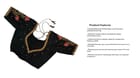
The blouse that carries as much work as the saree In most festive and bridal saree combinations, the saree receives all the attention and the blouse is treated as secondary — matched in colour, perhaps bordered, rarely considered on its own terms....
Read MorePopular Categories
Support
Language
Our apps
Aariwork Blouse
Key Attributes
| Country of origin | India |
|---|---|
| gender | female |
| brand | Shiv Creation |
| colour | #000000 |
| size | M |
The blouse that carries as much work as the saree
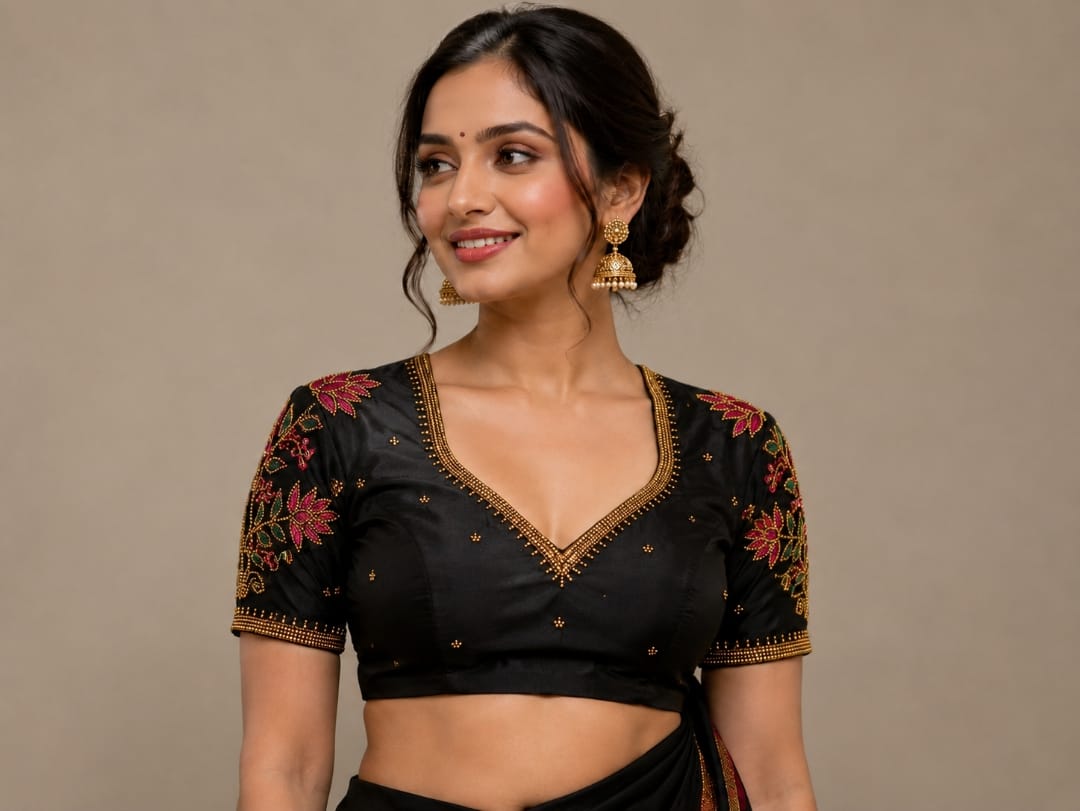
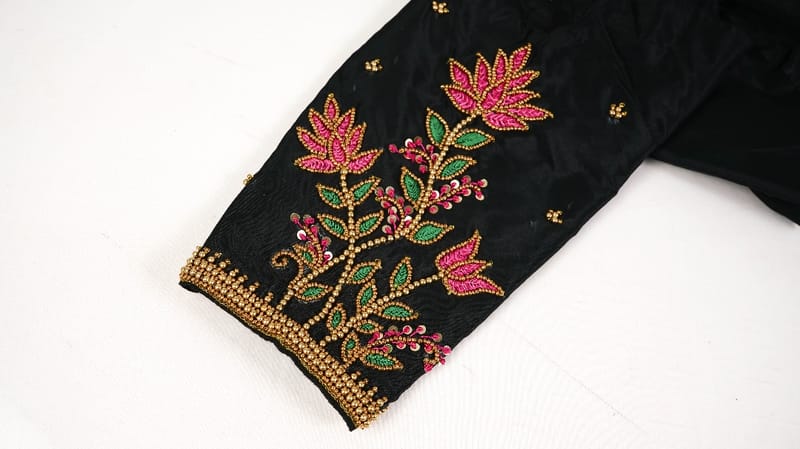
In most festive and bridal saree combinations, the saree receives all the attention and the blouse is treated as secondary — matched in colour, perhaps bordered, rarely considered on its own terms. An aari embroidery blouse changes that balance entirely. When both sleeves are densely worked with floral motifs and every edge is bordered in gold zari, the blouse becomes as much a part of the outfit as the drape itself. Shiv Creation's Aariwork Blouse is made in that understanding — deep black silk, hand-embroidered using the traditional aari needle, finished to hold its own alongside any heavily worked saree in a woman's festive wardrobe.
What aari embroidery is
Aari work is a hand embroidery technique that uses a long hooked needle — the aari — to pull thread through fabric from below, creating a continuous chain stitch that builds into dense, raised motifs on the surface. The technique produces embroidery that is textured and three-dimensional in a way that machine embroidery cannot replicate — each element has a slight lift from the fabric, catches light differently depending on the angle, and reads as handmade from across a room.
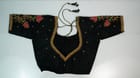
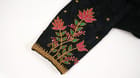
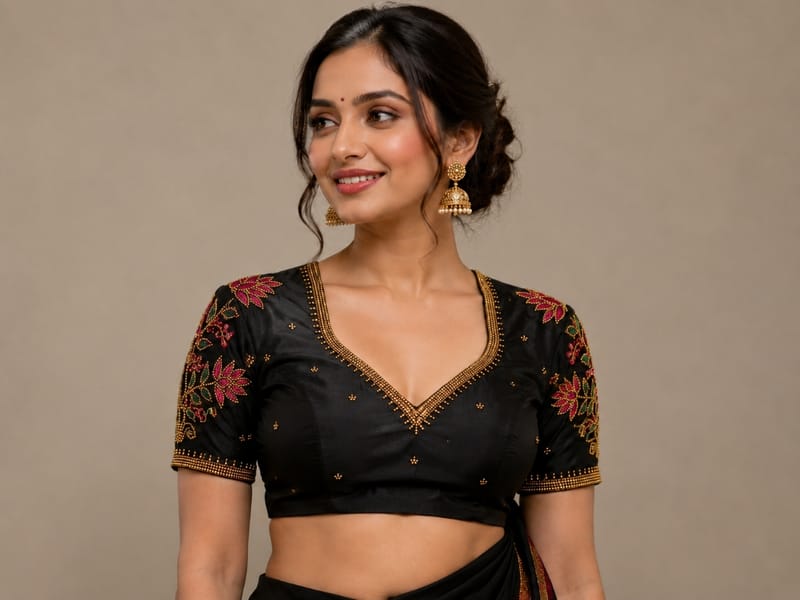
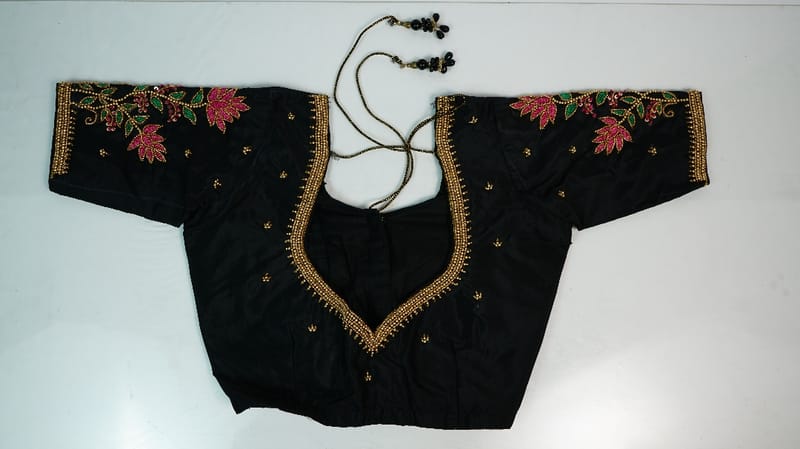
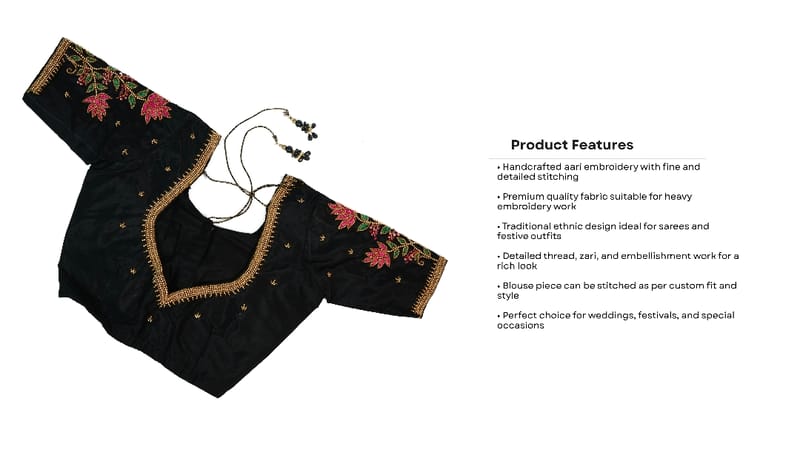
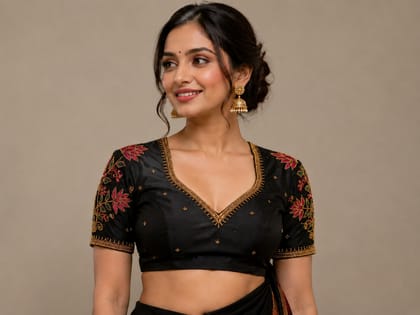
The motifs on this blouse are large floral forms — lotus and tulip-inspired flowers with trailing leaf sprays — worked in hot pink and forest green thread with gold zari highlights. These cover both full sleeves from cuff to shoulder, creating an unbroken embroidered panel on each arm. The body of the blouse carries scattered gold butti — small individual motifs placed at measured intervals — that add richness without crowding the silk. All edges, including the neckline and hem, are finished with a gold zari border that gives the blouse a clean, defined silhouette.
The silk base
The blouse is made from black silk — a fabric chosen deliberately for aari work rather than as an incidental choice. Silk has the weight and tight weave needed to support heavy hand embroidery without puckering or pulling at the stitch points. It also holds the thread colour more vividly than synthetic alternatives, meaning the hot pink and green motifs appear saturated and clear rather than dull against the base.
Black silk specifically amplifies the contrast between the base and the embroidery. The coloured thread work reads with full clarity, the gold zari reflects light against the deep matte of the silk, and the scattered butti on the body catch light with each movement. It is a combination that works particularly well in indoor festive lighting — at weddings, during puja ceremonies, and at evening receptions where the blouse is seen up close.
When and how to wear it
This blouse is occasion wear without qualification — designed for weddings, receptions, Diwali, and any festive event where a fully embroidered blouse is appropriate and expected. It pairs most naturally with solid or lightly patterned sarees in silk, georgette, or chiffon, where the blouse provides the embellishment and the saree provides the sweep of colour. With a Paithani, Kanjivaram, or Banarasi silk saree, it creates a considered, layered look where both garments contribute equally to the overall appearance.
The black base gives it flexibility across multiple occasions and multiple sarees — it is not tied to a single colour combination, which makes it a genuinely useful piece in a festive wardrobe rather than a single-use garment bought for one event.
Why the difference from machine embroidery is worth understanding
Machine-embroidered blouses are widely available at lower price points. The difference is not simply one of effort — it is one of result. Machine embroidery lies flat on the fabric surface, uniform in stitch length and depth, with no variation across the design. Aari chain stitch is raised, slightly irregular in the way handwork always is, and builds texture across the motif that changes how the embroidery reads in different light. On a silk base, this difference is more visible than on cotton or synthetic fabric, because silk reflects light in a way that makes surface texture apparent. The density of the work on this blouse — covering both full sleeves and all borders — represents significant hours of skilled hand embroidery, and the result wears accordingly.
Specifications
Fabric: Black silk
Embroidery technique: Hand-done aari chain stitch
Thread colours: Hot pink, forest green, gold zari
Colours Available: Pink, Navy Blue, Golden, Black, Orange, Green
Sizes: M, L, XL
Motifs: Floral with leaf sprays on sleeves; scattered gold butti on body
Border: Gold zari on neckline and all edges
Net Weight: 450 g
Fit: Stitched; customisation in fit and neckline available on order
Occasions: Weddings, receptions, festivals, festive gatherings
Care
Dry clean only — do not machine wash or hand wash, as water will loosen the aari thread work, affect the zari border, and alter the drape of the silk. Store folded in soft muslin or a cloth bag, away from direct light and moisture. Avoid hanging for extended periods, as the weight of the embroidery can stretch the silk at the shoulders over time. If ironing is needed, press on the reverse side only, on the lowest silk setting, with a pressing cloth placed between the iron and the fabric.
About the Entrepreneur
Geeta Talekar has been in the business of doing attractive aari work on blouses for the past 2 years.
Through Mann Deshi's business network and support, Geeta's designer blouse products got a large market and her work began to reach more people.
Geeta manages this entire business herself with great skill. Purchasing aari work blouses from her not only promotes this traditional handicraft but also helps a woman entrepreneur create an independent identity beyond being a housewife.
| Country of origin | India |
|---|---|
| gender | female |
| brand | Shiv Creation |
| colour | #000000 |
| size | M |
| fabric | Fabric, embroidery thread |
| colour name | #000000 |
| cancellable | yes |
| time to ship | 2 days |
| seller pickup return | yes |
| return window | 2 days |
| contact details consumer care | Vanita Shinde,[email protected],9607589078 |
| manufacturer or packer name | Shiv Creation |
| manufacturer or packer address | Manndeshi Foundation, Dhayri Jay Complex, Sr no10/1,2/2/2,Nr Kailsh Jeevan Factory, Benkar vasti rd,Dhayri 411041,Block-Dhayri District-pune,Maharashtra |
| common or generic name of commodity | Aariwork Blouse |
| month year of manufacture packing import | 2026-01-01 23:26 |
| imported product country of origin | IN |
Other Products from seller Mann Deshi Udyojika Private Limited

Check Estimated Delivery Date

Sold By: Mann Deshi Udyojika Private Limited
Vendor Source:Mann Deshi Udyojika Private Limited