


 Contact Us
 Appliances
 Agri Inputs
 Auto Components & Accessories
 Beauty & Personal Care
 Electronics
 Fashion
 Grocery
 Gift Cards
 Home & kitchen
 Health & Wellness
 Vehicles & Automotives
 Books & Stationary
 Pet Care
 Toys & Games
Shopify Multi Store India: How to Set Up and Manage Multiple Stores With One Admin
Multi store
Key Takeaways
- Shopify multi store setup in India helps businesses create dedicated storefronts for brands, regions, B2B, D2C, and customer segments.
- Managing separate Shopify stores can increase subscription costs, integration dependencies, inventory syncing issues, and administrative work.
- A multi store with single admin simplifies catalogue, inventory, orders, shipping, and fulfilment management across storefronts.
- Mystore Multistore® solutions combine centralised operations, AI-powered commerce, omnichannel selling, and integrated services for Indian businesses.
Managing one Shopify store is easy enough. But a Shopify multi store setup in India can become difficult to manage when every new storefront brings its own product updates, inventory checks, orders, shipping workflows, apps, and reports.
As your business grows, you may need separate stores for B2B and D2C customers, different brands, regional markets, or specific customer groups. While launching multiple stores gives you the flexibility to serve these markets, managing each store separately can mean more manual work, disconnected operations, and higher overheads.
So, how do you manage multiple Shopify stores in India without juggling different backends? Can you run a multi store with single admin and keep your operations connected as you grow?
In this blog, we explore how Shopify multiple stores in India work, the challenges of managing them, and how Mystore Multistore® solutions can help you run multiple storefronts from one connected backend.
Table of Contents
- What Is a Shopify Multi Store Setup in India?
- Why Is Multi Store Ecommerce Important for Growing Indian Businesses?
- Can You Manage Multiple Shopify Stores in India With One Admin?
- What Are the Challenges of Managing Multiple Shopify Stores in India?
- Is Having One Login Enough for Multi Store Ecommerce?
- What Should Indian Businesses Look for in a Shopify Multi Store Solution With Single Admin?
- How Do Mystore Multistore® Solutions Help Manage Multiple Stores With One Admin?
- Which Indian Businesses Can Benefit from Mystore Multistore® Solutions?
- Shopify Multi Store India vs Mystore Multistore®: Which Is Better?
- How to Set Up and Manage Multiple Stores With Mystore Multistore® in India
- 1. Choose a Mystore Multistore® Plan Based on Your Business Needs
- 2. Connect Your Domain and Configure Payment Options
- 3. Create and Customise Stores for Different Business Models
- 4. Manage Products, Inventory, and Orders From One Admin
- 5. Enable AI for Store Management and Customer Experiences
- 6. Sell Across Multiple Channels From One Admin
- 7. Connect Shipping, Payments, and Other Commerce Services
- 8. Add New Stores as Your Business Expands
- Looking for a Better Way to Manage Your Shopify Multi Store Setup in India?
- FAQs
What Is a Shopify Multi Store Setup in India?
A Shopify multi store setup in India usually means a seller runs two or more separate Shopify storefronts for different business requirements. These could be separate stores for B2B and D2C customers, different brands, geotargeted markets, product categories, or customer groups.
Each Shopify store typically has its own backend, including products, inventory, orders, apps, themes, settings, and reports. This gives sellers flexibility to create distinct buying experiences, but it can also increase the work required to keep multiple stores updated and aligned.
As the number of storefronts grows, sellers often start looking for ways to manage multiple Shopify stores in India more efficiently, especially when products, inventory, fulfilment, and other operations need to remain connected across stores.
Why Is Multi Store Ecommerce Important for Growing Indian Businesses?
A single storefront may serve a brand's initial needs, but as Indian businesses expand across regions, brands, customer segments, and B2B and D2C models, can the same storefront effectively support different pricing structures, product catalogues, and buying experiences?
This is where multi store ecommerce makes a difference. Instead of trying to accommodate every customer and business requirement in one store, brands can create dedicated storefronts with relevant products, pricing, promotions, and shopping experiences.
Here are six reasons why growing businesses go for Shopify multi store setup in India:
- Separate B2B and D2C stores: Offer wholesale pricing, bulk ordering, and personalised retail experiences through dedicated storefronts.
- Manage multiple brands: Build distinct brand identities with separate catalogues, promotions, and customer experiences.
- Expand into regional markets: Create location-specific storefronts with relevant products, languages, and delivery options.
- Reach international customers: Offer market-specific currencies, payment options, product collections, and shopping experiences.
- Serve different customer segments: Create dedicated stores for specific customer groups with tailored pricing and product offerings.
- Launch new business models: Test new product categories, brands, and markets without disrupting existing stores.
However, opening multiple stores is only half the job. As storefronts increase, so does the effort required to manage inventory, orders, customers, shipping, and reporting.
That's why businesses exploring Shopify multi store India options also need to consider how easily they can manage their growing operations. A multi store with single admin approach can help reduce repetitive work and keep business operations connected across storefronts.
Can You Manage Multiple Shopify Stores in India With One Admin?
Yes, Shopify offers several workarounds to manage multiple storefronts, but each comes with its own limitations.
Businesses can use solutions like Shopify Store Switcher, Shopify Markets, Shopify Plus Expansion Stores, or third-party apps to create and manage different types of multi-store setups, depending on their business needs. While these options support different multi store ecommerce requirements, businesses may still need additional tools or integrations to keep products, inventory, orders, fulfilment, and reporting aligned across storefronts.
Businesses face challenges with centralised management, data synchronisation, additional costs, and growing operational overhead.
What Are the Challenges of Managing Multiple Shopify Stores in India?
As businesses expand across brands, regions, and customer segments, managing separate Shopify stores can bring new operational challenges. While a Shopify multi store setup in India offers flexibility, keeping multiple storefronts connected may require additional tools, investment, and administrative effort.

Here are the key challenges businesses should consider:
- Separate store management: Managing products, orders, customer data, and settings across different Shopify admin dashboards.
- Product and catalogue updates: Updating product information, categories, and collections across stores without duplicating work.
- Inventory synchronisation: Keeping stock levels accurate across multiple storefronts, warehouses, and fulfilment locations.
- Order and fulfilment management: Processing orders, coordinating shipping, and managing returns across separate store backends.
- B2B and D2C customisation: Managing different catalogues, pricing, discounts, and buying workflows for different customer segments.
- Storefront design limitations: Managing separate themes and customisations, with additional development effort when changes need to be replicated across stores.
- App and integration dependencies: Connecting and maintaining additional tools to synchronise data and automate operations.
- Higher operational costs: Managing store subscriptions, third-party app charges, integrations, and ongoing maintenance.
- Fragmented reporting: Consolidating sales, customer, inventory, and performance data to get a unified business view.
For enterprises looking to manage multiple Shopify stores in India, these challenges can grow with every new storefront. This makes it important to evaluate whether a multi store with single admin setup can simplify operations while supporting different business models and expansion needs.
Is Having One Login Enough for Multi Store Ecommerce?
Consider an Indian enterprise running separate online stores for its D2C brand, wholesale buyers, and regional customers. Switching between these stores may be straightforward, but keeping stock levels accurate, updating catalogues, managing orders, and tracking performance across them can still require considerable coordination.
As more stores are added, businesses may need additional apps, separate subscriptions, or custom integrations to keep operations connected. The actual cost and effort depend on the number of stores, Shopify plans, and business requirements.
This is why businesses exploring a Shopify multi store solution India should look beyond storefront creation and ask a more practical question: How much effort and investment will it take to manage every new store?
For businesses planning long-term expansion, choosing the right multi store ecommerce setup means balancing storefront flexibility with centralised operations, integration requirements, and ongoing costs.
What Should Indian Businesses Look for in a Shopify Multi Store Solution With Single Admin?
The challenges of managing multiple Shopify stores make one thing clear: adding more storefronts should not mean adding more operational work.
A good set up of Shopify multi store solution in India should help businesses manage products, inventory, orders, and fulfilment centrally while allowing each storefront to serve its own customers, pricing needs, and business requirements.
For enterprises looking for a multi store with single admin, here are the key capabilities to evaluate.

For businesses planning to manage multiple Shopify stores in India, these capabilities can make the difference between operating several independent stores and building a connected multi store ecommerce ecosystem.
The goal is to build a more connected Shopify multi store solution India setup that reduces duplicated work and gives teams better control as the number of storefronts grows.
How Do Mystore Multistore® Solutions Help Manage Multiple Stores With One Admin?
The multi store set up often ends up into managing multiple storefronts and disconnected operations for brands. For Indian businesses looking for a multi store with single admin, Mystore Multistore® solutions offer a centralised, more connected approach to launching, customising, and managing multiple stores.
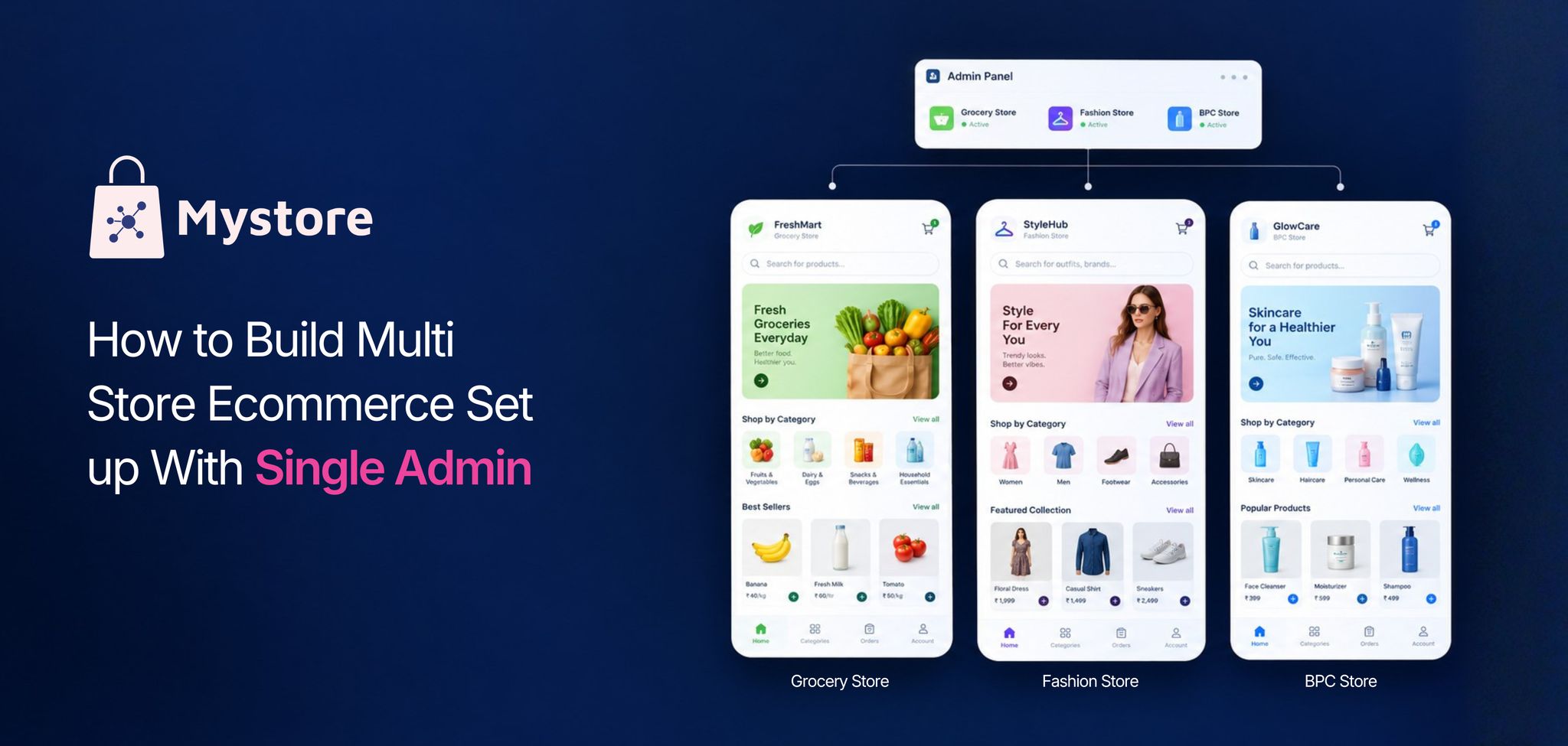
Built into Mystore's AI-powered ecommerce platform, Mystore Multistore® feature enables businesses to run dedicated storefronts for different brands, regions, customer segments, and B2B or D2C models. The teams can manage their end-to-end operations through a unified backend.
Instead of depending on separate plugins to connect every store, businesses can manage their commerce operations with pre-integrated and built-in AI, logistics, payments, marketing, and support capabilities.

Here's how Mystore simplifies multi store ecommerce for growing Indian businesses:
- Manage multiple stores from one admin: Run storefronts, manage daily operations, and monitor performance without switching between separate store backends.
- Customise each storefront independently: Set up unique themes, domains, languages, product catalogues, pricing, offers, payment options, and shipping configurations for different business needs.
- Use an AI-powered commerce core: Leverage integrated AI for store creation, catalogue building, image enhancement, multilingual content, product discovery, recommendations, shopping assistance, customer support, marketing, and logistics workflows.
- Control catalogues centrally: Maintain a master product catalogue while selecting products, collections, pricing, and visibility for individual storefronts.
- Keep inventory and orders connected: Manage stock across stores and locations, process orders centrally, and coordinate fulfilment without duplicating operational workflows.
- Sell across multiple commerce channels: Connect web storefronts, PWAs, Android/iOS apps, WhatsApp commerce, AI-powered shopping conversations, and voice-based experiences within one commerce ecosystem.
- Support Indian business requirements: Built-in multilingual support to enable buying in Indic languages, GST-related support, invoicing, e-way bills, and UPI and other local payment options.
- Simplify shipping with ShipKaro®: Access 30+ logistics providers, compare shipping rates, automate carrier selection, manage tracking, or connect existing logistics partners.
- Use unique domains and payments: Give individual storefronts their own branded domains and configure payment gateways according to business requirements.
- Expand without rebuilding operations: Add new stores for brands, regions, and buyer groups while continuing to use the connected commerce backend.
For Indian brands evaluating a Shopify multi store solution India, the advantage of Mystore Multistore® solutions goes beyond creating additional storefronts. It is the ability to combine store-level flexibility with centralised control, built-in AI, and connected commerce operations as the business expands.
Which Indian Businesses Can Benefit from Mystore Multistore® Solutions?
Mystore Multistore® solutions are suitable for Indian businesses that need multiple storefronts for different brands, regions, business models, or customer segments while managing their operations from one admin.
Whether you're running separate B2B and D2C stores, expanding a dealer network, or launching new regional storefronts, Mystore Multistore® helps you tailor each store to its audience without building separate commerce backends.
Here are some common multi store ecommerce use cases:
- B2B and D2C businesses: Run dedicated wholesale and retail storefronts with different catalogues, pricing, and buying workflows.
- Regional and geotargeted businesses: Create location-specific stores with relevant products, offers, languages, and fulfilment options.
- Multi-brand enterprises: Give each brand its own storefront, identity, and promotions while managing shared operations centrally.
- Dealer and distributor networks: Launch dedicated stores for dealers, distributors, or business partners with territory-specific products and commercial arrangements.
- Multi-category businesses: Build separate storefronts for different product categories while managing catalogues, inventory, and orders centrally.
- Businesses entering new Indian markets: Launch additional regional storefronts using existing payment, shipping, AI, and commerce capabilities.
- Enterprises serving diverse customer segments: Offer customised storefronts for different buyer groups while retaining centralised operational control.
For brands evaluating a Shopify multi store setup in India, the value of Mystore Multistore® lies in supporting different growth strategies without creating disconnected operations for every new storefront.
Shopify Multi Store India vs Mystore Multistore®: Which Is Better?
Choosing between a Shopify multi store India setup and Mystore Multistore® depends on how your business plans to manage multiple storefronts. Shopify offers different multi-store options through its native features, enterprise plans, and third-party integrations.
Mystore Multistore® solutions take a more integrated approach, bringing multiple storefronts, centralised operations, AI-powered capabilities, and commerce services into one connected ecosystem.
Here's how the two approaches compare.

Which Multi Store Ecommerce Setup Is Better for Indian Businesses?
The right choice depends on how closely your storefronts need to work together.
Shopify offers flexibility through its native features, separate stores, and app ecosystem. However, businesses that want to manage multiple Shopify stores in India may need additional tools to connect operations across independently managed stores.
For Indian brands looking for a Shopify multi store solution India alternative, Mystore Multistore® offers a more integrated approach. Businesses can build distinct storefronts for different brands, regions, and customer segments while using centralised management, AI-powered capabilities, and connected commerce services.
Ultimately, the right multi store ecommerce solution isn't just about how many stores you can launch. It's about how easily you can manage them together as your business grows.
How to Set Up and Manage Multiple Stores With Mystore Multistore® in India
Whether you're planning a Shopify multi store setup in India or looking for a simpler way to manage existing storefronts, Mystore Multistore® solutions offer a connected approach to multi-store management.
From creating dedicated storefronts to managing products, orders, inventory, AI, and shipping, businesses can bring their commerce operations together without building separate systems for every store.
Here's how to get started with Mystore Multistore®.
1. Choose a Mystore Multistore® Plan Based on Your Business Needs
Start by identifying how many storefronts your business needs and whether you plan to expand across brands, regions, or customer segments.
Mystore offers plans for different store requirements, allowing businesses to start with one store and upgrade as their operations grow.
2. Connect Your Domain and Configure Payment Options
Set up your branded domain and configure the payment options your business needs.
Mystore allows businesses to connect their own domains and use their own payment gateways on those domains, helping maintain brand identity and control over payment workflows.
3. Create and Customise Stores for Different Business Models
Build dedicated storefronts for B2B, D2C, regional markets, multiple brands, dealers, distributors, or specific customer groups.
Customise individual stores with relevant products, catalogues, pricing, promotions, languages, and shopping experiences while keeping core operations connected.
4. Manage Products, Inventory, and Orders From One Admin
A multi store with single admin setup should make everyday operations easier, not just storefront creation.
With Mystore Multistore®, businesses can manage master catalogues, control store-specific product visibility, monitor inventory, process orders, and coordinate fulfilment through a connected commerce backend.
This helps reduce duplicate updates and the need to manage each storefront independently.
5. Enable AI for Store Management and Customer Experiences
Use Mystore's AI-powered ecommerce capabilities to support operations and shopping journeys across storefronts.
- Store creation: Build and customise storefronts with AI assistance.
- Catalogue management: Create and enrich product listings faster.
- Image editing: Improve product images for different storefronts.
- Product discovery: Help shoppers find relevant products through AI search.
- Recommendations: Suggest products based on customer needs and shopping context.
- Marketing: Assist with campaigns, content, and growth activities.
- Shopping and support: Help customers discover products and get assistance through Genie.
- Seller operations: Use Mitra to support seller-side tasks and workflows.
- Logistics: Assist with shipping and fulfilment activities.
6. Sell Across Multiple Channels From One Admin
Expand beyond web storefronts and reach customers across Android and iOS apps, PWAs, WhatsApp commerce, AI shopping agents, and multilingual voice commerce.
With Mystore Multistore®, businesses can offer connected shopping experiences across channels while managing products, inventory, orders, and other commerce operations through one unified backend.
This helps Indian brands grow their multi store ecommerce presence without creating separate systems for every sales channel.
7. Connect Shipping, Payments, and Other Commerce Services
Add the commerce capabilities needed for each storefront without rebuilding the entire operating setup.
Mystore's connected ecosystem brings together ShipKaro® logistics, payment integrations, marketing, customer support, WhatsApp commerce, and other services.
Businesses can use shared capabilities across stores while configuring supported services according to individual storefront requirements.
8. Add New Stores as Your Business Expands
Once your initial storefronts are operational, expand into additional Indian regions, brands, product categories, or customer segments using the same commerce foundation.
Instead of rebuilding your catalogue, integrations, and operational workflows for every new store, reuse existing capabilities and customise what each storefront needs.
For businesses evaluating a Shopify multi store solution India, this is the larger advantage of Mystore Multistore® solutions: the flexibility to launch dedicated storefronts while keeping commerce operations, services, and AI-powered workflows connected.
Looking for a Better Way to Manage Your Shopify Multi Store Setup in India?
Running multiple storefronts should help your business grow, not add more work, costs, and disconnected operations. If managing inventory, orders, shipping, and integrations across separate Shopify stores is becoming difficult, it may be time to explore a more connected approach.
With Mystore Multistore® solutions, Indian businesses can bring multiple storefronts, centralised operations, omnichannel selling, and AI-powered commerce capabilities into one integrated ecosystem.
Already using Shopify? You can plan a phased migration based on your existing setup and business requirements, with dedicated Shopify migration channel for transitioning storefronts, product catalogues, and essential commerce workflows.
If you're exploring a Shopify multi store solution India alternative, Mystore Multistore® solutions give your brand the flexibility to run multiple storefronts with the ease of centralised management, connected operations, and room to grow.
Explore Mystore Multistore® Solutions. Talk to our experts today.
FAQs
1. Can I manage multiple Shopify stores in India from a single admin?
Yes, but it depends on your Shopify setup. Shopify Markets supports market-specific experiences within one admin, while separate Shopify stores generally require individual store-level management. Shopify Plus offers additional organisation-level controls. For businesses that need a multi store with single admin for connected products, inventory, orders, and fulfilment, Mystore Multistore® solutions offer an integrated alternative.
2. Do I need separate Shopify subscriptions for multiple stores in India?
Not always. Shopify Markets allows businesses to serve different markets within one store and subscription, although some capabilities depend on the plan. However, independently operating Shopify stores generally require separate subscriptions, with different arrangements available through Shopify Plus. When evaluating a Shopify multi store setup in India, consider store subscription costs, app charges, integrations, and ongoing maintenance before choosing an approach.
3. How can I sync inventory and orders across multiple Shopify stores?
Businesses can use inventory synchronisation apps, ERP integrations, or centralised order management systems to connect independently operating Shopify stores. The right solution should update stock across storefronts, consolidate orders, and support fulfilment across locations. For brands looking to manage multiple Shopify stores in India, Mystore Multistore® offers a connected commerce setup with centralised inventory, order management, and shipping capabilities.
4. Is there a Shopify multi store solution India alternative with a single admin?
Yes. Businesses looking for a Shopify multi store solution India alternative can consider platforms that offer centralised store management, connected inventory, unified orders, and integrated commerce services. Mystore Multistore® solutions allow Indian businesses to run dedicated storefronts for different brands, regions, and buyer groups through one connected backend, with built-in AI, logistics, marketing, and support capabilities.
5. Can I manage B2B, D2C, and regional ecommerce stores from one backend?
Yes. A multi store ecommerce platform with centralised management can support B2B, D2C, regional, and dealer storefronts through one backend. Each store can have its own products, pricing, offers, languages, and buying experience while sharing core operations. Mystore Multistore® helps Indian businesses manage these different storefront requirements without creating completely separate commerce systems for every business model.
6. Can I use AI and omnichannel selling across multiple ecommerce stores?
Yes. An integrated multi store ecommerce platform can support AI-powered shopping and selling across websites, mobile apps, PWAs, WhatsApp, and conversational commerce channels. With Mystore Multistore®, businesses can connect these channels to shared products, inventory, orders, and commerce services. Mitra supports seller-side AI workflows, while Genie enables customer-facing product discovery, shopping assistance, and support.