


 Contact Us
 Appliances
 Agri Inputs
 Auto Components & Accessories
 Beauty & Personal Care
 Electronics
 Fashion
 Grocery
 Gift Cards
 Home & kitchen
 Health & Wellness
 Vehicles & Automotives
 Books & Stationary
 Pet Care
 Toys & Games

In most Maharashtrian and Hindu homes, a toran above the front door is not decoration for its own sake. It marks a threshold — between the outside world and the home, between the ordinary and the auspicious. Before guests arrive for a wedding, bef...
Read MorePopular Categories
Support
Language
Our apps
In most Maharashtrian and Hindu homes, a toran above the front door is not decoration for its own sake. It marks a threshold — between the outside world and the home, between the ordinary and the auspicious. Before guests arrive for a wedding, before a festival morning begins, before Griha Pravesh, the toran goes up first. It says something about what the family values and what they are welcoming in.
The Khanache Toran by S.S. Arts is made for exactly that purpose. Rooted in this tradition and handcrafted from khan fabric, it carries the weight of that meaning without feeling heavy or ceremonial. It is bold, colourful, and detailed enough to hold its own above a door — and practical enough to be taken down, stored, and reused season after season.
Fabric and Construction
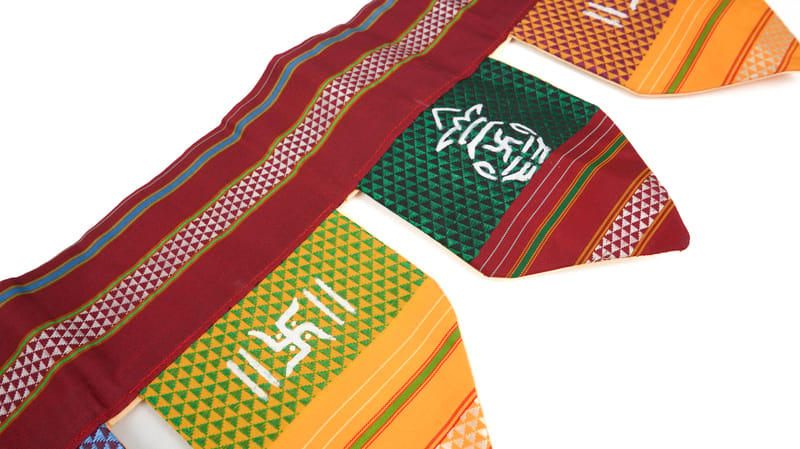
Khan cloth, a tightly woven cotton-based textile with natural structure and a crisp hand-feel, forms the base of both the header and the pennant panels. The material is firm enough to hold shape when hung but lightweight enough not to sag or distort over time.
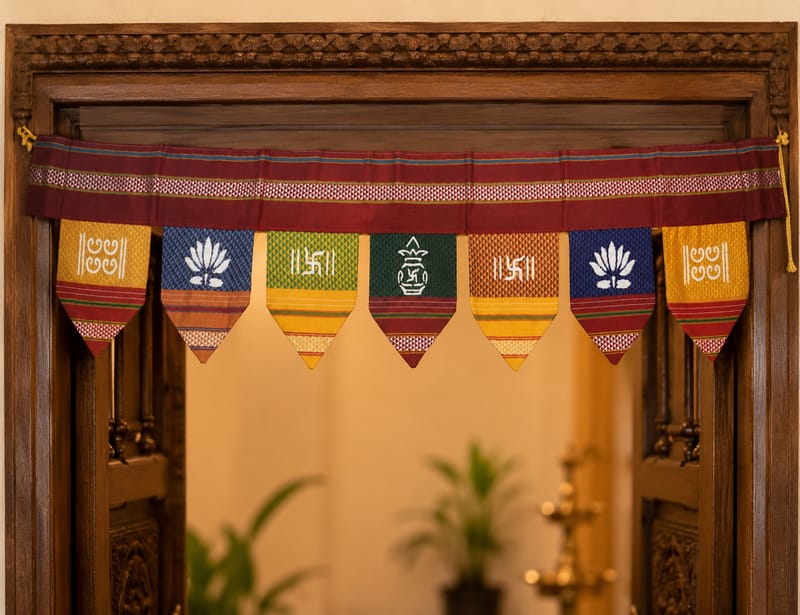
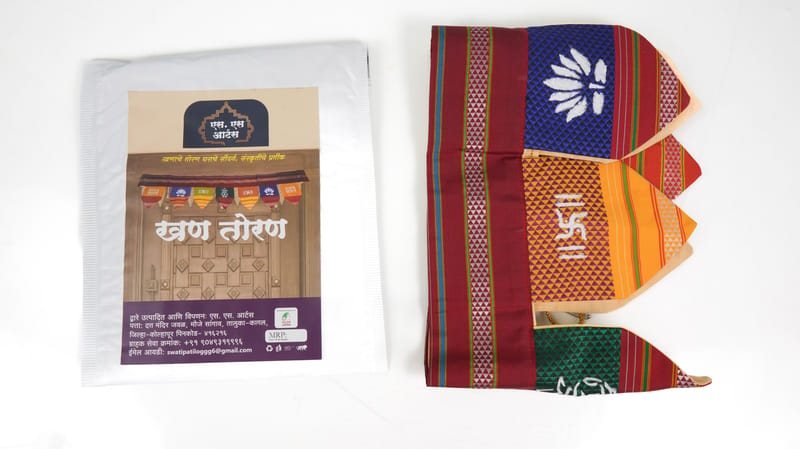
The toran features seven pointed pennant-shaped panels in a rich palette — deep blue, mustard yellow, forest green, and burnt orange — each bordered with the characteristic multicoloured stripe weave of khan fabric. The header, from which the panels hang, is made from the same cloth in deep maroon with a decorative woven stripe running its length.
Each pennant carries a white embroidered auspicious symbol: a lotus in full bloom, a swastika, a kalash (sacred pot), or stylised Devanagari motifs — the traditional emblems of prosperity, purity, and divine presence. The embroidery is clean and well-defined, readable even from a distance across a doorway.
The toran is finished with a gold braided cord running through the header for hanging, with the ends left free for easy tying or looping over a nail or hook.
The Symbols and Their Meaning
The lotus represents spiritual purity and the divine feminine. The swastika is one of the oldest Hindu symbols of auspiciousness and good fortune. The kalash — the sacred pot — is associated with abundance and is present in almost every Indian religious ceremony. Together, across seven panels, these symbols create a complete visual prayer at the threshold of the home.
Where and When to Use
The Khanache Toran works for front door entrances, pooja room doorways, puja mandap decorations during weddings and housewarming ceremonies, and festive setups for Diwali, Navratri, Ganesh Chaturthi, and Gudi Padwa. It is also appropriate for permanent display in homes where the pooja room has a dedicated entrance.
Unlike paper or synthetic torans that fade or tear after a single season, the khan fabric construction holds colour and shape with repeated use, making this a lasting addition to the home rather than a single-occasion purchase.
Specifications
Material: Khan fabric (header and panels), embroidered auspicious motifs in white thread
Number of Panels: 7
Panel Colours: Deep blue, mustard yellow, forest green, burnt orange
Header: Maroon khan fabric with woven stripe detailing
Symbols: Lotus, swastika, kalash, and Devanagari motifs
Hanging: Gold braided cord
Available Colours: Red, Pink, Blue, White, Yellow, Green, Black
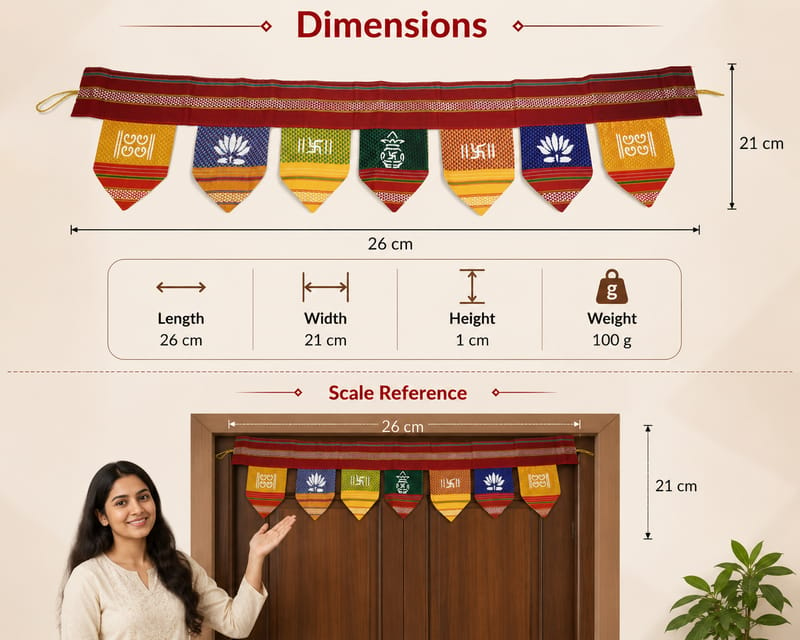
Sizes: Small: 60 × 15 cm, Medium: 90 × 20 cm, Large: 120 × 25 cm
Net Weight: 400 g
Care
Dry clean or spot clean gently with a damp cloth. Do not machine wash. Store flat or rolled, not folded sharply at the pennant tips, to preserve the pointed shape. Keep away from prolonged direct sunlight to retain colour. Iron on low heat on the reverse side only.
About the Entrepreneur
Swati Ranjit Patil has been creating beautiful handmade handbags using traditional khan fabric for many years. She started this business on a small scale from home and gradually grew it through creativity, hard work and handicraft skills. Her handbags are made using materials such as needles, beads, bells, fabric glue and cardboard along with khan fabric, giving each product a special traditional and attractive decorative look.
| Country of origin | India |
|---|---|
| colour | #800000 |
| brand | Anandi Foods |
| material | cotton silk |
| colour name | #800000 |
| cancellable | yes |
| time to ship | 2 days |
| seller pickup return | yes |
| return window | 2 days |
| contact details consumer care | Vanita Shinde,[email protected],9607589078 |
| manufacturer or packer name | S.S.Arts |
| manufacturer or packer address | Manndeshi Foundation A1 Bangalow, Grand Residency, E Ward ,Behind jilha parishad, Mahavir Garden Chowk,Nagala Park, Tal-Kavir Dist-Kolhapur pincode-416011 |
| common or generic name of commodity | Khan Toran |
| month year of manufacture packing import | 46143 |
| imported product country of origin | IN |
Other Products from seller Mann Deshi Udyojika Private Limited


Check Estimated Delivery Date

Sold By: Mann Deshi Udyojika Private Limited
Vendor Source:Mann Deshi Udyojika Private Limited