


 Contact Us
 Appliances
 Agri Inputs
 Auto Components & Accessories
 Beauty & Personal Care
 Electronics
 Fashion
 Grocery
 Gift Cards
 Home & kitchen
 Health & Wellness
 Vehicles & Automotives
 Books & Stationary
 Pet Care
 Toys & Games


The lamp that has been lit in Indian homes for thousands of years Before clay diyas, before electric lights, before scented candles, there was gomay — cow dung, shaped and dried and lit with ghee. It is among the oldest forms of sacred fire in Hin...
Read MorePopular Categories
Support
Language
Our apps
The lamp that has been lit in Indian homes for thousands of years
Before clay diyas, before electric lights, before scented candles, there was gomay — cow dung, shaped and dried and lit with ghee. It is among the oldest forms of sacred fire in Hindu tradition, and its continued use in ritual contexts is not nostalgia but belief: the smoke of burning gomay is considered purifying, the material itself is regarded as sacred, and the light it produces carries a quality that electrical light simply does not replicate in a pooja space. MaayMaati's Gomay Lamp brings this tradition into a form that can be hung, used repeatedly, and placed with intention — a handcrafted lamp from cow dung and clay, painted by hand, and made to be lit.
What it is made from
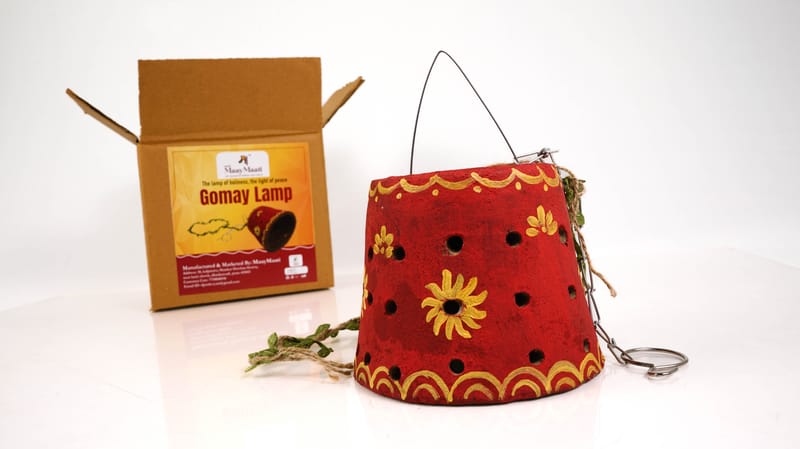
The lamp is made from a mixture of gomay — purified cow dung — and clay, shaped into a truncated cone form and sun-dried until hard. The combination of cow dung and clay gives the body its characteristic dense, matte, earthy texture: it is neither smooth like fired ceramics nor fragile like unfired clay, but somewhere between the two — solid, slightly rough to the touch, and visibly handmade.
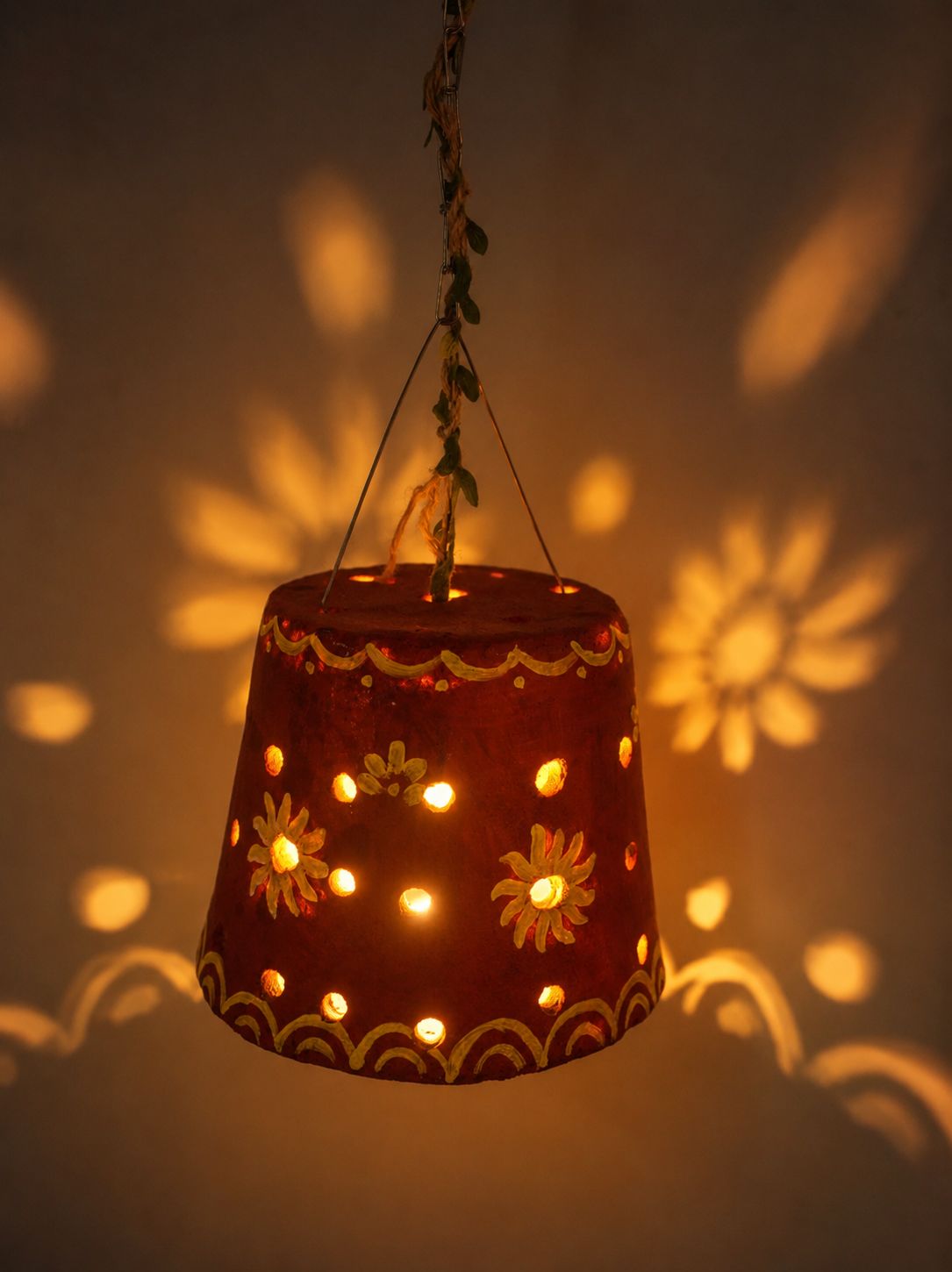
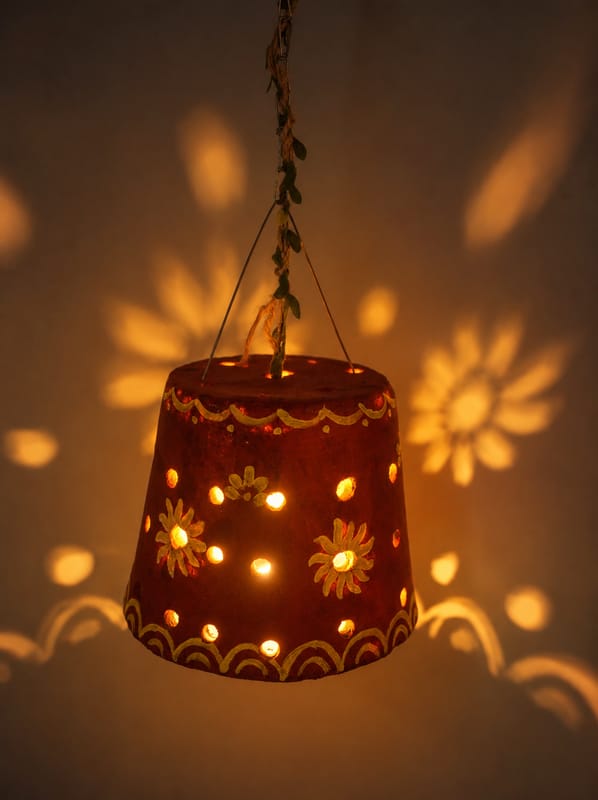
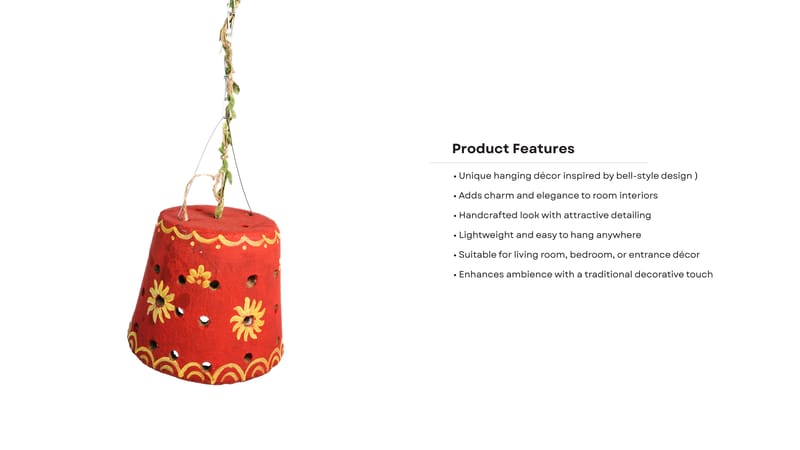
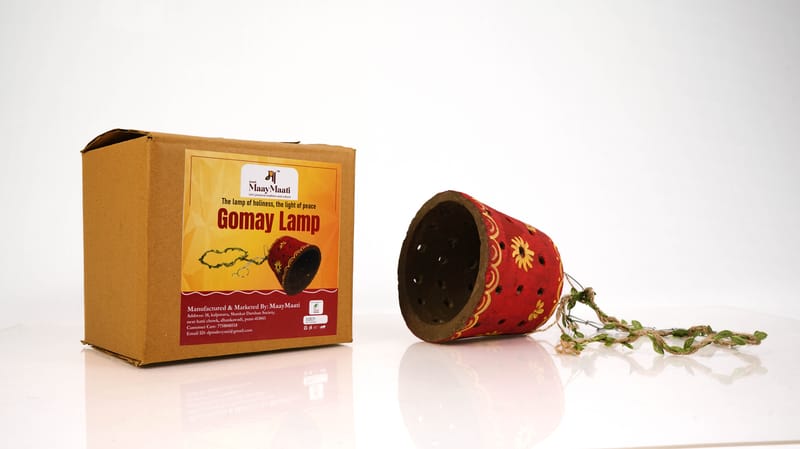
The surface is painted in deep red with hand-painted yellow motifs: sunflower forms on the body and scalloped wave borders at the top and base. The painting is done by hand — the motifs are consistent in character but not mechanically identical, which is the nature of handwork. Small circular holes are punched through the body of the lamp in a scattered arrangement, sized to allow light to pass through when the lamp is lit from inside — casting small circles and points of warm light onto the surrounding surfaces.
The lamp hangs from a twisted metal wire threaded through the top, attached to a jute cord wrapped with dried leaf or vine material. This hanging mechanism gives the lamp its character as a suspended object — hung in a doorway, above a pooja space, or from a ceiling hook in a prayer room, it becomes a functional and devotional object simultaneously.
How it is used
A ghee-soaked wick or small ghee diya is placed inside the lamp at the base. When lit, the flame is contained within the body of the lamp, and light passes outward through the punched holes in dotted patterns — a warm, moving glow that changes with the flame's movement. The lamp can also be used with oil. The smoke produced is minimal and carries the natural, mild scent of burning cow dung and ghee — a smell that is inseparable from the experience of traditional Hindu ritual for many households.
It is suited for daily aarti, for Diwali and Navratri decoration, for hanging near the entrance of a home during festive months, and for any ritual occasion where traditional materials and sacred fire are part of the practice. It can be used indoors in a well-ventilated space or outdoors during festivals and ceremonies.
Why gomay matters as a material
In Indian ritual tradition, cow dung is not merely a functional material — it is considered a purifying substance, used to clean and sanctify spaces, applied to walls, and used in havan and yagna preparations. A lamp made from gomay carries this significance beyond the decorative. It is not simply a colourful hanging object; it is an object of spiritual intention made from a material with centuries of sacred use behind it.
The biodegradable nature of the material also means that when the lamp's functional life ends, it returns to the earth without leaving synthetic waste — a quality that matters increasingly in households that are conscious of what they bring into their homes.
Specifications
Materials: Cow dung (gomay) and clay
Finish: Hand-painted in deep red with yellow sunflower and scallop motifs
Light holes: Punched circular openings throughout body
Hanging mechanism: Twisted wire with jute and vine cord
Fuel: Ghee or oil with wick
Net Weight: 500 g
Suitable for: Daily pooja, aarti, Diwali, Navratri, festive décor, ritual use
Packaging: Branded gift box
Care
Keep dry when not in use — the gomay-clay body is durable but should not be soaked or left in rain, which can soften the material over time. Clean the inside gently after use to remove wax or ghee residue before it hardens. Handle with reasonable care — the body is sturdy but will crack if dropped on a hard surface. Store in its original box in a cool, dry place between uses.
About the Entrepreneur
Devyani Tamboli has been in the business of making clay items for the past 10 years. A year ago she started making natural 'Gomata Dhoop' (incense) from cow dung. On a friend's advice she connected with 'Mann Deshi Foundation'. Through Mann Deshi's network, Devyani's products have now started reaching directly worldwide, receiving tremendous response from customers. Devyani manages this entire business herself. Purchasing from her provides support to traditional products.
| Country of origin | India |
|---|---|
| colour | #FF0000 |
| brand | Shree Creation |
| material | SAND |
| colour name | #FF0000 |
| cancellable | yes |
| time to ship | 2 days |
| seller pickup return | yes |
| return window | 2 days |
| contact details consumer care | Vanita Shinde,[email protected],9607589078 |
| manufacturer or packer name | Maay Maati |
| manufacturer or packer address | Manndeshi Foundation, Dhayri Jay Complex, Sr no10/1,2/2/2,Nr Kailsh Jeevan Factory, Benkar vasti rd,Dhayri 411041,Block-Dhayri District-pune,Maharashtra |
| common or generic name of commodity | Gomay Lamp |
| month year of manufacture packing import | 46143 |
| imported product country of origin | IN |
Other Products from seller Mann Deshi Udyojika Private Limited













Check Estimated Delivery Date

Sold By: Mann Deshi Udyojika Private Limited
Vendor Source:Mann Deshi Udyojika Private Limited