


 Contact Us
 Appliances
 Agri Inputs
 Auto Components & Accessories
 Beauty & Personal Care
 Electronics
 Fashion
 Grocery
 Gift Cards
 Home & kitchen
 Health & Wellness
 Vehicles & Automotives
 Books & Stationary
 Pet Care
 Toys & Games
How to Build a Franchise-Based D2C Hyperlocal Marketplace
ONDC Network for D2C Sellers
Key Takeaways
- A D2C hyperlocal marketplace connects customers with nearby franchise stores, helping brands make local inventory easier to discover and fulfil.
- The right hyperlocal ecommerce solutions help manage franchisees, catalogues, inventory, pricing, order routing and logistics from one platform.
- AI-powered discovery, mobile commerce and omnichannel selling can create a faster, more personalised shopping experience across local markets.
- Mystore helps enterprises build and scale a hyperlocal marketplace with franchise management, local fulfilment, integrated logistics and built-in marketing tools.
The D2C franchise model has seen several success stories in India, with brands using franchise networks to expand into new markets while building a strong local presence. From fashion and beauty to electronics and food, franchise stores have become an important part of how growing brands reach customers beyond major cities.
But the opportunity does not end at the physical store.
By connecting franchise locations with digital commerce, brands can turn these stores into local inventory and fulfilment hubs. Customers can discover products available near them, place orders online and receive faster fulfilment from a nearby franchise location.
This is where a D2C hyperlocal marketplace can create a significant advantage. Instead of operating ecommerce and franchise stores as separate channels, brands can bring them together through hyperlocal ecommerce, making local inventory digitally discoverable and easier to fulfil.
However, scaling this model across multiple franchise locations requires the right technology to manage catalogues, inventory, orders, franchisees and logistics. Here’s how brands can build and scale a franchise-based D2C hyperlocal marketplace.
Table of Contents
- Why a Hyperlocal Ecommerce Model Is Essential for Franchise-Based D2C Growth
- What is a Franchise-Based D2C Hyperlocal Marketplace
- What are the Benefits of the D2C Franchise Model
- How to Build a Franchise-Based D2C Hyperlocal Marketplace
- Step 1: Define Your D2C Franchise Model
- Step 2: Choose the Right Hyperlocal Ecommerce Platform
- Step 3: Bring Your Franchise Network Online
- Step 4: Create a Centralised Product Catalogue
- Step 5: Connect Franchise Inventory With Local Demand
- Step 6: Automate Order Routing and Allocation
- Step 7: Integrate Logistics for Local and Wider Fulfilment
- Step 8: Create a Seamless D2C Buyer Experience
- Step 9: Enable Omnichannel and Mobile Commerce
- Step 10: Track Performance and Scale Your D2C Hyperlocal Marketplace
- Conclusion
- FAQs
Why a Hyperlocal Ecommerce Model Is Essential for Franchise-Based D2C Growth
As more customers choose to shop online from businesses closer to home, hyperlocal ecommerce is opening up a strong growth opportunity for franchise-led D2C brands. These trends show why bringing local stores into the digital shopping journey is becoming increasingly important.
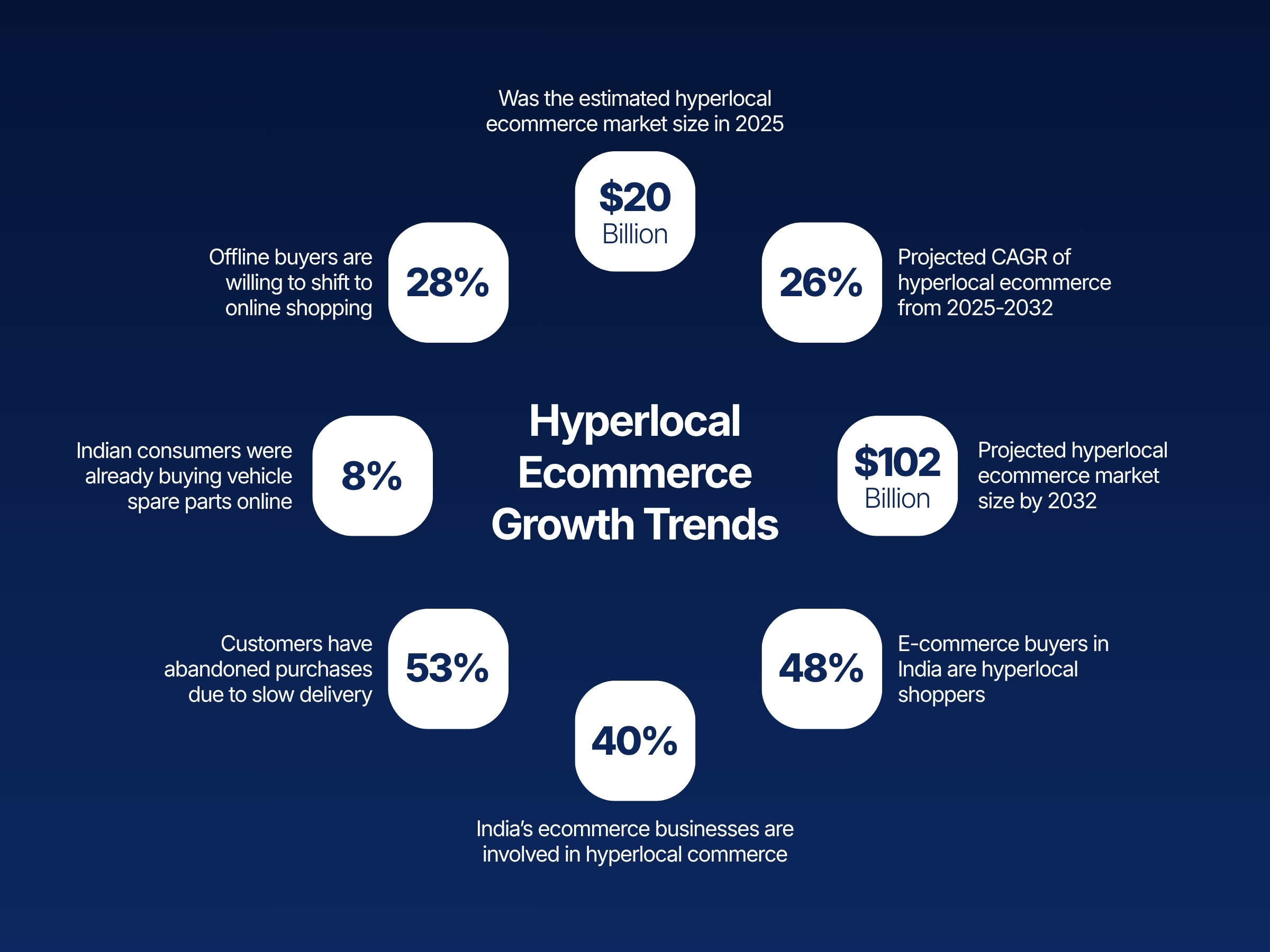
- $20 bn was the estimated hyperlocal ecommerce market size in 2025
- 26.21% is the projected CAGR of hyperlocal ecommerce from 2025-2032
- $102 bn is the projected hyperlocal ecommerce market size by 2032
- 48% of all e-commerce buyers in India are hyperlocal shoppers
- 40% of India’s ecommerce businesses are involved in hyperlocal commerce
- 53% of customers have abandoned purchases due to slow delivery
- 8% of Indian consumers were already buying vehicle spare parts online
- 28% of offline buyers are willing to shift to online shopping
Source: Ken Research, Bain & Company, FYND, Convey, Maxicus, Bain Research
These numbers show that customers increasingly value local availability and faster delivery when shopping online. For brands using a D2C franchise model, moving towards hyperlocal ecommerce can turn existing franchise stores into convenient digital sales and fulfilment points.
What is a Franchise-Based D2C Hyperlocal Marketplace
A Franchise-Based D2C Hyperlocal Marketplace is an online platform where a brand sells directly to customers through its network of franchisees across different locations. Customers can discover products available near them, place orders online and receive fulfilment from suitable franchise locations. Meanwhile, the brand centrally manages the catalogue, operations and marketplace while franchisees manage local inventory and orders.
Real-Life Use Cases of a Franchise-Based D2C Hyperlocal Marketplace
- Fashion brands: Customers can order from the nearest franchise store instead of waiting for stock to arrive from a central warehouse.
- Beauty and personal care: Local franchise outlets can fulfil online orders for cosmetics, skincare and personal care products available in their inventory.
- Furniture and home décor: Customers can discover products available at nearby franchise stores and arrange local delivery or store pickup.
- Electronics and appliances: Franchise outlets can fulfil online orders using their local stock, helping customers receive products faster.
- Grocery and FMCG: Franchise stores can serve nearby customers with everyday products, enabling faster local fulfilment.
- Sports and fitness: Customers can browse products online and order from the nearest franchise outlet that has the required item in stock.
- Pharmacy and wellness: Eligible franchise outlets can use their local inventory to fulfil nearby online orders, subject to applicable regulations.
What are the Benefits of the D2C Franchise Model
The D2C franchise model offers several benefits like faster local expansion, lower operational costs, and stronger market reach for brands looking to expand their local presence while keeping ecommerce operations connected. Here are the core benefits:
- Wider local reach: Enter new markets faster by leveraging existing franchise locations and their local customer base.
- Faster fulfilment:Get orders to customers sooner by fulfilling them from inventory stocked at nearby dealers or franchise locations..
- Lower delivery costs: Reduce shipping expenses by by fulfilling orders from inventory located closer to customers.
- Better inventory utilisation: Make inventory across franchise locations available for online orders, helping brands sell more stock and reduce excess inventory.
- Stronger local presence: Build greater customer trust and brand visibility by combining the convenience of online shopping with an established local franchise presence.
- Scalable growth: Expand into more locations and markets without having to rebuild the ecommerce infrastructure for every new franchise.
- Higher customer trust: Boost customer confidence by combining the convenience of online shopping with the reassurance of an accessible local store.
How to Build a Franchise-Based D2C Hyperlocal Marketplace
A successful franchise-based D2C marketplace needs more than an online storefront. You need to connect franchisees, inventory, orders and fulfilment across different locations.
Here are the to build and scale a D2C hyperlocal ecommerce marketplace.
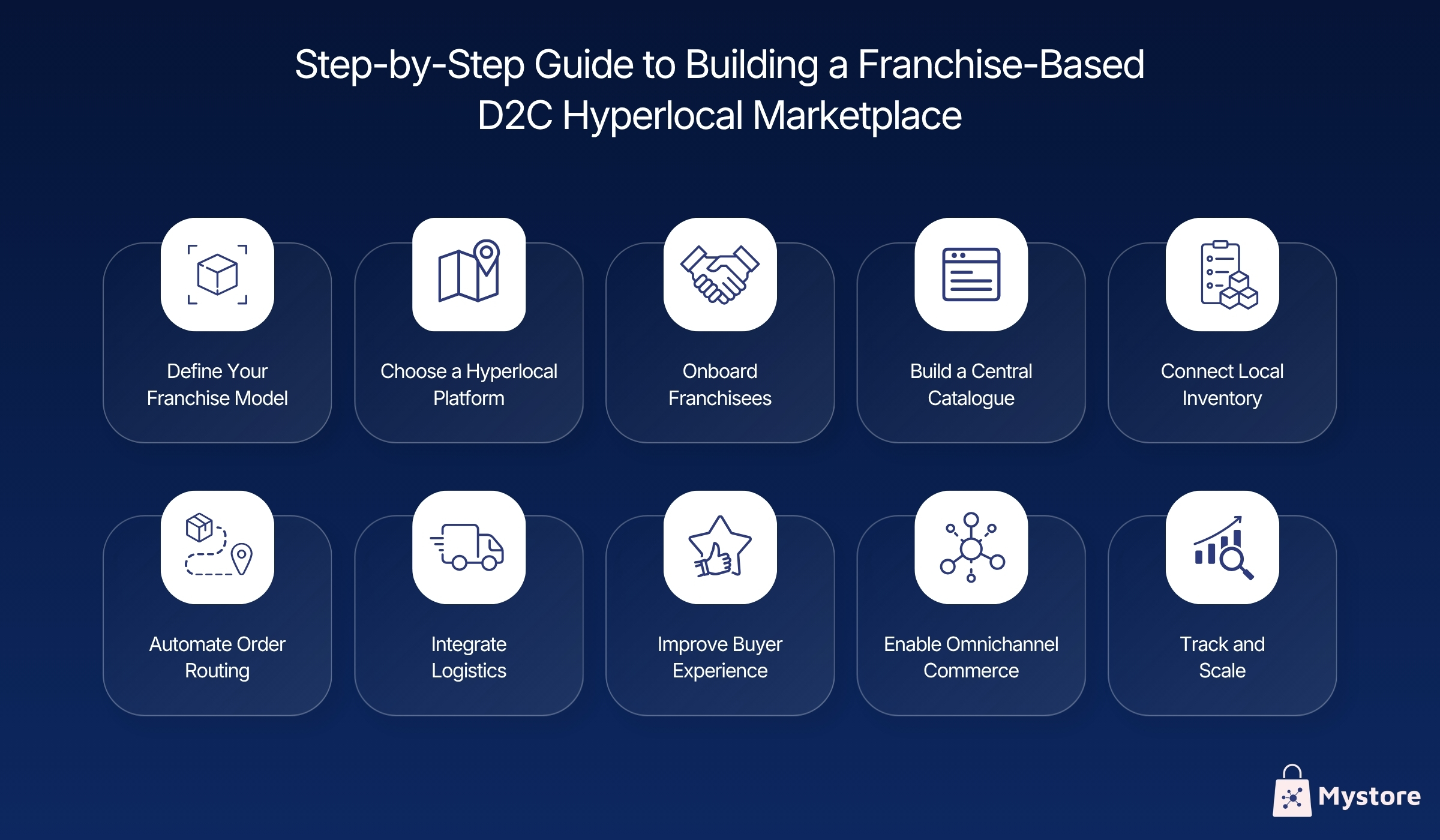
Step 1: Define Your D2C Franchise Model
The first step in building a D2C hyperlocal marketplace is figuring out how your franchise network will work with the online business. Start by defining your target customers, product categories, franchise locations, serviceable pincodes and delivery timelines.
Then decide what role each franchisee will play. Will they simply fulfil orders, or will they also manage products, pricing, promotions and customer interactions? Sorting this out from the beginning makes it much easier to build a hyperlocal ecommerce marketplace that can scale without adding unnecessary complications to franchise operations.
Mystore offers hyperlocal ecommerce solutionsfor multiple business models, including D2C, B2C, B2B, B2B2C, quick commerce and hybrid models, giving enterprises the flexibility to structure their hyperlocal operations around their existing franchise network. You can bring franchise locations, products, inventory and fulfilment into one connected ecosystem while maintaining central control over the overall marketplace.
Step 2: Choose the Right Hyperlocal Ecommerce Platform
Once your D2C franchise model is clear, the next step is choosing the right ecommerce platform to manage your hyperlocal ecommerce operations. A standard hyperlocal ecommerce platform may help you create a storefront, but a franchise-based model needs much more. You should choose a platform that lets you manage multiple franchise locations, distributed inventory, franchise operations, location-based discovery, order routing, fulfilment and logistics from one place. It should also be flexible enough to scale as you add more franchisees, products and markets.
Mystore provides a plugin-free ecommerce ecosystem with built-in capabilities for managing catalogue, inventory, sellers, orders, payments, logistics, marketing and analytics. Instead of relying on multiple third-party plugins to run a D2C hyperlocal marketplace, enterprises can manage their key operations from a connected platform that can scale alongside their growing franchise network.
Step 3: Bring Your Franchise Network Online
Franchisees play an important role in your D2C hyperlocal marketplace, so getting them online should be one of the first priorities. Start by onboarding franchisees across different locations, verifying their business details, mapping their store locations and defining the pincodes they can serve.
Give franchisees enough control to manage their products, inventory and orders independently. This reduces the need for the central team to handle every small operational task and makes day-to-day marketplace management easier as the network grows.
Mystore’s hyperlocal ecommerce solutions make it easier for D2C enterprises to manage a franchise network with centralised seller management capabilities. Enterprises can onboard franchisees, give them dedicated dashboards and let them manage their own inventory and orders. At the same time, the brand gets a clear view of overall operations from a central admin dashboard. This allows franchisees to handle local orders while the enterprise stays in control of the wider hyperlocal marketplace.
Step 4: Create a Centralised Product Catalogue
When multiple franchisees sell the same products, keeping product information consistent across locations can become difficult. For a D2C franchise model, a central master catalogue makes this much easier. Add product names, descriptions, images, specifications, SKUs, variants, pricing and relevant GST or HSN details in one place.
Franchisees can then update local availability without creating separate product listings for every location. This keeps your catalogue consistent while still giving each franchisee the flexibility to manage what is available locally.
Mystore’s Master Catalogue Management helps enterprises keep product information consistent across their franchise network while letting each franchisee manage their own products and inventory. Its AI-powered cataloguing capabilities can also generate product information from images, making it easier to add and manage a large number of products.
This gives your hyperlocal ecommerce marketplace a consistent catalogue while making everyday product management simpler for both the central team and franchisees.
Step 5: Connect Franchise Inventory With Local Demand
One of the biggest advantages of a D2C franchise model is that products are already available across different locations. The challenge is making that local inventory visible to customers at the right time.
Connect each franchise location’s inventory with your hyperlocal marketplace so customers can easily find products available near them. The platform should use factors such as customer location, stock availability, serviceability and fulfilment capability to show the most relevant products.
Mystore lets enterprises manage inventory for individual sellers or franchise locations while keeping the product catalogue centralised. Businesses can also set different prices and product availability for different locations, so customers see what is actually available in their local market.
This brings inventory across the franchise network together in one connected system, making hyperlocal ecommerce more convenient for customers and easier for franchisees to manage.
Step 6: Automate Order Routing and Allocation
Once your franchise inventory is connected to the hyperlocal franchise marketplace, the next step is making sure each order goes to the right location for fulfilment. Manually assigning orders can quickly become difficult as your franchise network grows.
Your hyperlocal ecommerce marketplace should automatically consider factors such as the customer’s location, nearby franchisees, inventory availability, serviceability and fulfilment capacity to choose the most suitable location for each order.
Mystore’s hyperlocal ecommerce solutions enable enterprises to support location-based order allocation and dealer or franchise-powered fulfilment, routing eligible orders to suitable local locations. This reduces manual intervention and helps make better use of inventory distributed across the network. Instead of every order travelling from a central warehouse, your D2C hyperlocal marketplace can use nearby franchise locations as fulfilment points where appropriate.
Step 7: Integrate Logistics for Local and Wider Fulfilment
Not every franchise order will need the same delivery approach. Some customers may be just a few kilometres away, while others may live outside the franchise’s usual delivery area. Your hyperlocal ecommerce solutions should therefore support different fulfilment models, including hyperlocal, intra-city and inter-city deliveries.
You can also combine third-party logistics providers with franchise-owned delivery teams, choosing the option that works best for each location and order.
Mystore comes pre-integrated with 30+ on-network logistics providers, giving enterprises flexibility to support different delivery requirements across their franchise network. D2C businesses can also use their preferred third-party logistics partners or franchise-owned fleets where required. This enables your branded hyperlocal marketplace to choose fulfilment options based on location, delivery requirements and operational needs instead of forcing every order through the same logistics model.
Step 8: Create a Seamless D2C Buyer Experience
Customers don’t need to know how your franchise network works in the background. They should be able to search for a product, explore relevant options, check what’s available nearby, place an order and track the delivery with ease.
This becomes even more important as your catalogue grows and customers have hundreds or even thousands of products to browse.
Mystore makes product discovery easier with AI-powered tools built into the buyer journey. Its AI-powered Semantic Search understands what shoppers are looking for, even when their search doesn’t exactly match the product keywords. AI-powered recommendations then help customers discover relevant products based on their interests and behaviour.
With Mystore Genie, the AI Shopping Assistant, customers can also explore products through conversational and multilingual interactions. Together, these features make shopping simpler, more relevant and more engaging across your D2C hyperlocal marketplace.
Step 9: Enable Omnichannel and Mobile Commerce
In a D2C franchise model, a brand cannot rely on its website alone. Customers may discover products on their mobile, through WhatsApp, at a franchise store or on another digital channel before making a purchase. Your hyperlocal ecommerce solutions should support multiple sales channels and connect these touchpoints, so customers can discover products, switch between channels and complete their purchase without interruptions.
Mystore is built on a unified omnichannel architecture, enabling D2C brands to sell through multiple channels including web storefronts, WhatsApp commerce, partner portals, mobile commerce and franchise-level digital storefronts. With the built-in Mobile App Builder, enterprises can create branded mobile apps for their D2C brand without any coding requirement.
This gives franchisees more ways to reach local customers while keeping their sales channels and operations connected to the central hyperlocal marketplace.
Step 10: Track Performance and Scale Your D2C Hyperlocal Marketplace
Once your D2C hyperlocal marketplace is live, the next step is getting customers to discover your brand and the products available at nearby franchise locations. Franchisees already have strong connections in their local markets, so give them simple digital tools to turn those connections into online sales.
At the same time, keep an eye on marketplace performance to see which products, locations and customer segments are driving the most growth.
Mystore comes with built-in marketing tools that help both franchisees and enterprises improve local product discovery. Businesses can create unique QR codes for products and seller pages, generate downloadable PDF catalogues and use digital storefronts to showcase products available at each location.
Built-in analytics and reporting also make it easier to track orders, sales, inventory and franchise performance. With these tools in place, enterprises can expand their hyperlocal ecommerce model across more franchisees, cities, pincodes and product categories with greater ease.
Conclusion
Building a D2C hyperlocal marketplace around your franchise network can help you turn existing stores into connected digital sales and fulfilment points. Instead of relying only on a central warehouse, you can bring local inventory closer to customers, improve product discovery and give franchisees another channel to grow their business.
The right hyperlocal ecommerce solutions make this model easier to manage by connecting franchise operations, catalogues, inventory, order allocation, logistics, AI-powered discovery, mobile commerce and omnichannel selling on one platform. With Mystore, enterprises can build a scalable hyperlocal marketplace that combines centralised control with local execution, helping franchisees serve customers in their respective markets while remaining connected to the larger D2C ecosystem.
Want to build a franchise-based D2C hyperlocal marketplace and turn your franchise network into a connected digital commerce channel? Register as a seller on Mystore now.
FAQs
1. Is a D2C franchise model suitable for enterprises expanding into new cities?
Yes, a D2C franchise model can be an effective option for enterprises expanding into new cities. It lets brands use existing franchise infrastructure, local market knowledge and established customer relationships instead of building operations from scratch. With the right technology and processes, enterprises can extend their digital presence into new markets while keeping the overall brand experience consistent.
2. How can D2C brands tailor their marketing to customers in different local markets?
D2C brands can tailor marketing by looking at local customer preferences, buying behaviour, demand patterns and product performance. They can then create location-specific campaigns, offers, product recommendations and messaging that feel relevant to each market. A D2C hyperlocal marketplace can also use local insights to help marketers identify which products and promotions are performing best in different areas.
3. What should D2C enterprises look for when evaluating hyperlocal ecommerce solutions?
D2C enterprises should look for hyperlocal ecommerce solutions that can scale across locations while supporting franchise management, inventory visibility, order management, logistics, AI-powered features, omnichannel selling and analytics. The platform should also offer built-in capabilities instead of requiring multiple third-party plugins, making it easier to manage growing operations from one connected ecommerce ecosystem.
4. How can a D2C hyperlocal marketplace improve customer acquisition?
A D2C hyperlocal marketplace can improve customer acquisition by combining local product availability with targeted marketing, location-specific offers and personalised recommendations. Brands can use customer and market insights to create more relevant campaigns for different areas. Faster local fulfilment can also make the overall experience more appealing, helping brands attract new customers and encourage them to shop again.
5. How can D2C brands use local customer data to improve ecommerce performance?
D2C brands can use local customer data to understand product preferences, buying patterns and demand across different markets. These insights can help them personalise marketing campaigns, optimise product assortments, identify high-performing locations and plan inventory more effectively. By acting on these local insights, brands can improve customer engagement, increase conversions and make better decisions about where to expand
6. Why should enterprises consider AI when choosing hyperlocal ecommerce solutions?
Enterprises should consider AI when choosing hyperlocal ecommerce solutions because it can improve product discovery, recommendations, catalogue management and customer interactions at scale. AI can help brands understand shopper intent, personalise experiences and reduce manual work as their product range and customer base grow. This makes it easier to deliver relevant experiences across multiple local markets while supporting long-term growth.
7. How can Mystore help enterprises build a scalable franchise-led ecommerce strategy?
Mystore helps enterprises build a scalable franchise-led ecommerce strategy with built-in tools for franchise management, catalogue and inventory management, order routing, logistics, AI-powered product discovery, omnichannel commerce and marketing. Its plugin-free ecosystem brings these capabilities together on one platform, helping enterprises expand their D2C hyperlocal marketplace across more franchisees, locations and markets without adding unnecessary technology complexity.