


 Contact Us
 Appliances
 Agri Inputs
 Auto Components & Accessories
 Beauty & Personal Care
 Electronics
 Fashion
 Grocery
 Gift Cards
 Home & kitchen
 Health & Wellness
 Vehicles & Automotives
 Books & Stationary
 Pet Care
 Toys & Games
How to Build a Dealer-Powered Hyperlocal Marketplace for Auto Parts
Dealer Powered Quick Commerce
Key Takeaways
- A dealer powered hyperlocal marketplace connects customers with nearby dealers, making auto parts discovery and fulfilment faster.
- The right hyperlocal ecommerce solutions help manage dealers, catalogues, inventory, order routing and logistics from one platform.
- AI-powered discovery, mobile commerce and omnichannel selling create a smoother buying experience across digital touchpoints.
- Mystore helps enterprises build a scalable auto parts marketplace with dealer management, hyperlocal fulfilment, integrated logistics and built-in marketing tools.
What if the fastest way to build an auto parts marketplace is not to build a new fulfilment network at all?
Most auto parts enterprises already have one. Dealers, distributors and regional stock points are spread across cities, holding inventory close to where demand actually comes from. The opportunity is to turn that existing network into a digital sales and fulfilment engine.
With hyperlocal ecommerce, customers can discover the right parts available nearby, orders can be routed to the right dealer, and local inventory can move faster without depending only on central warehouses. Dealers get more demand. Brands get wider reach. Customers get faster access to the parts they need.
But this model works only when the network operates as one connected marketplace. Catalogue, inventory, pricing, order routing, dealer operations and local fulfilment all need to stay in sync.
So how do you turn an existing dealer network into a scalable hyperlocal marketplace for auto parts?
Table of Contents
- Why Shifting to Hyperlocal Ecommerce Model is Essential for Auto Parts Marketplace Growth
- How to Build a Dealer-Powered Hyperlocal Ecommerce Marketplace for Auto Parts
- Step 1: Define Your Auto Parts Marketplace Model
- Step 2: Choose a Hyperlocal Ecommerce Platform
- Step 3: Bring Your Dealer Network Online
- Step 4: Build a Centralised Auto Parts Catalogue
- Step 5: Connect Dealer Inventory and Enable Local Discovery
- Step 6: Automate Order Routing and Fulfilment
- Step 7: Integrate Logistics and Dealer-Powered Delivery
- Step 8: Create a Seamless Buyer Experience
- Step 9: Equip Dealers With Marketing and Self-Service Tools
- Step 10: Track, Optimise and Scale the Marketplace
- How Mystore Helps Build a Dealer-Powered Hyperlocal Auto Parts Marketplace
- 1. Plugin-Free Hyperlocal Ecommerce Solution
- 2. Dealer and Distributor Management
- 3. AI-Powered Ecommerce
- 4. Master Catalogue Management
- 5. Unified Omnichannel Solution
- 6. Mobile Commerce
- 7. Integrated Logistics
- 8. Hyperlocal Order Fulfilment
- 9. Seamless Integrations
- 10. Marketing and Promotions Local Discovery
- Conclusion
- FAQs
Why Shifting to Hyperlocal Ecommerce Model is Essential for Auto Parts Marketplace Growth
The dealer network gives auto parts enterprises the infrastructure. The market shift gives them the timing.
Across India, ecommerce is moving towards faster, location-driven buying, with quick commerce and hyperlocal models reshaping what customers expect from online purchases. For a category like auto parts, where availability and speed can directly influence the purchase decision, that shift makes nearby dealer inventory far more valuable.
And the numbers show just how quickly this behaviour is gaining ground.
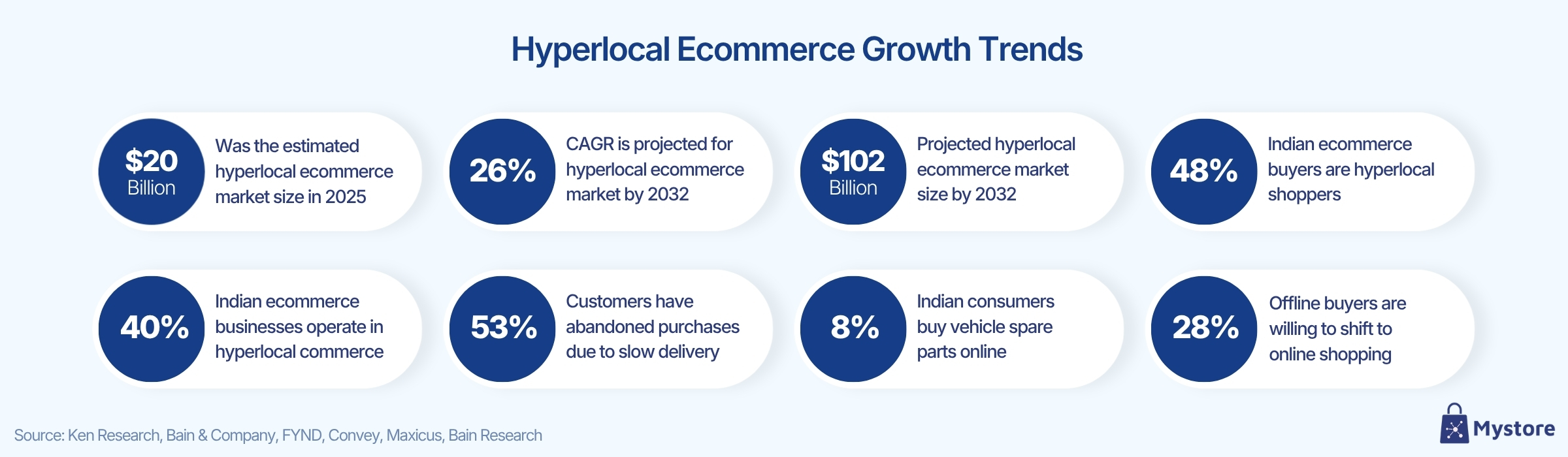
- $20 bn was the estimated hyperlocal ecommerce market size in 2025
- 26.21% is the projected CAGR hyperlocal ecommerce market size during 2025-2032
- $102 bn is the projected hyperlocal ecommerce market size by 2032
- 48% of all e-commerce buyers in India are hyperlocal shoppers
- 40% of India’s ecommerce businesses are involved in hyperlocal commerce.
- 53% of customers have abandoned a purchase because of slow delivery
- 8% of Indian consumers were already buying vehicle spare parts and accessories online
- 28% of offline buyers are willing to shift online
Source: Ken Research, Bain & Company, FYND, Convey, Maxicus, Bain Research
The picture is clear: hyperlocal commerce is growing rapidly, while Indian consumers are increasingly open to buying auto parts online. For auto parts businesses, this is a great opportunity to bring dealer inventory online and help nearby customers find the right parts faster. A dealer-powered hyperlocal ecommerce marketplace can make this possible by connecting local inventory with customers in the same area.
How to Build a Dealer-Powered Hyperlocal Ecommerce Marketplace for Auto Parts
The demand for faster, more convenient and genuine auto-parts delivery is pushing businesses to rethink how they connect customers with local dealers.
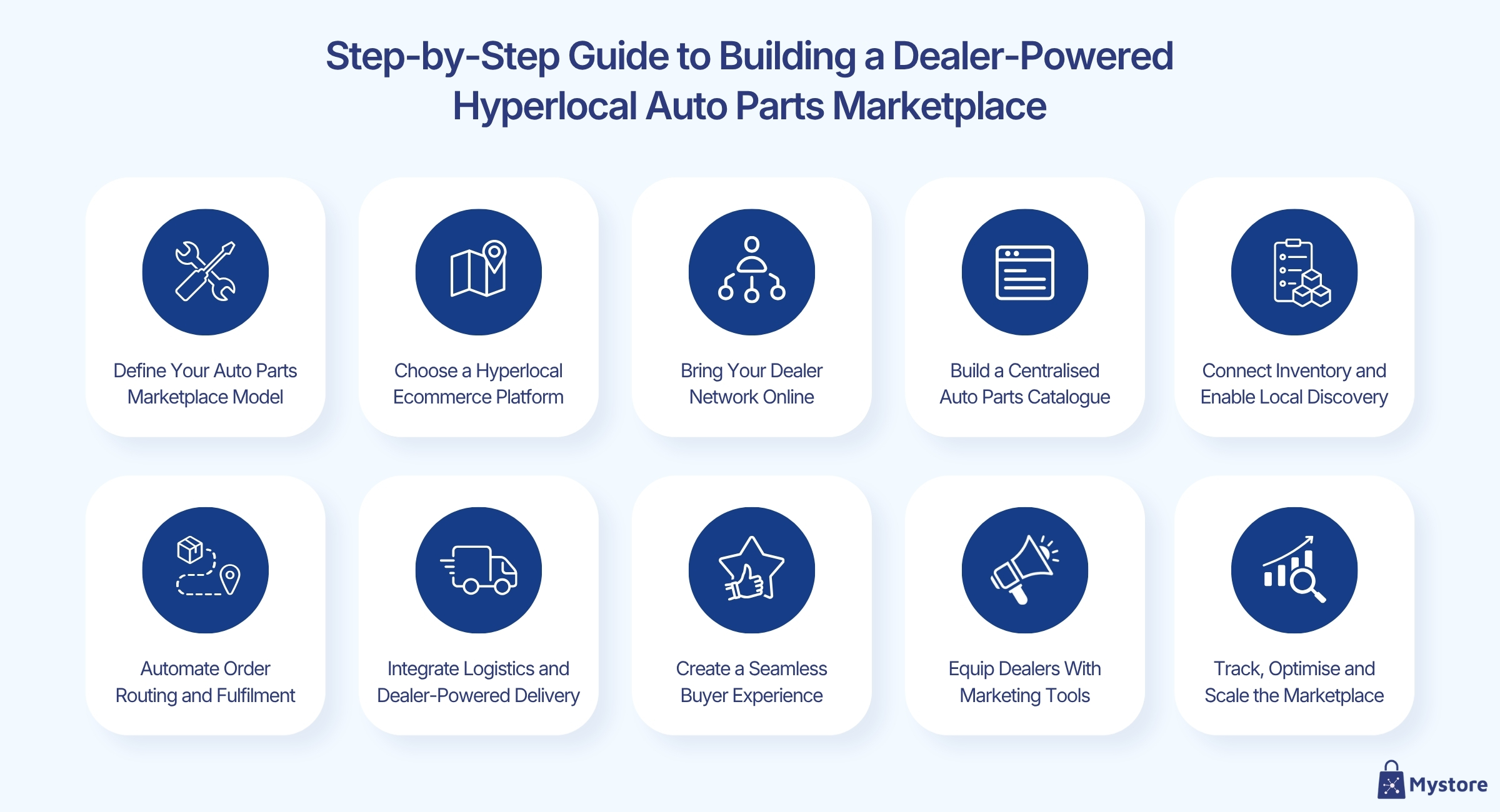
Here are the 10 key steps to help you build and scale a dealer-powered hyperlocal marketplace for auto parts:
Step 1: Define Your Auto Parts Marketplace Model
The first step to build a hyperlocal auto parts marketplace is to clearly identify your target customers. You should have a clear understanding of who you want to serve, what parts you will sell, where you will operate and how quickly orders should reach customers. Decide in advance whether you want to build hyperlocal ecommerce marketplace for B2C, B2B or B2B2C buyers, including vehicle owners, workshops, garages and fleet operators. Also identify fast-moving and special-order parts, target pincodes and realistic delivery SLAs.
Step 2: Choose a Hyperlocal Ecommerce Platform
After you are clear about the business model, now is the time to choose a hyperlocal ecommerce platform where you can build your auto parts marketplace. Select a robust, scalable and future-ready hyperlocal marketplace platform that can give you ready-to-use tools and features to manage your entire dealer network, distributed inventory, orders and fulfilment from one place. Before finalising the platform, you should evaluate if the hyperlocal ecommerce solution can support multi-vendor operations, dealer management, location-based stores, master catalogue, inventory, order routing, logistics and integrations with existing systems. Look beyond the storefront builder and choose a platform that can actually run your hyperlocal marketplace.
Step 3: Bring Your Dealer Network Online
After choosing the hyperlocal ecommerce solution, bring your existing dealers and distributors on the marketplace and give them the tools to manage their day-to-day business operations. Set up dealer onboarding, verification, dashboards, location mapping, pincode serviceability and dealer-specific inventory and pricing. This enables your physical dealer network to work as a powerful fulfilment network for your dealer-powered hyperlocal marketplace.
Step 4: Build a Centralised Auto Parts Catalogue
Create a central master catalogue to keep product information accurate and consistent across your auto parts marketplace, while giving dealers the flexibility to manage their catalogues independently. Add essential details such as part numbers, vehicle compatibility, brands, specifications, warranty, HSN/GST information, pricing and local availability for each auto parts product. This helps buyers quickly find and choose the right part for their vehicle, while making your hyperlocal ecommerce marketplace easier to manage as it grows.
Step 5: Connect Dealer Inventory and Enable Local Discovery
The next step is connecting each dealer’s inventory with the marketplace so customers can see which auto parts are available near them. Your hyperlocal marketplace should match each order with the right dealer based on stock availability, customer pincode, delivery coverage and fulfilment speed. This helps customers find the right part quickly and gives them a clearer idea of where their order will be fulfilled.
Step 6: Automate Order Routing and Fulfilment
Automate order allocation so every purchase reaches the most suitable dealer without requiring manual intervention. Your hyperlocal ecommerce solutions should consider customer location, dealer proximity, inventory availability, serviceability, fulfilment capacity and delivery SLA when routing orders. For instance, when multiple dealers stock the same brake pad, the system can prioritise the closest eligible dealer for faster fulfilment.
Step 7: Integrate Logistics and Dealer-Powered Delivery
Give your auto parts marketplace the flexibility to fulfil orders through hyperlocal logistics partners, intercity carriers, dealer-owned fleets or your own logistics network. A hybrid approach lets you choose the right delivery option based on the product, location and urgency of the order. This makes a dealer-powered hyperlocal marketplace well-suited for fast-moving auto parts that customers may need quickly.
Step 8: Create a Seamless Buyer Experience
Now, after integrating your auto parts marketplace with logistics partners, you should make it easy for your buyers to search, identify and order the right products with minimal effort. Add smart search, filters, vehicle- or model-based discovery, AI-powered recommendations, location-based availability, flexible payments, order tracking and returns. A smooth hyperlocal ecommerce experience helps buyers go from finding the right part to placing an order with less effort.
Step 9: Equip Dealers With Marketing and Self-Service Tools
Give dealers enough control to manage day-to-day marketplace activities without depending on admins. Give dealers their dedicated dashboard so they can update inventory, process orders, track shipments, promote products, share digital catalogues, use QR codes and monitor sales. This helps dealers actively manage their business on your hyperlocal ecommerce marketplace instead of limiting their role to order fulfilment.
Step 10: Track, Optimise and Scale the Marketplace
Once your hyperlocal marketplace is live, keep track of customer activity and dealer performance to see what is working and where you need to improve. Monitor orders, GMV, conversions, repeat purchases, inventory accuracy, fulfilment rates, cancellations, delivery times, pincode coverage and customer satisfaction. Use these insights to gradually expand into more cities, dealers, pincodes, product categories and customer segments.
With these 10 steps in place, you have a clear roadmap for building a dealer powered hyperlocal marketplace that connects local inventory with customer demand. However, making this model work smoothly requires more than just the right strategy. You need a feature-rich hyperlocal ecommerce platform that makes it easy to manage dealers, inventory, order routing, logistics and local fulfilment from one place.
As your dealer network and customer base grow, the platform should be able to grow with you without making operations harder to manage. Mystore brings these capabilities together, helping enterprises build and scale a dealer-powered hyperlocal commerce model with greater ease.
How Mystore Helps Build a Dealer-Powered Hyperlocal Auto Parts Marketplace
Managing auto parts across multiple dealers can get complicated when stock, prices, orders and customer needs differ from one location to another. Mystore brings everything together on one unified platform, helping enterprises connect dealers with customers and run a hyperlocal marketplace with ease.
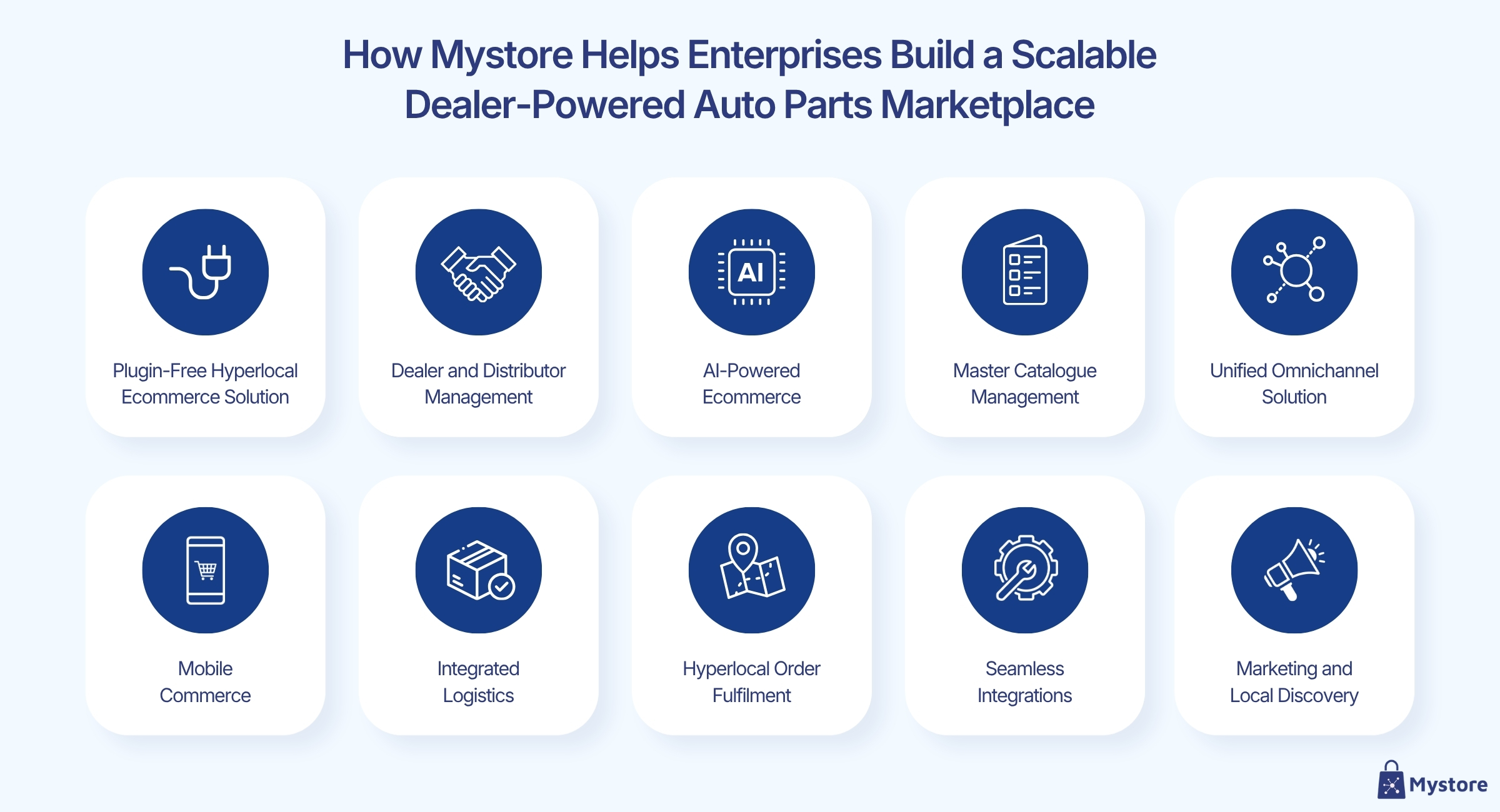
Here are the key Mystore features that can help you manage your dealer network, streamline fulfilment and deliver a seamless hyperlocal ecommerce experience:
1. Plugin-Free Hyperlocal Ecommerce Solution
Building a dealer-powered hyperlocal marketplace for auto parts requires multiple capabilities to work together, from dealer management and inventory to fulfilment and customer-facing experiences. Relying on multiple plugins to add these capabilities can make things complicated as the marketplace grows. Mystore takes a plugin-free approach, with built-in capabilities that help enterprises manage and scale their hyperlocal marketplace without relying on a long list of third-party plugins.
Mystore helps enterprises build a plugin-free hyperlocal marketplace with:
- End-to-end hyperlocal ecommerce solutions: Connect dealers, local inventory and nearby customers through a unified platform.
- Built-in catalogue management: Maintain a centralised auto parts catalogue across multiple dealers and locations.
- Native marketing tools: Help dealers promote products, offers and local inventory to nearby customers.
- Pre-integrated payment, shipping and tax modules: Simplify order processing, delivery and compliance across dealer locations.
- In-platform analytics and reporting dashboards: Track dealer performance, inventory, orders and sales across locations.
- Seamless ERP, CRM and accounting integrations: Keep dealer, inventory and business operations connected without relying on multiple middleware plugins.
2. Dealer and Distributor Management
Managing a large dealer network becomes challenging when every dealer operates independently across different cities and regions. For example, an auto parts marketplace with 200+ dealers may struggle to keep onboarding, seller information, operations and performance tracking consistent across the network.
Mystore helps enterprises manage their dealer-powered hyperlocal marketplace with:
- Location-based dealer onboarding: Onboard auto parts dealers and distributors across different cities and regions, helping you expand your local parts network without managing each location separately.
- Dedicated dealer dashboards: Give each dealer a dedicated dashboard to manage their auto parts catalogue, inventory and orders, while keeping their day-to-day operations independent.
- Centralised dealer network management: Manage dealers across multiple locations from one central admin dashboard while allowing each dealer to serve customers in their local market.
- Dealer performance tracking: Track dealer activity and performance across locations to identify gaps in catalogue, inventory or order fulfilment and improve marketplace operations.
- Centralised order and fulfilment management: Coordinate orders across dealers from one system and route fulfilment through the relevant local dealer, helping customers get the right parts from nearby inventory.
3. AI-Powered Ecommerce
Auto parts customers may search using vehicle names, product descriptions or everyday terms instead of exact part numbers. A buyer looking for a component for a specific car model on your hyperlocal ecommerce marketplace, for instance, may not know the technical name of the part. AI can make this discovery journey easier by connecting everyday search language with relevant catalogue information.
Mystore makes it easier for customers on your auto parts marketplace to discover the relevant products with:
- AI Image Editing with Magic Edit: Improve auto parts product images to create cleaner, more presentable catalogue listings and give customers a clearer view of the products they are considering.
- AI-Powered Cataloguing: Automatically generate product information such as titles, descriptions, categories and HSN codes from product images, helping dealers add auto parts to the auto parts marketplace faster.
- AI-Powered Semantic Search: Understand the intent behind searches even when buyers use everyday terms, vehicle names or descriptions instead of exact part numbers, helping them discover relevant products more easily.
- AI-Powered Recommendations: Recommend relevant auto parts based on shopper interests and behaviour, helping customers discover related products while creating additional selling opportunities for dealers.
- AI Shopping Assistant , Mystore Genie: Help buyers discover products through conversational and multilingual shopping assistance, making it easier to find the right products across a diverse hyperlocal marketplace.
- AI Bot Builder: Enables enterprises to create custom AI bots for distributors, dealers, internal teams and buyers to answer queries, provide relevant information and support everyday marketplace activities.
4. Master Catalogue Management
When hundreds of dealers on your hyperlocal marketplace sell the same auto parts, maintaining consistent product information across the network can become difficult. At the same time, a brake pad or battery available with one dealer may be out of stock with another, making accurate local inventory visibility essential for a hyperlocal marketplace.
Mystore’s hyperlocal ecommerce solutions provide a centralised catalogue with:
- Master catalogue management: Maintain one central catalogue for auto parts and share standardised product information across your dealer network, making it easier to manage a growing auto parts marketplace.
- Dealer-level inventory configuration: Allow individual dealers to update and manage their available stock against products in the central catalogue, giving buyers visibility into local inventory.
- Differential dealer pricing: Configure different prices for the same auto part across dealer locations, giving you the flexibility to accommodate location-specific pricing strategies.
- Centralised product information: Keep product details such as names, descriptions and specifications consistent across dealer stores, without requiring separate catalogues for every location.
- Location-specific product availability: Display auto parts based on inventory available at relevant dealer locations, helping customers find the right products closer to them and making hyperlocal ecommerce more effective.
5. Unified Omnichannel Solution
Customers may discover auto parts through a dealer’s storefront, WhatsApp, mobile app, website or other digital touchpoints before making a purchase. Managing these channels separately can create fragmented customer experiences and make it harder for enterprises to maintain consistent product, inventory and order information. Mystore brings these touchpoints together through a unified omnichannel solution.
Mystore helps enterprises create a connected omnichannel experience with:
- Unified commerce across channels: Connect your website, mobile app, dealer storefronts, WhatsApp and other sales channels from a single ecommerce platform.
- Consistent catalogue and inventory: Keep product information, pricing and inventory aligned across different customer-facing channels, helping customers see accurate information wherever they shop.
- Connected customer journeys: Allow customers to discover auto parts through one channel and continue their buying journey through another without creating disconnected experiences.
- Dealer-powered omnichannel selling: Enable dealers to sell through their own digital storefronts, WhatsApp and other channels while remaining connected to the central marketplace.
6. Mobile Commerce
Customers looking for auto parts may need to place orders while on the move, at a workshop, or from areas where network connectivity is unreliable. Mystore helps enterprises extend their auto parts marketplace to mobile with built-in tools that make shopping more accessible and convenient.
Mystore supports mobile commerce with:
- Responsive website: Offer a mobile-friendly web storefront that adapts seamlessly to different screen sizes, making it easy for customers to browse and order auto parts from smartphones, tablets and desktops.
- Mobile-first architecture: Build your hyperlocal ecommerce experience on a mobile-first architecture designed to deliver smooth, consistent performance across mobile and other connected devices.
- Built-in Mobile App Builder: Create a branded mobile app for your auto parts marketplace without relying on separate app development tools, giving customers an easy way to browse products and place orders.
- PWA Store: Provide a lightweight Progressive Web App experience that helps customers browse and order auto parts from nearby dealers even in areas with low or unreliable network connectivity.
- Mobile-first ordering: Make it easier for customers to search, select and order auto parts from their mobile devices, supporting convenient purchases across different locations.
7. Integrated Logistics
Auto parts orders can range from urgent same-city requirements to shipments between different cities. Enterprises with auto parts need flexible logistics options that can match different delivery distances, dealer locations and customer requirements.
Mystore hyperlocal ecommerce solutions simplify logistics management with:
- 40+ integrated logistics partners: Access a wide logistics network to fulfil orders across different regional locations and delivery requirements.
- Flexible delivery options: Support hyperlocal, intra-city and inter-city deliveries, allowing auto parts orders to move efficiently between dealers and customers across different locations.
- Flexible fleet options: Connect your preferred last-mile logistics partners or leverage your dealers’ existing delivery fleets in various markets to fulfil orders based on your hyperlocal marketplace requirements.
- Real-time shipping rates: View available shipping rates and select suitable delivery options based on your fulfilment requirements.
- Preferred logistics provider support: Switch between integrated on-network logistics providers and your preferred off-network delivery partners based on your fulfilment requirements.
8. Hyperlocal Order Fulfilment
Customers looking for auto parts often need them quickly, especially when a vehicle is being repaired or serviced. Connecting customer orders with nearby dealers can help your marketplace fulfil orders faster while making better use of inventory available across your dealer network.
Mystore enables dealer-powered hyperlocal fulfilment through:
- Dealer-powered fulfilment: Use existing dealers as local fulfilment points, allowing customer orders to be fulfilled from nearby auto parts inventory.
- Location-based fulfilment: Route orders based on dealer location and serviceability, helping connect customers with suitable dealers in their area.
- Decentralised fulfilment: Leverage your network of dealers across different locations to fulfil orders closer to customers.
- Automated order allocation: Automatically allocate eligible orders to suitable dealers, reducing manual intervention and speeding up order processing.
9. Seamless Integrations
Whether you are building a new auto parts marketplace or expanding an existing dealer network, you may already rely on ERP, dealer management or other business systems. Connecting these systems with ecommerce helps reduce duplicate work and keeps important operational data aligned.
Mystore hyperlocal ecommerce solutions helps connect ecommerce with existing operations through:
- DMS and ERP integrations: Connect your existing Dealer Management System or ERP with Mystore to bring dealer and business operations together in a more connected workflow.
- Inventory and order sync: Connect supported inventory and ERP systems to sync product, inventory and order information, reducing the need for manual updates across systems.
- API integrations: Use Mystore APIs to build programmatic integrations and automate data exchange with your existing systems and applications.
- Connected dealer operations: Keep dealer inventory and orders connected with marketplace operations, helping your team manage a distributed dealer network more efficiently. Mystore provides centralised seller management along with individual dealer dashboards for inventory and orders.
10. Marketing and Promotions Local Discovery
Dealers often have strong relationships with customers in their local markets but may lack digital tools to showcase their inventory. A dealer with the right part in stock could miss a nearby sale simply because customers cannot discover that inventory online.
Mystore helps dealers on your auto parts marketplace drive local discovery with:
- Built-in marketing tools: Give dealers and enterprises tools to promote products, run offers and engage customers across the dealer powered hyperlocal commerce ecosystem.
- Unique QR codes: Create dedicated QR codes for brand pages, seller pages and individual products, making it easy for dealers to take customers directly to their digital listings.
- Digital catalogues: Create downloadable PDF product catalogues that dealers can share digitally, helping them showcase their auto parts range across different customer touchpoints.
- Dealer storefronts: Give individual dealers their own digital storefronts where they can showcase their products and build a stronger online presence within the marketplace.
- WhatsApp business integration: Share products and catalogues through WhatsApp, allowing dealers to reach existing customers and promote their auto parts offerings through their preferred channel.
Conclusion
Building an auto parts marketplace around an existing dealer network can help enterprises bring local inventory closer to customers while giving dealers a bigger role in digital commerce. With the right hyperlocal ecommerce solutions, businesses can connect dealer stores, inventory, order fulfilment, logistics and customer discovery through one platform.
Mystore helps enterprises turn this model into a scalable dealer-powered hyperlocal commerce ecosystem, combining central control with local operations. From master catalogues and dealer management to hyperlocal fulfilment, AI-powered discovery, integrated logistics and local marketing, Mystore brings the key pieces together.
Want to build a dealer-powered hyperlocal auto parts marketplace?
Book a personalised demo with Mystore now.
FAQs
1. What should businesses evaluate in hyperlocal ecommerce solutions before choosing one for an auto parts marketplace?
Businesses should evaluate hyperlocal ecommerce solutions for dealer management, real-time inventory visibility, location-based order routing, logistics, integrations, scalability, mobile commerce, omnichannel capabilities and security. The platform should also make it easy to expand across dealers, cities, pincodes and customer segments as the auto parts marketplace grows.
2. How can hyperlocal ecommerce improve customer trust when buying auto parts online?
Hyperlocal ecommerce can build customer trust by showing nearby dealer details, local product availability, accurate delivery timelines and transparent order tracking. Customers can also feel more confident when they know where their auto parts are coming from and can connect with an established local dealer when needed.
3. How can businesses maintain product authenticity in an auto parts marketplace?
Businesses can maintain product authenticity in an auto parts marketplace by verifying dealers, sourcing from authorised suppliers, displaying manufacturer details and part numbers, and clearly identifying genuine products. Regular dealer audits, documentation checks and quality standards can further reduce the risk of counterfeit or incorrect parts.
4. How can AI improve product discovery in an auto parts marketplace?
AI can improve product discovery in an auto parts marketplace by understanding natural-language searches, vehicle details and product requirements to surface relevant parts. AI-powered recommendations and conversational assistance can further help customers identify suitable products, even when they do not know the exact part name or number.
5. Why is mobile commerce important for a hyperlocal marketplace selling auto parts?
Mobile commerce is important for a hyperlocal marketplace because customers often search for auto parts while travelling, at workshops or during urgent repairs. A mobile-friendly buying experience makes it easier to check nearby availability, compare options and place orders quickly from any location.
6. How does unified omnichannel selling benefit a dealer powered hyperlocal marketplace?
Unified omnichannel selling helps a dealer powered hyperlocal marketplace connect websites, mobile apps, dealer storefronts, WhatsApp and other sales channels into one consistent customer journey. It also enables dealers to engage customers across multiple touchpoints while keeping product, inventory and order information connected.
7. What should businesses consider before expanding a dealer powered hyperlocal marketplace to new cities?
Businesses should consider dealer coverage, local demand, inventory availability, serviceable pincodes, delivery capabilities, competition and fulfilment capacity before expanding a dealer powered hyperlocal marketplace. They should expand city by city only when the local dealer network can consistently support product availability and reliable delivery.
8. What KPIs should businesses track after launching a dealer-powered hyperlocal marketplace?
Businesses should track order volume, GMV, conversion rate, repeat purchases, inventory accuracy, dealer activation, fulfilment time, delivery success rate, cancellations, returns, customer acquisition cost and customer satisfaction after launching a dealer powered hyperlocal marketplace