


 Contact Us
 Appliances
 Agri Inputs
 Auto Components & Accessories
 Beauty & Personal Care
 Electronics
 Fashion
 Grocery
 Gift Cards
 Home & kitchen
 Health & Wellness
 Vehicles & Automotives
 Books & Stationary
 Pet Care
 Toys & Games
10 Tried and Tested Strategies to Boost Sales of Your D2C Ecommerce Brand in 2026
ONDC Network for Enterprises
Key Takeaways
- In 2026, D2C growth depends on rebuilding ecommerce foundations around intelligence, speed, and integration, not fragmented tools or channel-specific fixes.
- Ecommerce trends 2026 show that brands that experiment faster, adopt AI-driven automation, and deliver seamless omnichannel experiences consistently outperform competitors.
- Online selling trends 2026 make mobile-first journeys, personalised discovery, frictionless payments, and reliable fulfilment essential drivers of conversions and repeat purchases.
- A unified enterprise ecommerce solution empowers D2C brands to scale efficiently by combining automation, personalisation, marketing, and logistics into a single, high-performance growth engine.
D2C ecommerce evolved faster than anyone expected, driven by AI and new digital tools. Ecommerce trends weren’t just changing, they were redefining how brands attract, engage, and convert buyers.
But 2026 signals a different kind of shift.
This year isn’t just about experimenting with tools; it’s about rebuilding the digital foundation so D2C brands can operate with intelligence, agility, and customer-centricity at the core. Online selling trends in 2026 and beyond signal a turning point where brands seeking accelerated growth must move beyond fragmented workflows, channel-specific fixes, and manual processes. The key to winning lies in integrated systems, data-driven decisions, and automation embedded across every touchpoint, powered by an enterprise ecommerce solution that turns intelligence into action, helping D2C brands scale faster and smarter.
For D2C leaders, this is the moment to redefine what high-performing ecommerce looks like: AI-powered, omnichannel, personalised, and capable of delivering seamless experiences at scale. By embracing these strategies, brands can align with the ecommerce trends of 2026 and set the pace in the competitive D2C landscape.
These ten tried-and-tested strategies highlight exactly how D2C brands can boost sales, scale efficiently, and stay ahead with Mystore’s enterprise ecommerce solution.
Before exploring, let's have a look at some data-driven insights shaping future of D2C ecommerce.
Table of Contents
- Why D2C Ecommerce Brands Should Rethink Their Growth Strategies
- 10 Tried and Tested Strategies to Boost Sales of Your D2C Ecommerce Brand in 2026 and Beyond
- 1. Choose Tech Solution That Enables You to Experiment
- 2. Build A WOW, Branded Online Store
- 3. Offer Seamless Mobile Shopping Experience
- 4. Take Your D2C Brand Omnichannel
- 5. Reach New Buyers With Multilingual Voice Commerce
- 6. Implement Smart Automation at Multiple Levels
- 7. Offer Personalised Search and Recommendations
- 8. Make Payments Frictionless
- 9. Streamline Delivery with Efficient Logistics
- 10. Strategise Marketing to Sell More
- Conclusion
- FAQs
Why D2C Ecommerce Brands Should Rethink Their Growth Strategies
Buyer behaviour, digital commerce channels, and ecommerce technologies are evolving rapidly, pushing D2C brands to rethink how they scale and engage customers. These insights highlight the key trends shaping the future of D2C ecommerce growth.
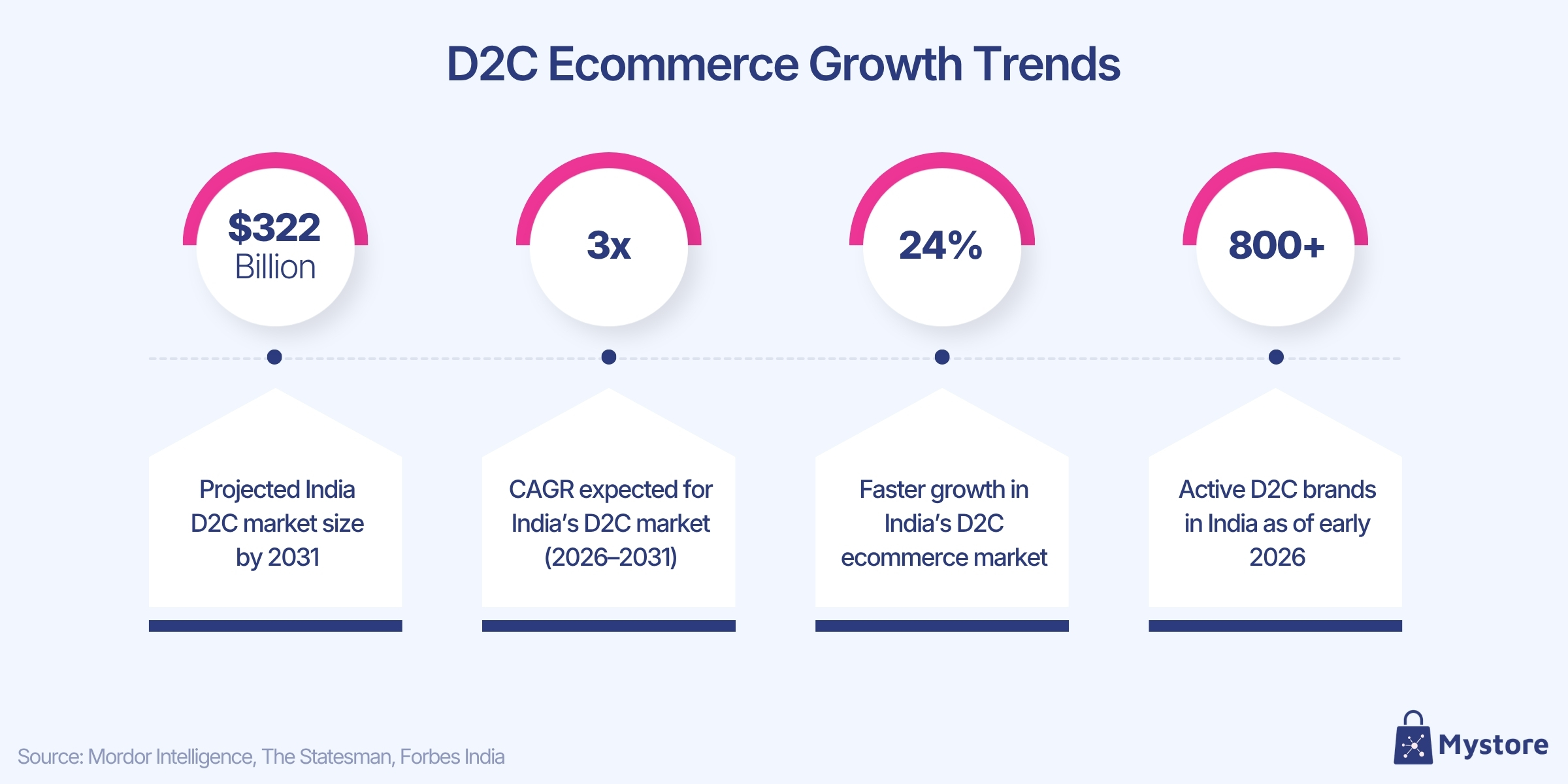
- $322.1 bn is the expected value of India's D2C Market size by 2031
- 24.30% is the expected CAGR of India's D2C Market size for 2026 - 2031
- 3X Faster Growth in India’s D2C Ecommerce Market
- 800+ Active D2C Brands in India as of Early 2026
Source: Mordor Intelligence , The Statesman , Forbes India
Key Takeaway: India’s D2C ecommerce space is scaling rapidly, making faster growth, differentiation, and operational agility critical for brands.
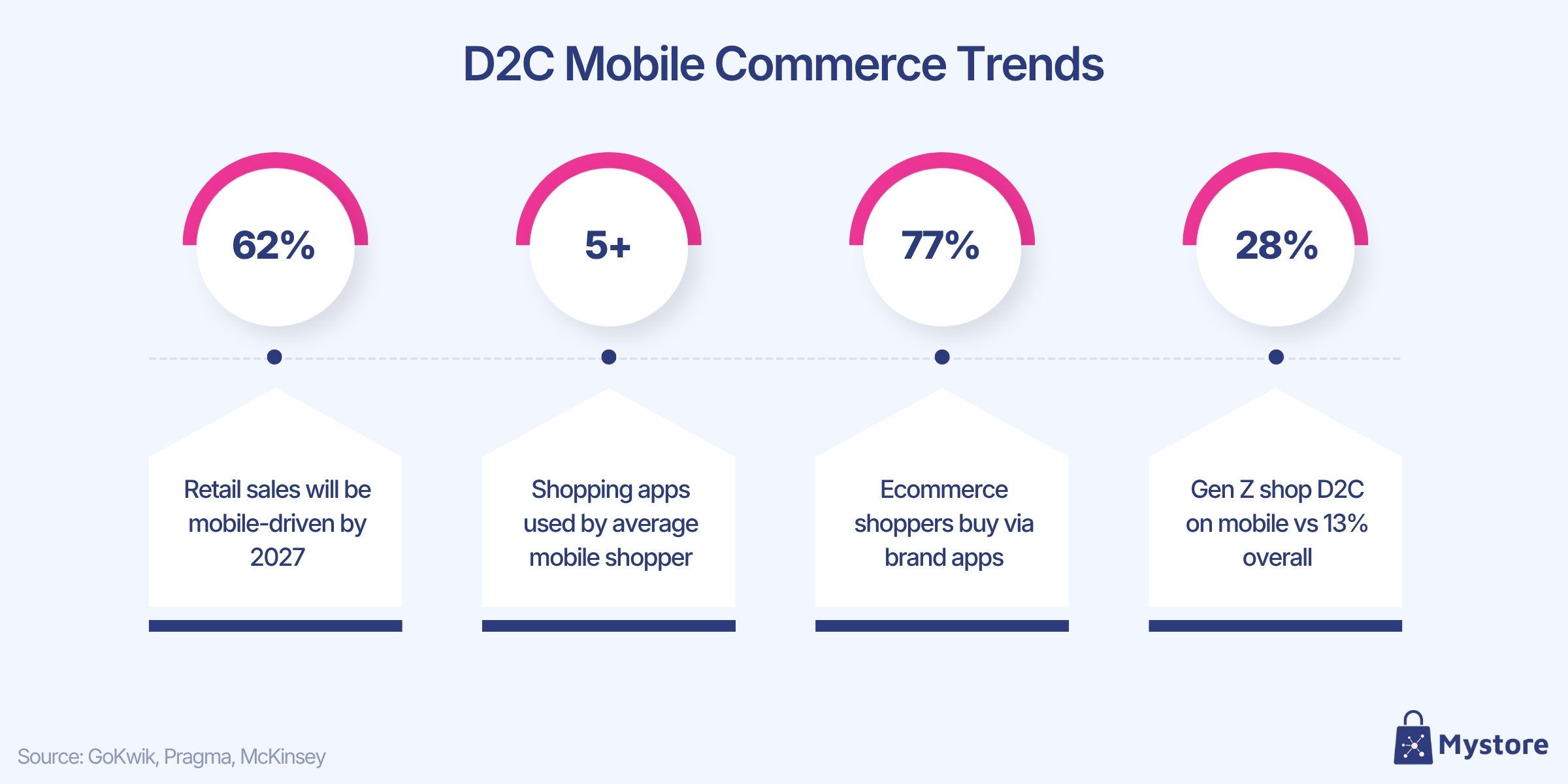
- 62% of all retail sales are expected to be mobile-driven by 2027
- 5+ shopping apps used by the average mobile shopper
- 77% of e-commerce shoppers now use brand-specific mobile apps to shop
- 28% of Gen Z shoppers buy from D2C brands via mobile vs 13% overall
Source: GoKwik, Pragma, McKinsey
Key Takeaway: Mobile-first shopping is dominating D2C commerce, making seamless app and mobile experiences essential for conversions.
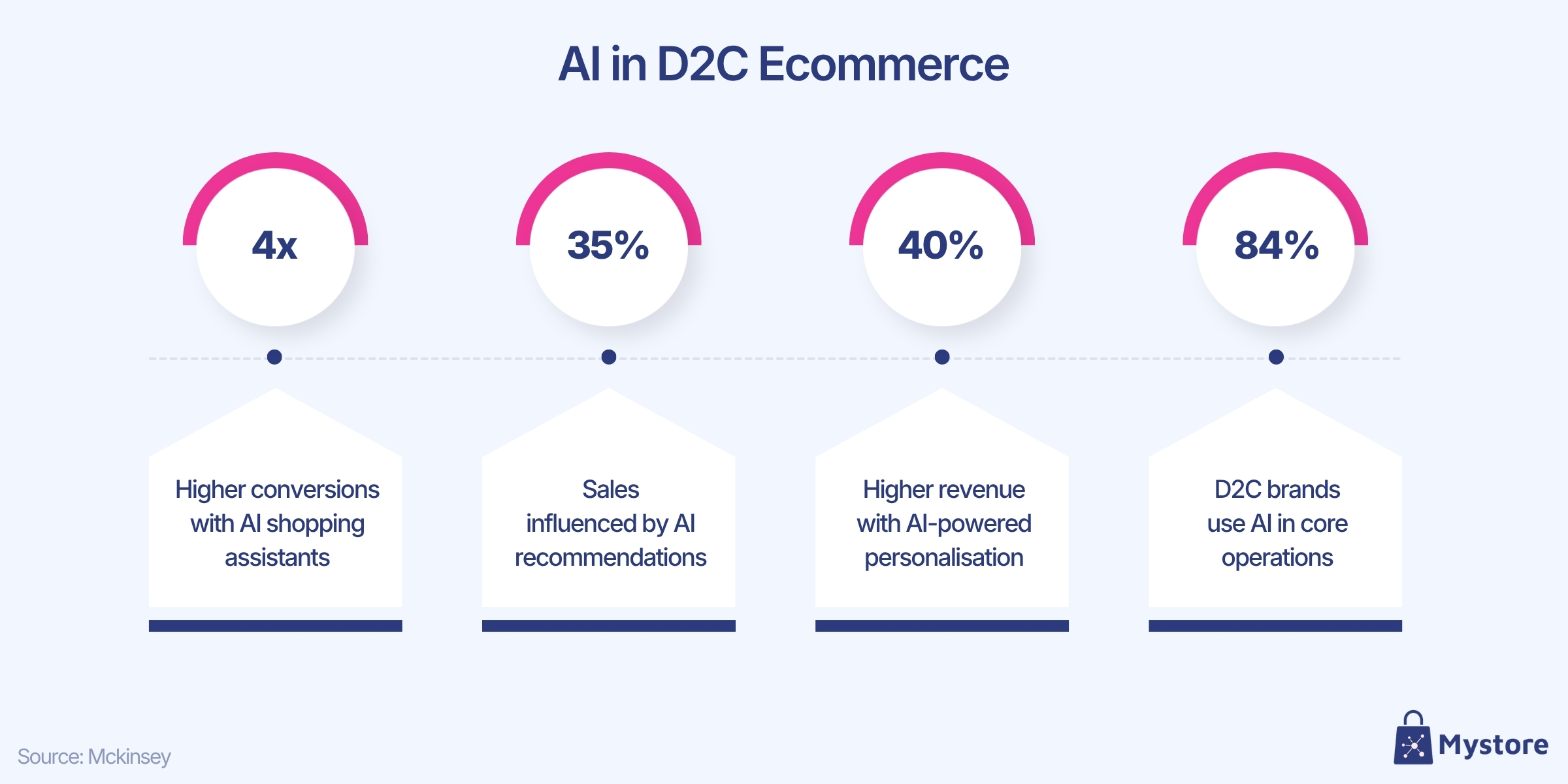
- 84% of D2C brands now actively integrate AI into their core operations
- 40% higher revenue for D2C brands using AI-powered personalisation over static commerce experiences
- 4x conversion growth for D2C brands using AI shopping assistants
- 25%-35% of D2C sales are influenced by AI-powered recommendations
Source: Mckinsey
Key Takeaway: AI has become a major revenue and conversion driver by powering personalisation, recommendations, and smarter buyer journeys.
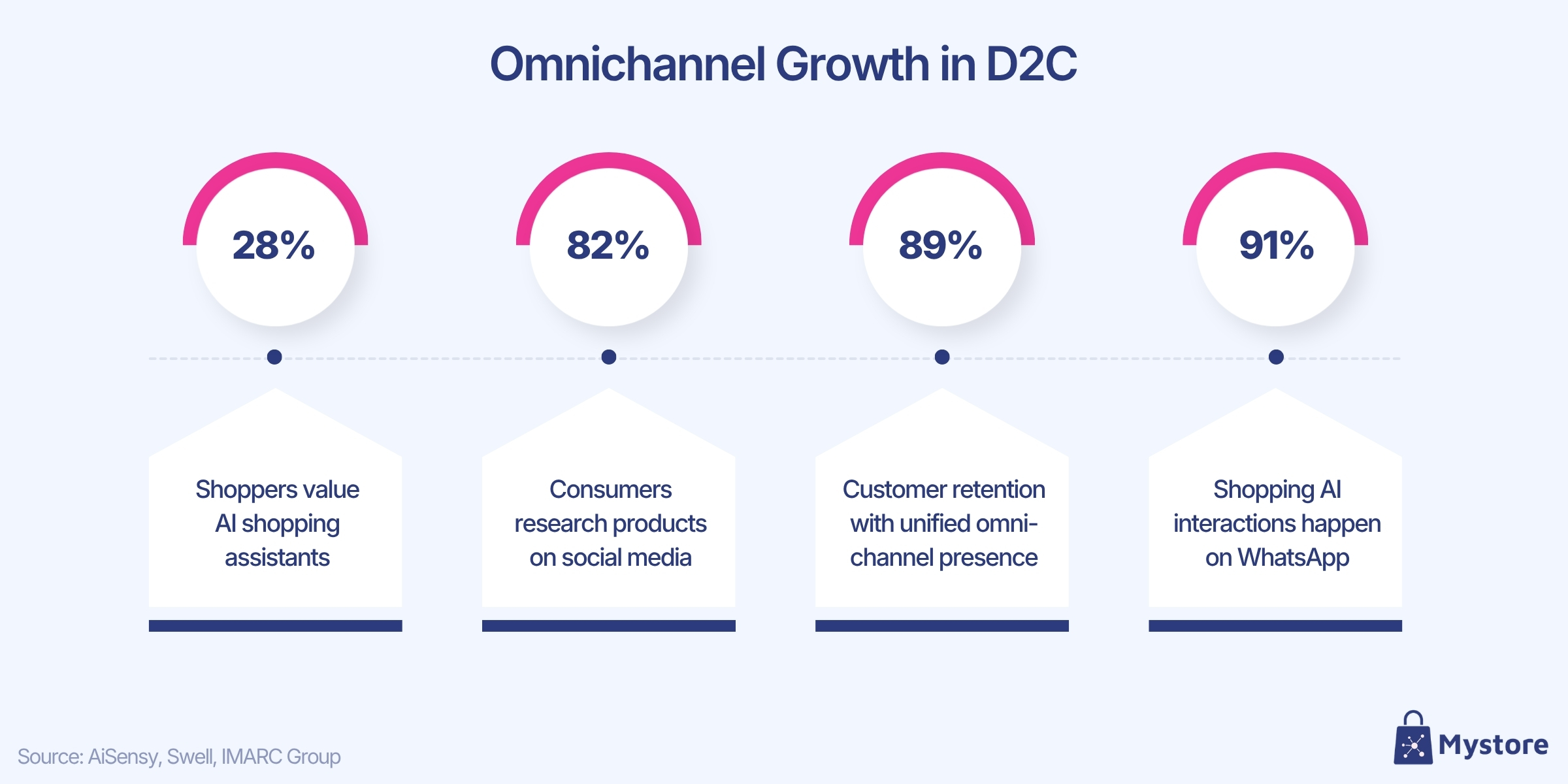
- 89% of customer retention for D2C brands with unified omnichannel presence
- 82% of consumers use social media for product research
- 28% of shoppers now find AI shopping assistants valuable
- 91% of all conversational AI interactions for shopping occurred on WhatsApp
Source: AiSensy, Swell, IMARC Group
Key Takeaway: Connected omnichannel experiences across social, mobile, WhatsApp, and AI channels has become essential for customer retention and growth.
The picture is clear: The next phase of D2C ecommerce growth will be driven by AI, mobile commerce, and connected omnichannel experiences. Brands that adapt early to these shifts will scale faster, improve customer engagement, and build stronger long-term growth.
10 Tried and Tested Strategies to Boost Sales of Your D2C Ecommerce Brand in 2026 and Beyond
Here are the top 10 tried and tested strategies that D2C ecommerce Brands must follow to stay ahead in 2026 and beyond
1. Choose Tech Solution That Enables You to Experiment
Over the last few years, high-growth D2C ecommerce brands have proven one thing clearly: the brands that scale fastest are the ones that experiment the most. Whether it’s launching new collections, testing pricing, optimising checkout, or introducing new channels, speed of execution has directly translated into higher revenue.
As we move into 2026 and beyond, this ability to test and iterate quickly becomes even more critical. Customer expectations are evolving faster, and platforms that rely on plugins and fragmented tools simply slow brands down.
Mystore’s enterprise ecommerce solution enables this growth by offering a native, plugin-free ecosystem. Payments, logistics, marketing, and AI tools are already integrated, so D2C brands can focus on running experiments that drive sales, not managing tech. This agility is exactly what allows brands to stay competitive and grow sustainably in the next phase of D2C ecommerce.
2. Build A WOW, Branded Online Store
D2C brands that invested early in strong branding and immersive storefronts have consistently outperformed those relying only on marketplaces. Why? Because a branded store builds trust, recall, and emotional connection, which directly impacts conversion rates and repeat purchases.
In 2026, as customer acquisition becomes more expensive, your owned storefront will play an even bigger role in boosting sales. Buyers don’t just want products , they want brands they can connect with.
Mystore helps D2C ecommerce brands build high-performing branded stores at zero cost, zero coding and zero design effort. You get access to pre-designed themes and layouts that enhance your brand’s visual appeal while guiding shoppers through a seamless buying journey. With an SEO-friendly web store, built-in marketing and AI tools, multiple payment methods, on-network logistics solutions, and seamless integrations, your store doesn’t just look premium, it’s built to convert traffic into sales at scale.
3. Offer Seamless Mobile Shopping Experience
Mobile shopping has completely transformed the ecommerce buying experience. It’s the next wave of digital commerce because customers now want instant access, faster decisions, and a personalised journey on the device they use the most. Over 80% of D2C purchases now begin on mobile. If your store isn’t optimised for mobile, you lose buyers before they ever reach your product pages. A seamless mobile experience makes shopping fast, intuitive, and distraction-free. For D2C brands, this is where real conversion happens.
Mystore gives brands a fully responsive storefront and enables them to build branded mobile apps, so your buyers’ experience is truly mobile-native. With Mystore’s built-in mobile app builder, you can easily create Android and iOS apps for your brand without coding. Your products and inventory sync in real-time, ensuring accurate availability, pricing, and stock counts across channels. With accelerated page load, fast checkout flows, and integrated payments, your store feels like a premium mobile app, without spending lakhs on custom development. You deliver the kind of experience buyers love on smartphones: smooth, personal, and trust-building.
4. Take Your D2C Brand Omnichannel
If you want your D2C ecommerce brand to truly outshine competitors, having just an online presence is no longer enough. Today’s buyers discover, evaluate, and purchase products across multiple platforms, often interacting with four to five touchpoints before making a final decision. As online selling trends in 2026 continue to evolve, customers expect brands to be present everywhere they shop. A true omnichannel approach doesn’t just improve visibility; it actively boosts sales, builds trust, and increases repeat purchases.
Mystore makes omnichannel selling effortless with a single backend powering every channel. When you build your brand on Mystore, you get automatic presence across your web store, branded mobile app, PWA, and multiple ONDC Network buyer apps. There’s no need to manage separate systems, one dashboard handles orders, payments, catalogue, and fulfilment. This unified setup delivers a seamless customer experience while reducing operational complexity, helping D2C ecommerce brands scale faster in 2026 and beyond.
5. Reach New Buyers With Multilingual Voice Commerce
Voice commerce has already started changing how buyers discover products, especially in non-metro markets where typing long searches or navigating interfaces isn’t always convenient. Instead of endless browsing, customers are increasingly choosing to search, compare, and shop using simple voice commands. This shift is no longer experimental; it’s a real behaviour change shaping ecommerce trends in 2026.
Mystore makes this transformation effortless with Mystore Genie. Mystore Genie is a voice-enabled, multilingual conversational AI shopping agent that understands buyer intent, answers product queries, and guides customers from search to checkout in real time.
With Mystore’s enterprise ecommerce solution, brands can not only leverage Mystore Genie but also build customised conversational AI shopping experiences tailored to their niche. Buyers can search products, explore options, add items to cart, and place orders using voice commands in multiple languages. This transforms your D2C store from a static catalogue into a smart, conversational shopping experience that feels personal, intuitive, and built for growth in 2026 and beyond.
6. Implement Smart Automation at Multiple Levels
Automation has already helped D2C ecommerce brands reduce operational costs, speed up product launches, and maintain consistency at scale. Brands that embraced AI early have been able to scale faster and deliver more reliable customer experiences. As ecommerce trends in 2026 continue to evolve, automation is no longer just an efficiency tool, it’s a core sales strategy.
By automating repetitive workflows, brands free up their teams to focus on high-impact initiatives such as growth campaigns, brand building, and retention. This shift from manual execution to intelligent automation is what turns operational efficiency into sustained sales growth in modern D2C ecommerce.
Mystore enterprise ecommerce solutions offers a host of AI tools to help D2C brands move faster, operate smarter, and convert more efficiently across every stage of the buying journey. AI-powered cataloguing enables you to generate product titles, descriptions, and categories in minutes instead of hours. Magic Edit, Mystore’s AI image editing tool, transforms raw product photos into polished, conversion-ready visuals that improve click-through rates. Additionally, Mystore Genie, a conversational AI shopping assistant, allows buyers to discover products, add items to cart, and complete checkout through simple voice or chat commands. The result is a faster, smarter, and more seamless buying experience designed to drive sales in 2026 and beyond.
7. Offer Personalised Search and Recommendations
Personalisation has already emerged as one of the most powerful drivers of higher conversion rates and repeat purchases in the D2C ecommerce landscape. Brands that actively guide customers, rather than leaving them to browse endlessly, consistently see higher cart values, faster decision-making, and stronger customer loyalty.
As we move into 2026, personalised product discovery will no longer be a competitive advantage; it will be a minimum expectation. Buyers increasingly expect brands to understand their intent, preferences, and context the moment they start shopping.
Mystore’s AI-powered semantic search and recommendation engine enables D2C ecommerce brands to recommend the most relevant products at exactly the right moment. By analysing browsing behaviour, search intent, and past interactions in real time, Mystore helps brands reduce friction, increase conversions, and deliver a shopping experience that feels intuitive, personalised, and designed to drive sustained sales growth.
8. Make Payments Frictionless
If you are running a D2C brand, you have clearly seen that even minor payment friction leads to cart abandonment. Faster, smoother checkout experiences have consistently delivered higher conversion rates and lower drop-offs, proving that payments play a direct role in revenue performance.
As competition intensifies in 2026 and beyond, frictionless payments become essential not just for convenience, but for protecting and maximising conversions. Buyers expect checkout to be instant, intuitive, and interruption-free.
Mystore ensures this friction-free experience with fully native payment integrations built right into the platform. Whether it’s UPI, wallets, cards, or net banking, everything works inside your store without external redirects or plugin failures.
The result is a payment experience that builds trust, reduces abandonment, and ensures more buyers complete their purchases, a simple yet highly effective growth driver for boosting D2C sales.
9. Streamline Delivery with Efficient Logistics
The way you manage fulfilment can make or break your brand’s trust. In ecommerce, delivery is everything. You may have a stunning storefront and a wide product catalogue, but if orders don’t reach customers on time, you lose them. Delivery is the final touchpoint buyers remember, and for D2C brands, winning here means winning loyalty. Faster shipping, accurate timelines, and proactive communication turn first-time shoppers into repeat customers. Smart logistics also reduces costs, boosts satisfaction, and helps you build a strong brand presence.
Mystore makes this effortless with on-network logistics that connect you to multiple delivery partners, optimised routing, and real-time shipment updates. Orders are automatically assigned to the best courier based on speed, reliability, and cost. With on-network fulfilment and dealer-routed delivery options, you can even offer fast delivery without managing your own fleet. The outcome? Faster deliveries, reduced operational costs, and higher customer retention, powered by a logistics system built for a modern D2C ecommerce enterprise.
10. Strategise Marketing to Sell More
Even the most beautifully designed online store won’t deliver results if it’s not reaching the right customers. In 2026, strategic marketing is one of the defining trends for D2C ecommerce brands, and success depends on using the right tools to attract, engage, and retain buyers.
Mystore’s enterprise ecommerce solution strengthens your growth engine with robust built-in marketing capabilities. You can instantly generate PDF catalogues with clickable links, making it effortless to share products across WhatsApp, email, and other sales channels. Every product and seller page comes with a unique QR code that customers can scan, save, and revisit anytime, ensuring a constant flow of repeat traffic without extra effort.
Additionally, Mystore’s advanced discount engine lets you create multi-level offers, personalised deals, and targeted promotions that actively engage and convert buyers. With Mystore’s integrated marketing ecosystem, your brand becomes more discoverable, highly engaging, and conversion-ready across every touchpoint, keeping you ahead of the curve in online selling trends 2026.
Conclusion
The D2C ecommerce landscape in 2026 is fast, competitive, and constantly evolving. Brands that thrive won’t just sell products, they will deliver seamless, personalised, and memorable shopping experiences across every touchpoint.
With Mystore’s enterprise ecommerce solution, implementing these strategies becomes effortless. From AI-powered cataloguing and personalised recommendations to multilingual voice commerce and on-network logistics, Mystore provides a plug-and-play ecosystem that saves time, reduces costs, and empowers D2C brands to scale faster.
If you want your D2C brand to stay ahead, boost conversions, and turn first-time buyers into lifetime customers, now is the time to act.
Book a demo with Mystor enterprise solution to experiment, optimise, and grow.
FAQs
1. Why are AI-native enterprise ecommerce solutions essential for D2C brands in 2026 and beyond?
AI-native enterprise ecommerce solutions are essential for D2C brands because they embed intelligence across the entire business, not just customer interactions. They help automate catalogues, personalise shopping experiences, optimise marketing, streamline operations, and improve decision-making. This enables brands to scale faster, reduce manual effort, increase efficiency, and stay competitive in an increasingly AI-driven commerce landscape.
2. How can D2C brands scale faster without increasing operational complexity?
D2C brands can scale faster by using a unified, AI-powered ecommerce platform that automates routine tasks, centralises operations, and integrates commerce, inventory, fulfilment, marketing, and customer engagement. This reduces manual processes, improves visibility, and enables businesses to handle higher order volumes, more channels, and growing customer demands without adding operational complexity.
3. Why is omnichannel commerce a major growth strategy for D2C ecommerce brands?
Omnichannel commerce helps D2C brands reach customers wherever they prefer to shop, whether through websites, mobile apps, marketplaces, social channels, WhatsApp, or offline touchpoints. By creating a consistent experience across channels, brands can improve customer engagement, increase conversions, strengthen loyalty, and unlock new revenue opportunities while managing operations from a unified platform.
4. How can D2C ecommerce brands improve conversions through personalisation?
D2C brands can improve conversions through personalisation by delivering relevant product recommendations, targeted offers, customised content, and tailored shopping experiences based on customer behaviour, preferences, and purchase history. Personalisation helps shoppers discover the right products faster, increases engagement, builds loyalty, and encourages higher conversion rates and repeat purchases.
5. Why are mobile-first experiences critical for ecommerce trends 2026?
Mobile-first experiences are critical for ecommerce in 2026 because most product discovery, browsing, and purchases now happen on smartphones. Fast, intuitive mobile experiences improve engagement, conversions, and customer retention. They also enable brands to support app commerce, social commerce, conversational commerce, and on-the-go shopping, making mobile a key driver of growth and customer experience.
6. How can conversational commerce improve D2C customer engagement?
Conversational commerce improves D2C customer engagement by enabling real-time, personalised interactions through WhatsApp, chat, voice, and AI-powered assistants. It helps brands guide customers through product discovery, answer queries instantly, provide support, and simplify purchases, leading to higher engagement, better customer experiences, and increased conversions.
7. Why are integrated ecommerce ecosystems replacing plugin-based commerce models?
Integrated ecommerce ecosystems are replacing plugin-based models because they reduce complexity, improve reliability, and provide a more seamless experience across commerce, marketing, payments, inventory, fulfilment, and customer engagement. With fewer disconnected tools to manage, businesses gain better visibility, faster execution, lower maintenance overhead, and a stronger foundation for scaling growth.
8. How can AI automation improve operational efficiency for D2C brands?
AI automation helps D2C ecommerce brands streamline repetitive workflows like cataloguing, image optimisation, customer communication, recommendations, and order management. This improves operational efficiency while allowing teams to focus more on growth, retention, and brand building.
9. What role does logistics play in improving D2C ecommerce growth?
Logistics plays a critical role in D2C ecommerce growth by ensuring fast, reliable, and cost-effective order fulfilment. Efficient logistics improves delivery experiences, reduces delays and returns, increases customer satisfaction, and encourages repeat purchases. It also helps brands scale operations across regions while maintaining service quality and operational efficiency.
10. How can D2C brands prepare for future online selling trends beyond 2026?
D2C brands can prepare for future ecommerce trends by investing in flexible, AI-native, mobile-first commerce platforms that support omnichannel selling, personalisation, conversational commerce, automation, and seamless integrations. Building a scalable digital foundation enables brands to adapt quickly to changing customer expectations, new sales channels, and evolving market opportunities.