

 Contact Us
 Appliances
 Agri Inputs
 Auto Components & Accessories
 Beauty & Personal Care
 Electronics
 Fashion
 Grocery
 Gift Cards
 Home & kitchen
 Health & Wellness
 Vehicles & Automotives
 Books & Stationary
 Pet Care
 Toys & Games
Why Digital Native D2C Brands Should Choose Mystore For Omnichannel Growth
ONDC Network for D2C Sellers
Key Takeaways
- Omnichannel ecommerce is essential for D2C brands to scale, as customers increasingly engage across multiple platforms before making a purchase.
- A unified enterprise ecommerce solution is critical to manage multiple channels, streamline operations, and deliver consistent customer experiences.
- Mystore’s fully integrated ecommerce ecosystem enables D2C brands to connect storefronts, mobile apps, ONDC Network, WhatsApp, and AI-driven channels from a single platform.
- With built-in omnichannel capabilities, AI-powered tools, and seamless integrations, Mystore helps brands scale faster, improve conversions, and reduce operational complexity.
For digital-native D2C brands, growth isn’t really about demand anymore, it’s about how well that demand is fulfilled across different channels.
A product might be trending, marketing may be driving traffic, but if the buying experience breaks somewhere along the way, those potential sales are lost. The real challenge today isn’t visibility, it’s consistency.
This is where many D2C brands start to struggle. As they expand to multiple channels, things become harder to manage. Systems don’t sync properly, operations get messy, and what once felt smooth starts slowing everything down.
To truly scale, adding more tools isn’t the solution. What brands really need is a connected system where everything works together seamlessly.
That’s exactly what Mystore fully integrated ecommerce ecosystem is built for, helping D2C brands turn scattered growth into a more structured and scalable journey.
In this blog, we will explore how digital-native D2C brands can build scalable omnichannel ecommerce growth with Mystore, but before that, let’s take a look at the key trends shaping the D2C ecommerce landscape in India.
Table of Contents
- How D2C Ecommerce Markets In India Are Shaping Up
- Why D2C Brands Should Choose Mystore Ecommerce Solutions for Omnichannel Growth
- 1. 360-Degree D2C Ecommerce Solutions
- 2. Quick Go-to-Market
- 3. AI-powered Core for Smarter Business
- 4. Built Natively for Omnichannel Scale
- 5. Leverage M-commerce To Reach Tier II, III, and Beyond
- 6. Engage and Convert Customers on WhatsApp
- 7. Leverage AI Sales Channel with Mystore Genie
- 8. Manage Conversations with a Unified Conversational Dashboard
- 9. Seamless Integrations For Your Unique Brand Requirements
- 10. Flexible Payment Solutions
- 11. Streamline Deliveries with ON Network Logistics
- Conclusion
- FAQs
How D2C Ecommerce Markets In India Are Shaping Up
The Indian D2C ecosystem is no longer in its early growth phase, it has entered a scale phase driven by stronger digital adoption, deeper market penetration, and evolving customer expectations.
What’s changing is not just the size of the market, but how growth is being defined. It is increasingly shaped by omnichannel presence, AI-driven experiences, and mobile-first consumption patterns.
Let’s look at the key trends driving this transformation.
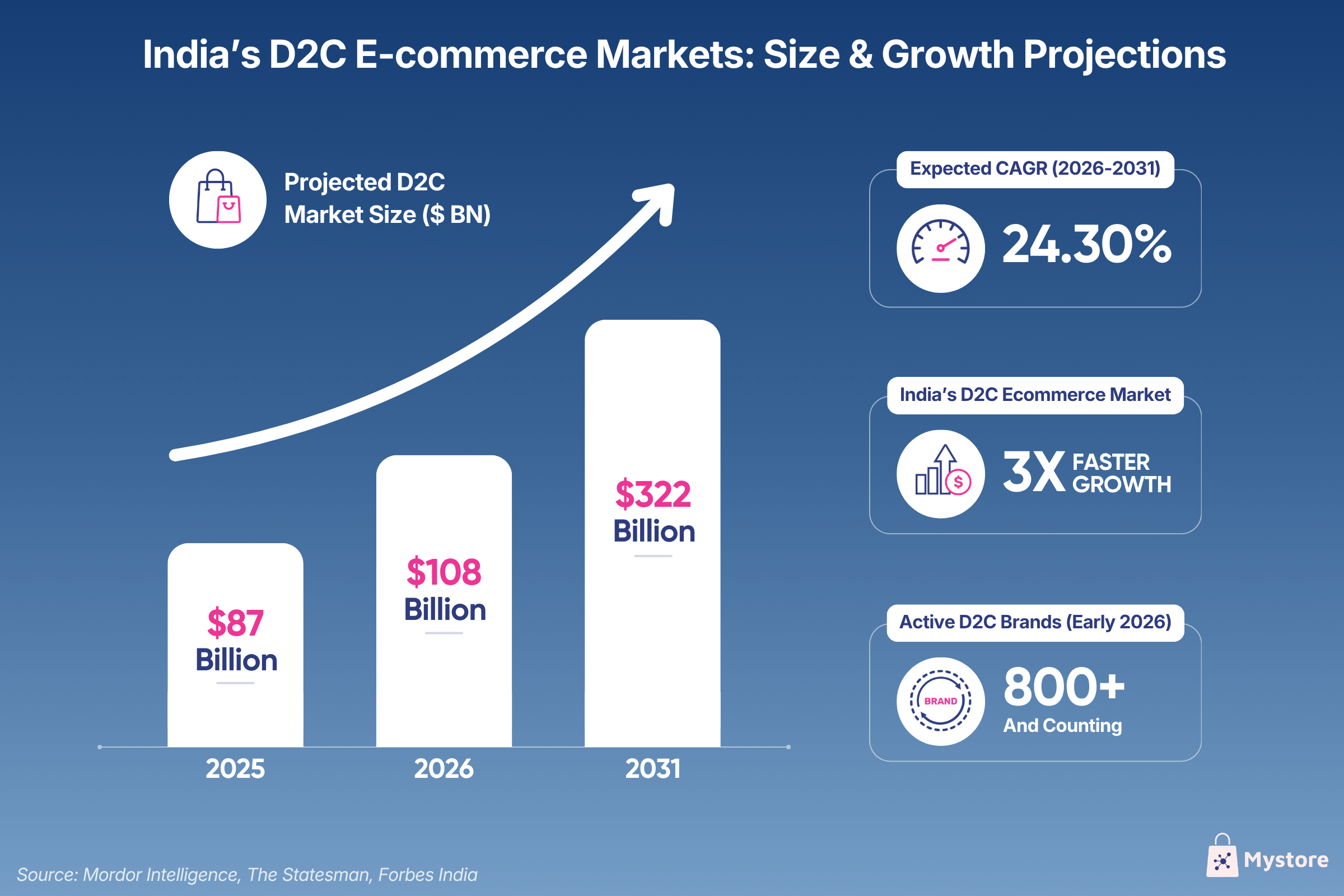
- $ 87.5 bn was India's D2C E-commerce market size in 2025
- $108.76 bn is the projected value of India's D2C Market size by 2026
- $322.1 bn is the expected value of India's D2C Market size by 2031
- 24.30% is the expected CAGR of India's D2C Market size for 2026 -2031
- 3X Faster Growth in India’s D2C Ecommerce Market
- 800+ Active D2C Brands in India as of Early 2026
Source Mordor Intelligence , The Statesman , Forbes India
The takeaway – The opportunity is massive, but with rapid growth comes intense competition. D2C brands need scalable and future-ready ecommerce solutions to sustain and capture this expanding market.
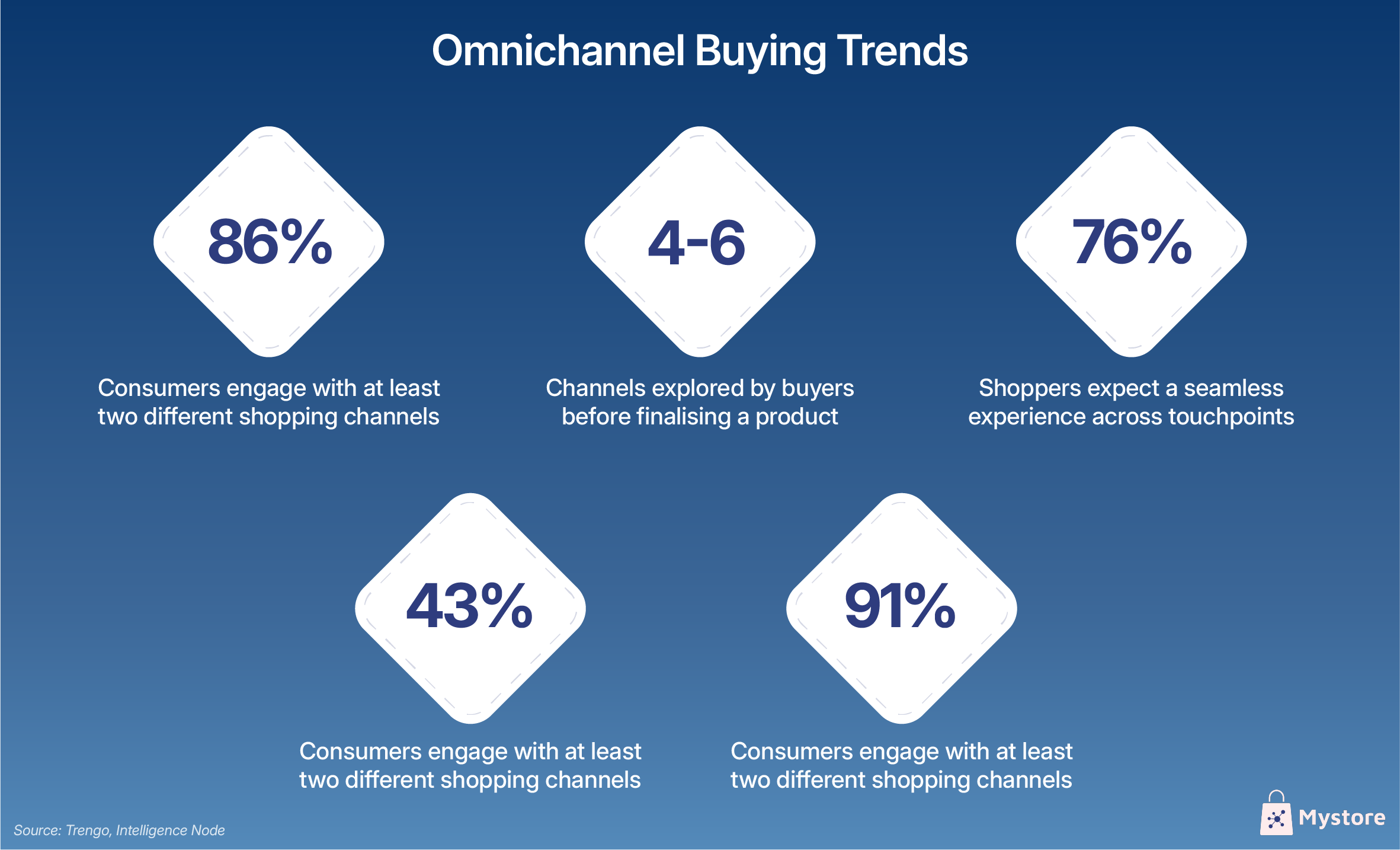
- 86% of consumers engage with at least two different shopping channels
- 4-6 channels explored by buyers before finalising a product
- 76% of shoppers expect a seamless experience across touchpoints
- 43% of businesses report a rising demand for omnichannel experiences
- 91% higher year-on-year customer retention for brands with omnichannel strategies
Source: Trengo, Intelligence Node
The takeaway – Growth is no longer driven by a single channel. Brands that fail to deliver a connected, seamless experience across platforms risk losing customers at critical decision points.
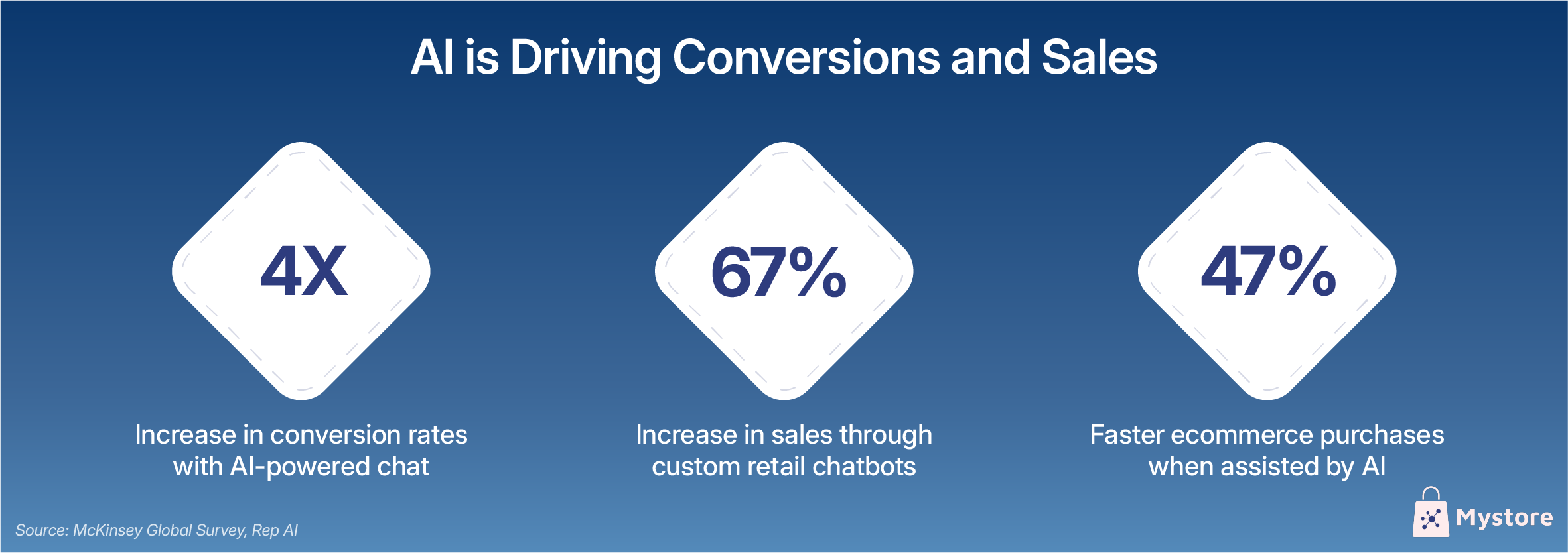
- 4X increase in conversion rates with AI-powered chat
- 67% increase in sales through custom retail chatbots
- 47% faster ecommerce purchases when assisted by AI
Source: McKinsey Global Survey, Rep AI
The takeaway – AI is shifting from a support tool to a revenue driver. Brands that embed AI into their core shopping experience are seeing faster decisions, higher conversions, and stronger customer engagement.
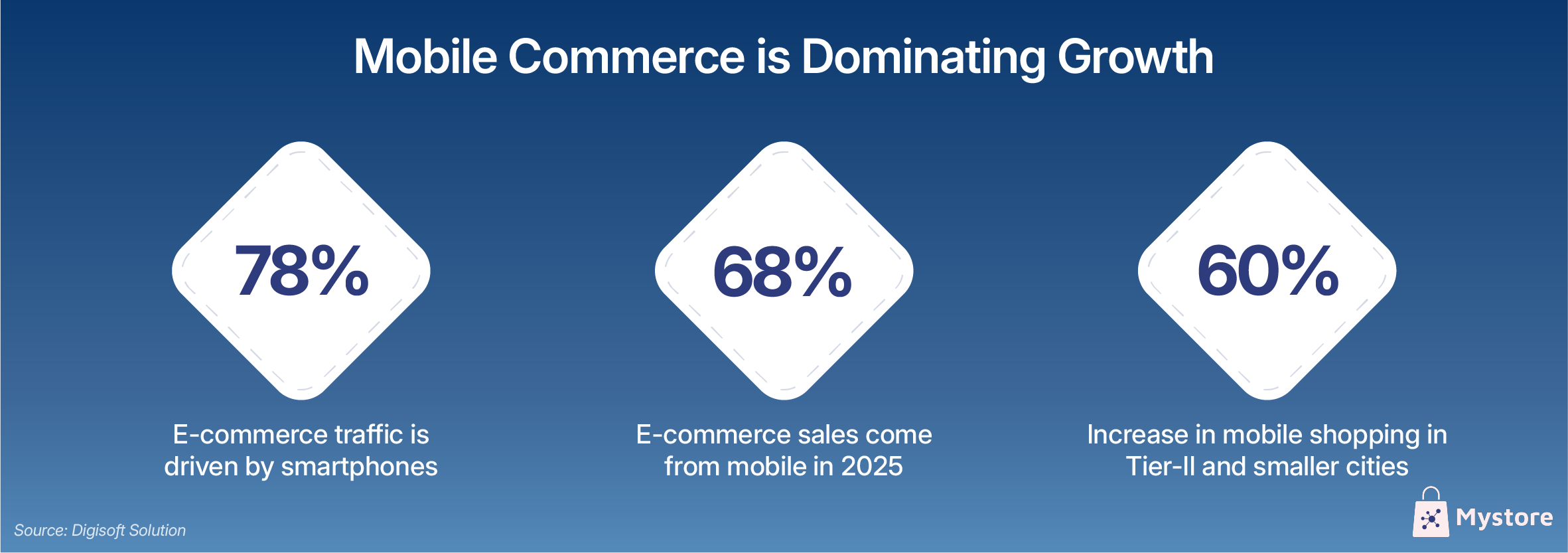
- 75-78% of all ecommerce traffic is driven by smartphones
- 68% of all ecommerce sales come from mobile in 2025
- 60% increase in mobile shopping in Tier-II and smaller cities
Source: Digisoft Solution
The takeaway – Mobile is now the primary commerce interface. D2C brands that fail to optimise for mobile-first experiences risk missing out on the fastest-growing customer segments.
The data highlights a clear shift in how D2C growth is being driven today. It is no longer just about launching online, it is about building an ecosystem that supports omnichannel engagement, AI-driven experiences, and mobile-first consumption.
So, how can digital-native brands adapt to this shift without adding operational complexity or relying on fragmented tools?
Why D2C Brands Should Choose Mystore Ecommerce Solutions for Omnichannel Growth
Here are the key ways Mystore’s enterprise ecommerce solutions enable D2C brands to achieve seamless omnichannel growth.
1. 360-Degree D2C Ecommerce Solutions
Are you managing multiple tools just to keep your D2C operations running smoothly? From storefronts and mobile apps to payments, logistics, and marketing, many brands rely on disconnected systems that increase complexity and create inconsistent customer experiences.
Mystore simplifies this with a fully integrated, enterprise-grade ecommerce ecosystem designed specifically for D2C growth. Instead of integrating with multiple tools and plugin, brands get built-in tools to manage everything from product catalogues and storefronts to orders, payments, and fulfilment through a single, unified system.
Built on flexible, headless and API-based architecture, Mystore enables easy customisation and supports multi-store, multi-vendor, and hyperlocal commerce models, all while ensuring enterprise-grade security and compliance. It simplifies operations, enhances visibility, and ensures a consistent omnichannel experience across every touchpoint.
2. Quick Go-to-Market
Are long development cycles slowing down your ability to launch and scale? In the fast-paced D2C ecommerce ecosystem, taking months to go live means missing out on trends, seasonal demand, and the advantage of being among the first to attract and engage customers.
Mystore eliminates these delays by enabling brands to launch fully functional, branded storefronts within days. Its fully integrated ecommerce ecosystem comes with built-in tools you can use from day one, along with pre-integrations for payments, logistics, and other essential ecommerce tools for managing orders, inventory, marketinge etc, so you can go live faster without heavy setup.
There’s no need to build everything from scratch or depend heavily on developers to manage complex systems and ongoing maintenance. With Mystore, you can quickly set up your D2C branded store and start selling from day one.
You can also test new markets faster, experiment with product lines, and respond quickly to changing customer demand. A faster go-to-market not only accelerates revenue but also gives your brand the agility needed to stay competitive.
3. AI-powered Core for Smarter Business
Struggling to keep up with evolving customer expectations and data-driven decision-making? As D2C businesses scale, manual processes often fall short in delivering the level of personalisation and efficiency required.
Mystore is built on an AI-powered core that enhances every aspect of ecommerce operations. From intelligent product discovery and personalised recommendations to automated catalogue management, AI works behind the scenes to optimise both customer experience and business performance.
Its AI-powered cataloguinghelps you quickly generate product titles and descriptions right from the product image, while automating categorisation and tagging. Its AI image editing tool, Magic Edit, transforms raw product images into high-quality visuals. D2C brands can also leverage the agentic AI shopping assistant, Mystore Genie, to deliver personalised shopping journeys. Mystore Genie is multilingual, voice-enabled, and conversational, helping buyers easily search, discover, and purchase products.
This enables brands to deliver highly relevant experiences, improve engagement, and make faster, data-backed decisions. Instead of reacting to trends, businesses can proactively optimise their strategies, driving better conversions and long-term customer loyalty.
4. Built Natively for Omnichannel Scale
Ecommerce today goes far beyond just a website. It’s about enabling sales across multiple channels and meeting customers wherever they choose to shop. However, many platforms offer omnichannel capabilities as add-ons, relying on multiple integrations that often fail to work smoothly together.
Mystore fully integrated ecosystem ensures your D2C brand goes omnichannel right from start. It comes with a built-in mobile app builder, enabling you to easily create Android and iOS apps for your D2C brand. You can also launch fully functional PWA stores to reach customers in low-connectivity areas.
With Mystore, D2C brands can also connect with the ONDC Network to expand their market reach and gain visibility across multiple buyer apps, helping them discover and engage with a wider customer base. You can also engage customers through WhatsApp by integrating your WhatsApp Business account, making it easier for customers to discover products, interact with your brand, and shop through preferred channel. All these channels are connected by a unified backend with real-time data synchronisation, keeping inventory, orders, and customer data instantly updated across every touchpoint. Using Mystore Genie your buyers can search and shop right inside a chat window.
Whether customers engage through your storefront, mobile app, ONDC Network buyer apps, WhatsApp, or AI chat interface, every interaction is seamlessly connected. This not only creates a consistent and frictionless shopping experience but also simplifies backend operations, enabling D2C brands to scale across channels without added complexity.
5. Leverage M-commerce To Reach Tier II, III, and Beyond
In India, around 81% of online shoppers make purchases through smartphones. In Tier II, III, and smaller cities, mobile is often the primary or only way to shop online. If your mobile experience isn’t strong, you risk missing out on a massive and fast-growing customer base.
But building a mobile app from scratch is time-consuming, expensive, and resource-intensive. You need to hire developers, invest heavily in custom development, and wait months to go live.
Even after launch, every product or price update often requires app updates, leading to ongoing delays, added costs, and operational complexity.
Mystore eliminates these challenges with a robust no-code mobile app builder. You can create Android and iOS apps directly from the admin dashboard without building from scratch or relying on developers. It also supports PWA-enabled webstores, enabling you to deliver fast, app-like experiences even in low connectivity areas, so your brand remains accessible, responsive, and easy to use for every customer.
From day one, your apps are ready to use, synced in real time with your inventory and product catalogue.
By building a strong mobile presence, you can unlock demand from high-growth regions, improve reach and accessibility, and create seamless shopping journeys. The result is better engagement, higher conversions, and faster growth across emerging markets.
6. Engage and Convert Customers on WhatsApp
In India, WhatsApp is where most online conversations and purchase decisions happen. If your brand is not present there, you are likely missing out on high-intent customer interactions.
With Mystore, WhatsApp is not just a messaging tool. It becomes a powerful commerce channel where you can engage customers in real time, answer queries, share product details, and even enable purchases directly within the chat. Customers can open your online store directly from WhatsApp with a single tap, making it easy to start shopping instantly. This removes friction from the buying journey by eliminating the need for app switching, repeated logins, or extra steps that often lead to drop-offs.
Mystore also helps you stay connected with customers through order updates, delivery notifications, and ongoing communication. This makes it easier to bring customers back to your store every time they interact with your D2C brand on WhatsApp, encouraging repeat purchases.
Overall, it simplifies communication and makes the buying process more convenient. For D2C brands, this leads to smoother interactions, faster conversions, and stronger customer relationships.
7. Leverage AI Sales Channel with Mystore Genie
Today’s buyers expect more than just a list of products. They want guidance, relevant suggestions, and a smooth buying experience that helps them quickly find what fits their needs. When this doesn’t happen, they tend to drop off without completing the purchase.
Mystore enterprise ecommerce solution addresses this gap by offering Mystore Genie, which is an intelligent shopping assistant rather than a basic chatbot. It interacts with customers through natural conversations, understands what they are looking for, and suggests products that are more aligned with their intent. This makes product discovery faster and more relevant.
It also supports customers beyond search. From helping them explore options to assisting during checkout steps, Genie ensures the journey remains smooth and uninterrupted. Buyers do not have to navigate complex menus or filters, as the experience feels more guided and intuitive.
For D2C brands, this means less drop-offs, quicker decision-making, and better conversion outcomes. By making the shopping journey more interactive and user-friendly, Genie helps create a differentiated experience that aligns with how modern customers prefer to shop.
8. Manage Conversations with a Unified Conversational Dashboard
As conversational commerce becomes an important part of the customer journey, managing interactions across different conversations can become challenging for growing D2C brands. Teams need visibility into customer interactions while ensuring that conversations remain consistent and relevant across the buying journey.
Mystore’s Unified Conversational Dashboard brings conversational interactions into a centralised interface, giving brands a single place to manage and monitor their AI-powered shopping conversations. Instead of handling customer interactions across disconnected systems, teams can get a unified view of conversations and better understand what customers are looking for.
This makes it easier to manage conversational shopping experiences at scale while maintaining consistency across customer interactions. By bringing conversational commerce management into the broader ecommerce ecosystem, Mystore helps D2C brands simplify operations while delivering more connected and personalised shopping experiences.
9. Seamless Integrations For Your Unique Brand Requirements
Is your current ecommerce setup too rigid to support your evolving business needs? As D2C brands scale, they often require specialised tools and integrations to streamline operations and drive efficiency.
While Mystore is a fully integrated enterprise ecommerce solution, it also offers seamless integration with third-party tools and software. Whether you want to connect your existing ERP, CRM, payment gateways, or logistics partners, Mystore enables smooth integrations without disrupting workflows, unlike plugin-dependent platforms.
This flexibility allows brands to build a customised ecosystem aligned with their unique requirements. By enabling easy, scalable integrations, Mystore empowers D2C brands to innovate and grow without being limited by their technology stack.
10. Flexible Payment Solutions
Are customers abandoning their carts due to limited or inconvenient payment options? A restricted checkout experience can directly impact conversion rates and overall customer satisfaction.
Mystore provides a wide range of flexible payment solutions, including UPI, wallets, cards, and other digital methods, catering to diverse customer preferences. This ensures that customers can complete their purchases using the option they trust and prefer.
A smoother, more flexible checkout experience reduces friction, minimises drop-offs, and helps D2C brands maximise conversions across all channels.
11. Streamline Deliveries with ON Network Logistics
Managing fulfilment on an omnichannel ecommerce system means handling orders across multiple channels simultaneously. You have orders coming in from your webstore, mobile app, marketplaces, and even offline channels and all of them need to be processed and delivered on time.
Coordinating this with multiple logistics partners often leads to delays, inefficiencies, and inconsistent customer experiences.
Mystore simplifies this with ON Network logistics by offering 40+ logistics partners with real-time rate comparisons. Brands can easily choose the delivery partner that offers the best deals and fast delivery. You can also connect your preferred delivery partners for more efficient fulfilment and switch seamlessly between on-network and off-network logistics whenever needed.
This flexibility helps optimise shipping costs while ensuring timely deliveries. With better control over logistics decisions, D2C brands can improve efficiency, maintain consistent service levels, and deliver a more reliable post-purchase experience that drives customer satisfaction and repeat business.
Conclusion
For digital-native D2C brands, growth today depends on how effectively they can adapt to evolving customer expectations and deliver seamless experiences across multiple channels.
Relying on fragmented systems and disconnected tools not only slows down operations but also creates gaps in the customer journey. To scale efficiently, brands need a platform that brings everything together while supporting speed, flexibility, and innovation.
Mystore’s fully integrated ecommerce ecosystem provides exactly that. With built-in omnichannel capabilities, AI-powered tools, and seamless integrations, it enables D2C brands to unify their operations, expand their reach, and deliver consistent, high-quality experiences across every touchpoint.
By choosing the right enterprise ecommerce solution, brands can move beyond basic digital presence and build a strong, scalable omnichannel foundation for long-term growth.
Ready to unlock omnichannel growth for your D2C brand?
Explore Mystore’s enterprise ecommerce solution and book a demo to take the next step towards scalable success.
FAQs
1. How does omnichannel ecommerce help D2C brands scale?
Omnichannel ecommerce helps D2C brands scale by connecting their website, mobile app, marketplaces, WhatsApp, and other sales channels through a unified system. It keeps inventory, orders, customer data, and fulfilment aligned across touchpoints. This reduces operational complexity, creates consistent shopping experiences, and helps brands reach more customers without having to manage every channel separately as they grow.
2. How does AI help D2C brands improve the shopping experience?
AI helps D2C brands make shopping faster, more relevant, and personalised. It can improve product discovery, generate and optimise catalogue content, recommend products based on customer intent, and assist shoppers through conversational interactions. With AI-powered tools, brands can reduce manual work while helping customers find the right products more easily, improving engagement, conversions, and overall shopping satisfaction.
3. How can D2C brands use mobile commerce to reach customers beyond major cities?
D2C brands can use mobile commerce to reach customers in Tier II, Tier III, and smaller cities, where smartphones are often a key gateway to online shopping. By offering fast, mobile-friendly websites, apps, and PWA stores, brands can make shopping more accessible. A strong mobile presence helps them reach new audiences, improve convenience, and drive growth beyond major cities.
4. How can D2C brands create a consistent customer experience across multiple channels?
D2C brands can create a consistent customer experience by connecting their website, mobile app, marketplaces, social commerce, and other touchpoints through a unified system. Centralised product information, inventory, pricing, customer data, and order management ensure customers receive consistent information across channels. This also reduces operational gaps, improves coordination, and creates a smoother, more reliable shopping journey.
5. What should D2C brands look for in an enterprise ecommerce solution?
D2C brands should look for an enterprise ecommerce solution that offers scalability, omnichannel capabilities, AI-powered tools, mobile commerce, flexible integrations, secure payments, and efficient logistics management. The platform should support multiple business models, enable seamless data synchronisation, and allow easy customisation. A future-ready solution should also reduce operational complexity while helping brands adapt quickly to changing customer expectations and market opportunities.
6. How can D2C brands reduce the complexity of managing multiple sales channels?
D2C brands can reduce the complexity of managing multiple sales channels by using a unified ecommerce platform to centralise catalogues, inventory, orders, customer data, payments, and fulfilment. Real-time synchronisation keeps information consistent across channels, while automation reduces repetitive manual tasks. This gives teams better visibility, simplifies daily operations, and makes it easier to scale across new channels efficiently.
7. How can D2C brands use WhatsApp to connect with customers and drive sales?
D2C brands can use WhatsApp to connect with customers, answer product questions, share recommendations, showcase products, and enable convenient shopping directly through conversations. Brands can also send order confirmations, delivery updates, and personalised offers to keep customers engaged after purchase. By combining communication and commerce, WhatsApp can reduce buying friction, strengthen customer relationships, and support repeat sales.
8. How can D2C brands enter new markets without making operations more complicated?
D2C brands can enter new markets without complicating operations by using a unified ecommerce platform that manages multiple channels, locations, inventory, orders, payments, and logistics from one system. Real-time data synchronisation and automation reduce manual work, while flexible integrations make it easier to adapt to local requirements. This allows brands to expand their reach while keeping operations streamlined.