



 Contact Us
 Appliances
 Agri Inputs
 Auto Components & Accessories
 Beauty & Personal Care
 Electronics
 Fashion
 Grocery
 Gift Cards
 Home & kitchen
 Health & Wellness
 Vehicles & Automotives
 Books & Stationary
 Pet Care
 Toys & Games




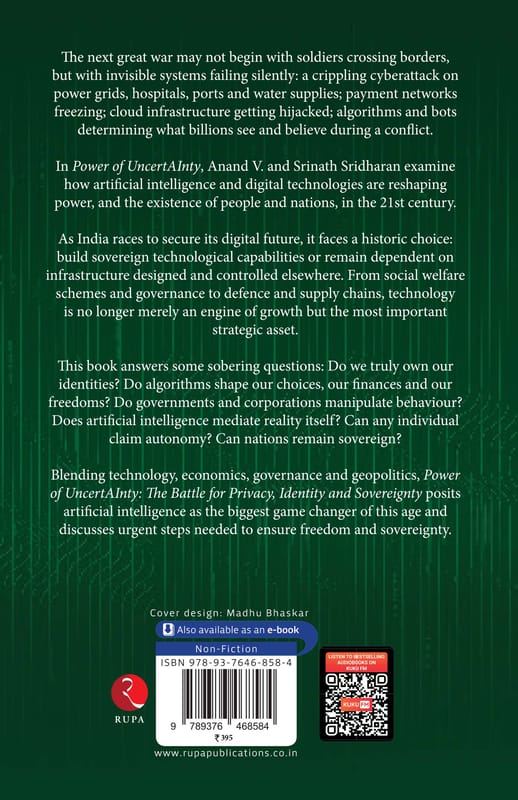



The next great war may not begin with soldiers crossing borders, but with invisible systems failing silently. A power grid goes down. Hospitals lose access to data. Ports stop functioning. Payment networks freeze. Cloud infrastructure is hija...
Read MorePopular Categories
Support
Language
Our apps
Power of Uncertainty: the Battle for Privacy, Identity and Sovereignty
Key Attributes
| Country of origin | India |
|---|---|
| Brand | Rupa Publications India |
| Net Quantity | 1 unit |
| Manufacturer or packer name | Rupa Publications India |
The next great war may not begin with soldiers crossing borders, but with invisible systems
failing silently.
A power grid goes down. Hospitals lose access to data. Ports stop functioning. Payment networks
freeze. Cloud infrastructure is hijacked. Algorithms and bots decide what millions see, believe and
fear. In the 21st century, sovereignty will not be tested only at borders—it will be tested in the
systems that run our lives.
In Power of UncertAInty, cybersecurity expert Anand V. and strategic counsel Srinath Sridharan
examine how artificial intelligence, digital infrastructure, data, financial systems and supply chains
are reshaping power itself. For India, the challenge is urgent: will it build sovereign technological
capability, or remain dependent on systems designed, owned and controlled elsewhere?
WHAT THIS BOOK EXPLORES
• Why digital sovereignty cannot be reduced to data localization or home-grown apps
• How KYC and financial regulation can become instruments of exclusion, harassment and fraud
• Why industrial policy, manufacturing capacity and social capital are central to national power
• How poor banking infrastructure reveals deeper failures in financial and industrial inclusion
• How digital, financial and industrial supply chains are now deeply interconnected
• How cybercrime networks can exploit systems such as UPI and identity infrastructure
• Why AI, LLMs, chips, cloud infrastructure and algorithms are now strategic assets
• What India must do to preserve freedom, privacy, autonomy and sovereignty in the AI age
WHY THIS BOOK MATTERS NOW
✔ It treats AI not merely as a technology trend, but as a question of national power.
✔ It connects everyday digital experiences—KYC, banking, UPI, identity checks—to larger questions
of sovereignty.
✔ It explains why technological dependence can become geopolitical vulnerability.
✔ It challenges simplistic ideas of self-reliance and argues for genuine capability-building.
✔ It places privacy, identity and freedom at the centre of India’s digital future.
✔ It speaks to policymakers, technologists, entrepreneurs, regulators, business leaders and citizens
alike.
| Country of origin | India |
|---|---|
| Brand | Rupa Publications India |
| Common name | Power of Uncertainty: The Battle for Privacy, Identity and Sovereignty |
| Net Quantity | 1 unit |
| Package Dimension | 7.79L x 5.07W x 0.78H cm |
| Manufacturer or packer name | Rupa Publications India |
| Manufacturer or packer address | Rupa Publications India |
| Manufacturing Date | 2026 |
| ISBN | 9789376468584 |
| contact details consumer care | Rupa Publications India Pvt Ltd, [email protected] |
Other Products from seller Rupa Publications India Pvt Ltd


₹145₹195 ( 26% OFF )


₹144₹195 ( 26% OFF )

₹145₹195 ( 26% OFF )

₹145₹195 ( 26% OFF )

₹144₹195 ( 26% OFF )


₹144₹195 ( 26% OFF )

₹145₹195 ( 26% OFF )

₹117₹195 ( 40% OFF )

₹144₹195 ( 26% OFF )

₹144₹195 ( 26% OFF )

₹145₹195 ( 26% OFF )

₹114₹150 ( 24% OFF )
