



 Contact Us
 Appliances
 Agri Inputs
 Auto Components & Accessories
 Beauty & Personal Care
 Electronics
 Fashion
 Grocery
 Gift Cards
 Home & kitchen
 Health & Wellness
 Vehicles & Automotives
 Books & Stationary
 Pet Care
 Toys & Games







The Indian tricolour—tiranga—has fluttered over battlefields and Olympic arenas, at the Red Fort and in the smallest village squares; it has wrapped the bodies of martyrs and been carried in protest and in prayer. Its colours are steeped deep in I...
Read MorePopular Categories
Support
Language
Our apps
A Flag to Live and Die For: a Short History of India’s Tricolour
Key Attributes
| Country of origin | India |
|---|---|
| Brand | Aleph Book Company |
| Net Quantity | 1 unit |
| Manufacturer or packer name | Aleph Book Company |
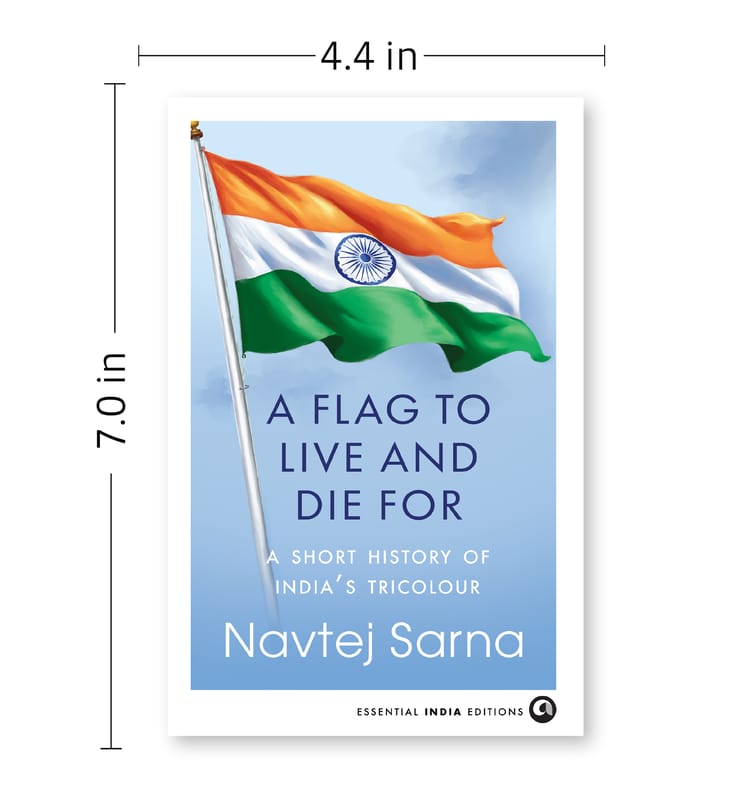
The Indian tricolour—tiranga—has fluttered over battlefields and Olympic arenas, at the Red Fort and in the smallest village squares; it has wrapped the bodies of martyrs and been carried in protest and in prayer. Its colours are steeped deep in India’s essential values—saffron denotes renunciation and sacrifice, white peace and truth, and green represents life and growth. Its very presence recalls India’s long struggle for freedom, the triumph of an inspired people against colonial domination and the resilience and sacrifice that goes into building a remarkable nation.
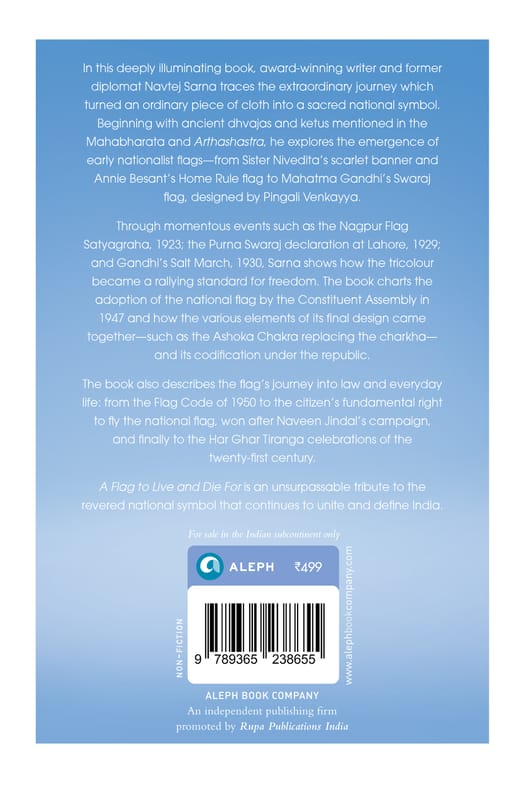
In this deeply illuminating book, award-winning writer and former diplomat Navtej Sarna traces the extraordinary journey which turned an ordinary piece of cloth into a sacred national symbol. Beginning with ancient dhvajas and ketus mentioned in the Mahabharata and Arthashastra, he explores the emergence of early nationalist flags—from Sister Nivedita’s scarlet banner and Annie Besant’s Home Rule flag to Mahatma Gandhi’s Swaraj flag, designed by Pingali Venkayya.
Through momentous events such as the Nagpur Flag Satyagraha, 1923; the Purna Swaraj declaration at Lahore, 1929; and Gandhi’s Salt March, 1930, Sarna shows how the tricolour became a rallying standard for freedom. The book charts the adoption of the national flag by the Constituent Assembly in 1947 and how the various elements of its final design came together—such as the Ashoka Chakra replacing the charkha—and its codification under the republic.
The book also describes the flag’s journey into law and everyday life: from the Flag Code of 1950 to the citizen’s fundamental right to fly the national lag, won after Naveen Jindal’s campaign, and finally to the Har Ghar Tiranga celebrations of the twenty-first century. A Flag to Live and Die For is an unsurpassable tribute to the revered national symbol that continues to unite and define India.
| Country of origin | India |
|---|---|
| Brand | Aleph Book Company |
| Common name | A FLAG TO LIVE AND DIE FOR: A Short History of India’s Tricolour |
| Net Quantity | 1 unit |
| Package Dimension | 7L x 4.48W x 0.39H cm |
| Manufacturer or packer name | Aleph Book Company |
| Manufacturer or packer address | Aleph Book Company |
| Manufacturing Date | 2026 |
| ISBN | 9789365238655 |
| contact details consumer care | Rupa Publications India Pvt Ltd, [email protected] |
Other Products from seller Rupa Publications India Pvt Ltd

₹701₹995 ( 30% OFF )

₹215₹295 ( 27% OFF )

₹215₹295 ( 27% OFF )

₹631₹895 ( 29% OFF )


₹145₹195 ( 26% OFF )

₹145₹195 ( 26% OFF )

₹145₹195 ( 26% OFF )

₹145₹195 ( 26% OFF )