



 Contact Us
 Appliances
 Agri Inputs
 Auto Components & Accessories
 Beauty & Personal Care
 Electronics
 Fashion
 Grocery
 Gift Cards
 Home & kitchen
 Health & Wellness
 Vehicles & Automotives
 Books & Stationary
 Pet Care
 Toys & Games





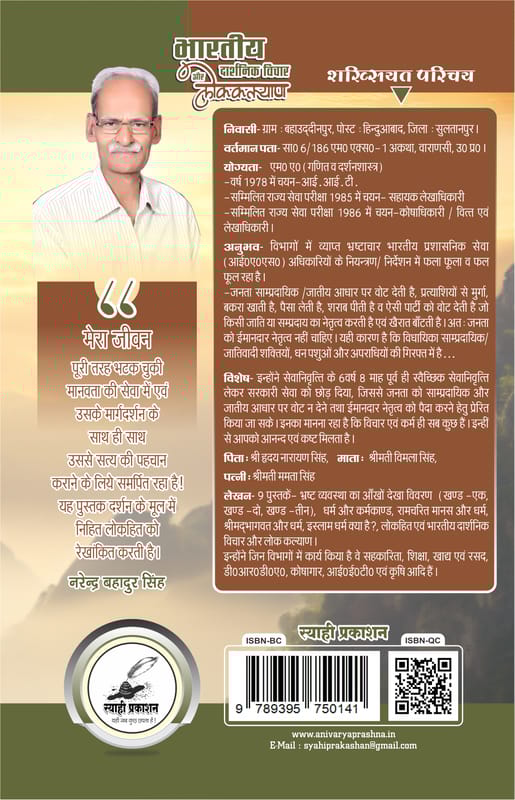



Name of the book - 'Indian philosophical thought and public welfare' --- Language - Hindi --- Author - Narendra Bahadur Singh --- Publisher - Syahi Prakashan --- Editor - Pandit Chatish Dwivedi 'Kunthit' --- This book will prove to be hel...
Read MorePopular Categories
Support
Language
Our apps
Bharatiya Darshanik Vichar Aur Lokakalyaan
Key Attributes
| Country of origin | India |
|---|---|
| Model | Book |
| Brand | Syahi Prakashan |
| Net Quantity | 1 unit |
| Product Dimensions | 12L x 2W x 19H cm |
Name of the book - 'Indian philosophical thought and public welfare' --- Language - Hindi --- Author - Narendra Bahadur Singh --- Publisher - Syahi Prakashan --- Editor - Pandit Chatish Dwivedi 'Kunthit' --- This book will prove to be helpful in understanding Indian philosophy and its depth and will prove to be a guide in life --- Why did we get birth? Who gave it? What is life and its purpose, why does death happen? What is there after death? What is the world? And does God exist or not? Apart from this, are the standards of sin and virtue correct or not? What is the ultimate truth? There are many such questions whose answers are being sought for ages. A well-structured plan is visible in the universe and in every form of society and there is some secret in that plan too. In such a situation, many people went to the higher dimensions of their consciousness in search of it. They examined and tested every aspect of life. Such people became sages, maharishis and philosophers. Answers to many such questions are found hidden in the philosophical documents of history. The author's research has answers to all these questions. The author has proved through his thinking that public welfare is the root of philosophy. Indian Philosophical Thought and Public Welfare, written by Narendra Bahadur Singh, highlights the depth of Indian philosophy, its society-oriented vision and its relevance in public welfare. This book explains the multi-layered aspects of Indian philosophical traditions as well as gives a special place to the philosophy of Lord Buddha and Mahavira Jain. Many questions like life, living beings, God, world, religion, faith, devotion, love and compassion and the search for their answers lead us to philosophy. The literal meaning of philosophy is: the search for truth or the discussion of the mysteries of life and the universe. This is the branch of knowledge that tries to answer the basic questions of human life, existence, morality, knowledge and truth. On the other hand, a philosopher is one who is dedicated to finding answers to these questions through deep thinking and analysis. In the main parts of the book, the philosophy of Lord Buddha and Mahavira Jain has not only been described as the great thought of ancient India, but it has also been proved to be relevant and best for today's society. Buddha's 'middle path' and 'eightfold path' and Mahavira Jain's thoughts are an important contribution towards making human life balanced and peaceful. Their principles not only provide solutions to personal but also social problems. Buddha and Mahavira's principle of non-violence and compassion towards all living beings are very relevant in today's violence-prone world. The author has shown that the views of Buddha and Mahavira inspire a person to establish harmony between his inner and outer world. This thought not only helps in spiritual progress but also makes a significant contribution towards social welfare and public good. The book prominently highlights the philanthropic nature of Indian philosophy. It argues that ancient Indian ideology was not limited to self-realization but also aimed at providing moral and spiritual basis to the society. In particular, the author has described the thoughts of Mahatma Buddha and Mahavira Jain as a symbol of revolution in those social structures which were based on exploitation and inequality. The author's style is clear and factual. Presenting complex philosophical ideas in simple language, he has inspired readers to think deeply. By adding the relevance of Buddha's thoughts in the modern context, this book becomes a source of inspiration for both the individual and the society. Indian Philosophical Thought and Public Welfare is a book that not only helps in understanding the depth of Indian philosophy, but also presents it as a guide for modern society. The breadth and depth with which the author has portrayed the philosophy of Lord Buddha and Mahavira Jain makes this book special. This book is a priceless work for those interested in philosophy and those who aspire for social reform.
| Country of origin | India |
|---|---|
| Model | Book |
| Brand | Syahi Prakashan |
| Material | paper |
| Height | 12 |
| Breadth | 02 |
| Length | 19 |
| Weight | 200 |
| Care Instructions | No |
| Net Quantity | 1 unit |
| Included items | Book and Book Mark |
| Batch number | No |
| Expiry Date | No |
| Weight | 200 g |
| Package Dimension | 12L x 2W x 19H cm |
| Product Dimensions | 12L x 2W x 19H cm |
| Instructions | Name of the book - 'Indian philosophical thought and public welfare' --- Language - Hindi --- Author - Narendra Bahadur Singh --- Publisher - Syahi Prakashan --- Editor - Pandit Chatish Dwivedi 'Kunthit' --- This book will prove to be helpful in understanding Indian philosophy and its depth and will prove to be a guide in life --- Why did we get birth? Who gave it? What is life and its purpose, why does death happen? What is there after death? What is the world? And does God exist or not? Apart from this, are the standards of sin and virtue correct or not? What is the ultimate truth? There are many such questions whose answers are being sought for ages. A well-structured plan is visible in the universe and in every form of society and there is some secret in that plan too. In such a situation, many people went to the higher dimensions of their consciousness in search of it. They examined and tested every aspect of life. Such people became sages, maharishis and philosophers. Answers to many such questions are found hidden in the philosophical documents of history. The author's research has answers to all these questions. The author has proved through his thinking that public welfare is the root of philosophy. Indian Philosophical Thought and Public Welfare, written by Narendra Bahadur Singh, highlights the depth of Indian philosophy, its society-oriented vision and its relevance in public welfare. This book explains the multi-layered aspects of Indian philosophical traditions as well as gives a special place to the philosophy of Lord Buddha and Mahavira Jain. Many questions like life, living beings, God, world, religion, faith, devotion, love and compassion and the search for their answers lead us to philosophy. The literal meaning of philosophy is: the search for truth or the discussion of the mysteries of life and the universe. This is the branch of knowledge that tries to answer the basic questions of human life, existence, morality, knowledge and truth. On the other hand, a philosopher is one who is dedicated to finding answers to these questions through deep thinking and analysis. In the main parts of the book, the philosophy of Lord Buddha and Mahavira Jain has not only been described as the great thought of ancient India, but it has also been proved to be relevant and best for today's society. Buddha's 'middle path' and 'eightfold path' and Mahavira Jain's thoughts are an important contribution towards making human life balanced and peaceful. Their principles not only provide solutions to personal but also social problems. Buddha and Mahavira's principle of non-violence and compassion towards all living beings are very relevant in today's violence-prone world. The author has shown that the views of Buddha and Mahavira inspire a person to establish harmony between his inner and outer world. This thought not only helps in spiritual progress but also makes a significant contribution towards social welfare and public good. The book prominently highlights the philanthropic nature of Indian philosophy. It argues that ancient Indian ideology was not limited to self-realization but also aimed at providing moral and spiritual basis to the society. In particular, the author has described the thoughts of Mahatma Buddha and Mahavira Jain as a symbol of revolution in those social structures which were based on exploitation and inequality. The author's style is clear and factual. Presenting complex philosophical ideas in simple language, he has inspired readers to think deeply. By adding the relevance of Buddha's thoughts in the modern context, this book becomes a source of inspiration for both the individual and the society. Indian Philosophical Thought and Public Welfare is a book that not only helps in understanding the depth of Indian philosophy, but also presents it as a guide for modern society. The breadth and depth with which the author has portrayed the philosophy of Lord Buddha and Mahavira Jain makes this book special. This book is a priceless work for those interested in philosophy and those who aspire for social reform. |
| Storage conditions | New |
| contact details consumer care | Syahi Prakashan, [email protected] |
Other Products from seller Syahi Prakashan

₹400₹450 ( 11% OFF )

₹51₹75 ( 32% OFF )

₹65₹96 ( 32% OFF )

₹1,100₹1,350 ( 19% OFF )

₹165₹180 ( 8% OFF )

₹325₹360 ( 10% OFF )

₹551₹620 ( 11% OFF )

₹1,099₹1,249 ( 12% OFF )

₹464₹520 ( 11% OFF )

₹220₹250 ( 12% OFF )

₹250₹280 ( 11% OFF )

₹195₹210 ( 7% OFF )

₹220₹250 ( 12% OFF )

₹189₹200 ( 6% OFF )

₹200₹250 ( 20% OFF )