


 Contact Us
 Appliances
 Agri Inputs
 Auto Components & Accessories
 Beauty & Personal Care
 Electronics
 Fashion
 Grocery
 Gift Cards
 Home & kitchen
 Health & Wellness
 Vehicles & Automotives
 Books & Stationary
 Pet Care
 Toys & Games
Why Enterprise D2C Brands Need More Than Basic Online Stores in 2027
ONDC Network for D2C Sellers
D2C ecommerce has evolved far beyond basic online storefronts. Customers today expect personalised shopping, fast mobile experiences, seamless checkout, and consistent engagement across every channel.
For enterprise D2C brands, managing all this with a basic online store has become increasingly difficult. As operations grow, brands need better control over inventory, customer journeys, fulfilment, marketing, and multi-channel selling.
This is why modern D2C commerce is shifting toward AI-powered, omnichannel commerce ecosystems that can automate operations, unify channels, and support enterprise-scale growth.
Let us understand why enterprise D2C brands now need more than just online storefronts to scale successfully.
Table of Contents
- How D2C Commerce Is Evolving Beyond Traditional Online Stores
- 6 Key Reasons Why Enterprise D2C Ecommerce Brands Need More Than Basic Online Stores in 2027
- 1. Customers Expect Hyper-Personalised Shopping Experiences Across Every Touchpoint
- 2. AI-Powered Product Discovery Is Becoming A Competitive Necessity
- 3. Brands Need To Sell Seamlessly Across Multiple Channels From One Backend
- 4. Mobile Commerce Demands More Than Just A Mobile-Friendly Website
- 5. Scaling Operations Requires AI-Powered Catalogue, Content, And Workflow Automation
- 6. Enterprise Growth Requires Next Gen Tech And Workflow Automation
- Why D2C eCommerce Brands Should Choose Mystore for a Future Ready Ecommerce Solutions in 2027
- Conclusion
How D2C Commerce Is Evolving Beyond Traditional Online Stores
The D2C ecommerce space is rapidly evolving toward AI-powered, mobile-first, and omnichannel commerce experiences. Customer expectations are rising while operational complexity continues to increase for enterprise brands.
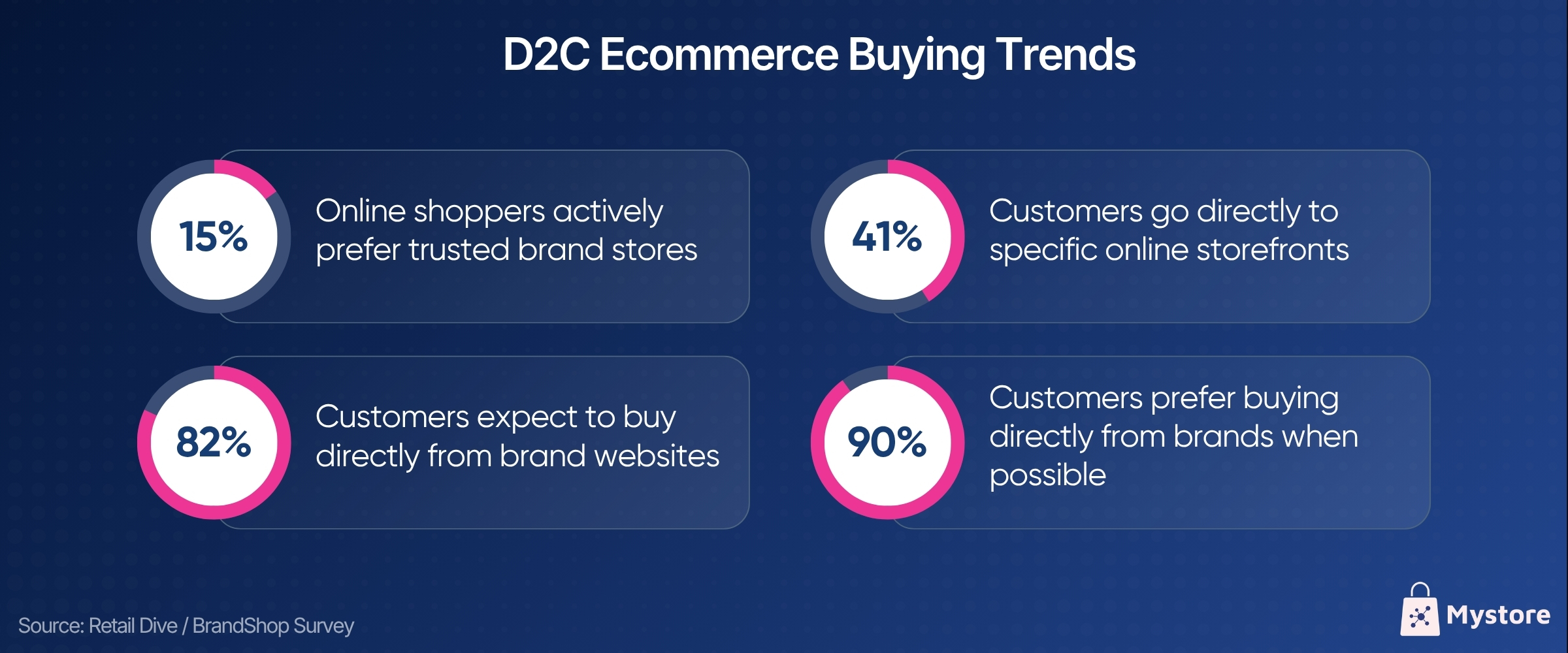
- 82% of customers expect to buy directly from brand websites
- 90% of customers prefer buying directly from brands when possible
- 15% of online shoppers actively prefer trusted brand stores
- 41% of customers go directly to specific online storefronts
Source:Retail Dive / BrandShop Survey
Key Takeaway: These trends show that customers increasingly want direct relationships with brands instead of relying entirely on marketplaces.
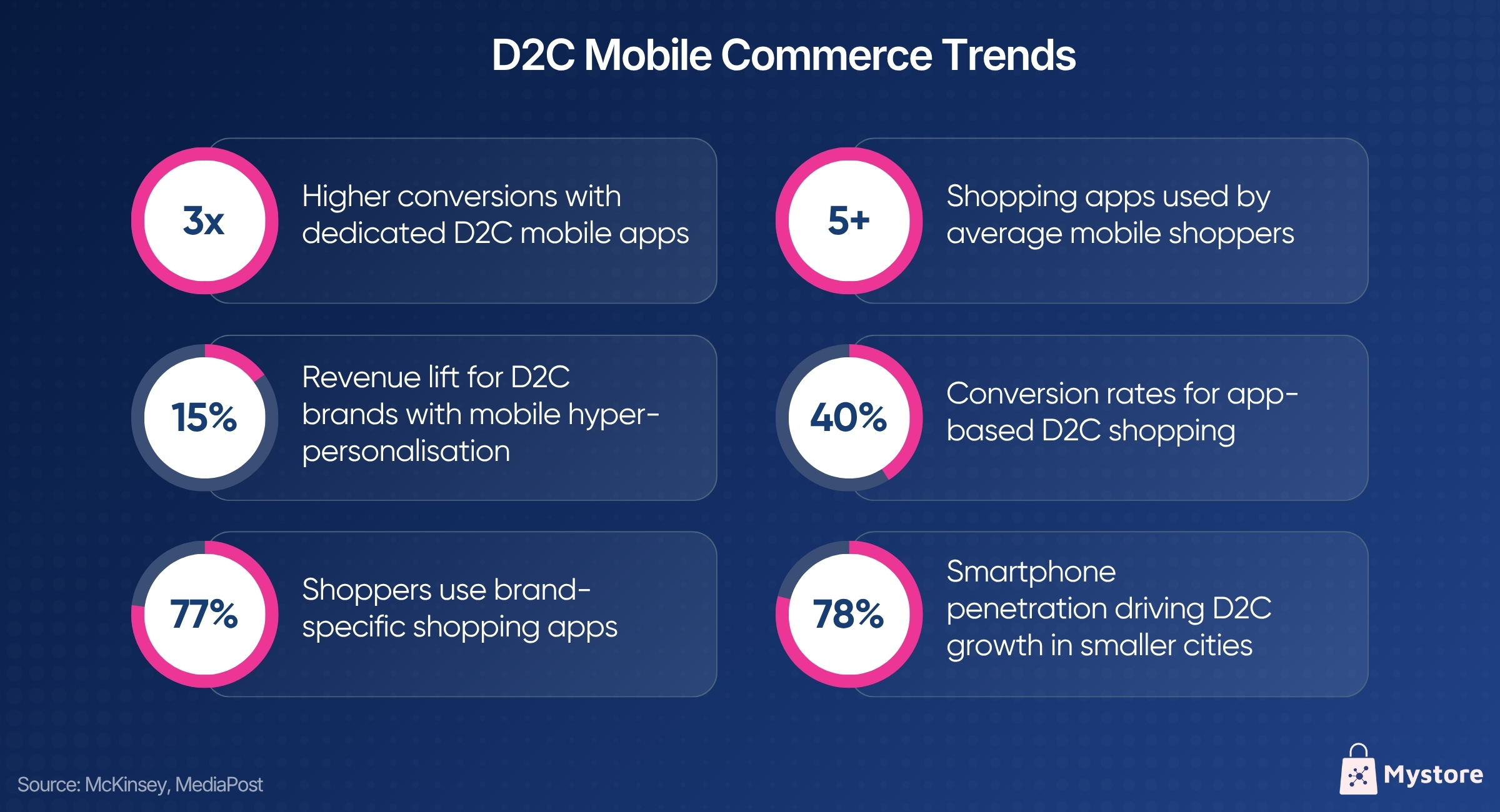
- 3x higher conversion rates for D2C brands with dedicated mobile apps vs responsive websites
- 77% of e-commerce shoppers now use brand-specific mobile apps to shop
- 40% conversion rates for D2C brands utilising dedicated apps
- 5+ shopping apps used by average mobile shoppers
- 78% smartphone penetration in smaller cities is driving D2C growth
- 15% revenue lift for D2C brands using mobile hyper-personalisation
Source: McKinsey, MediaPost
Key takeaway : Mobile commerce is no longer just about responsive websites. Customers now expect app-like speed, personalised recommendations, push notifications, loyalty integrations, and seamless mobile checkout experiences.
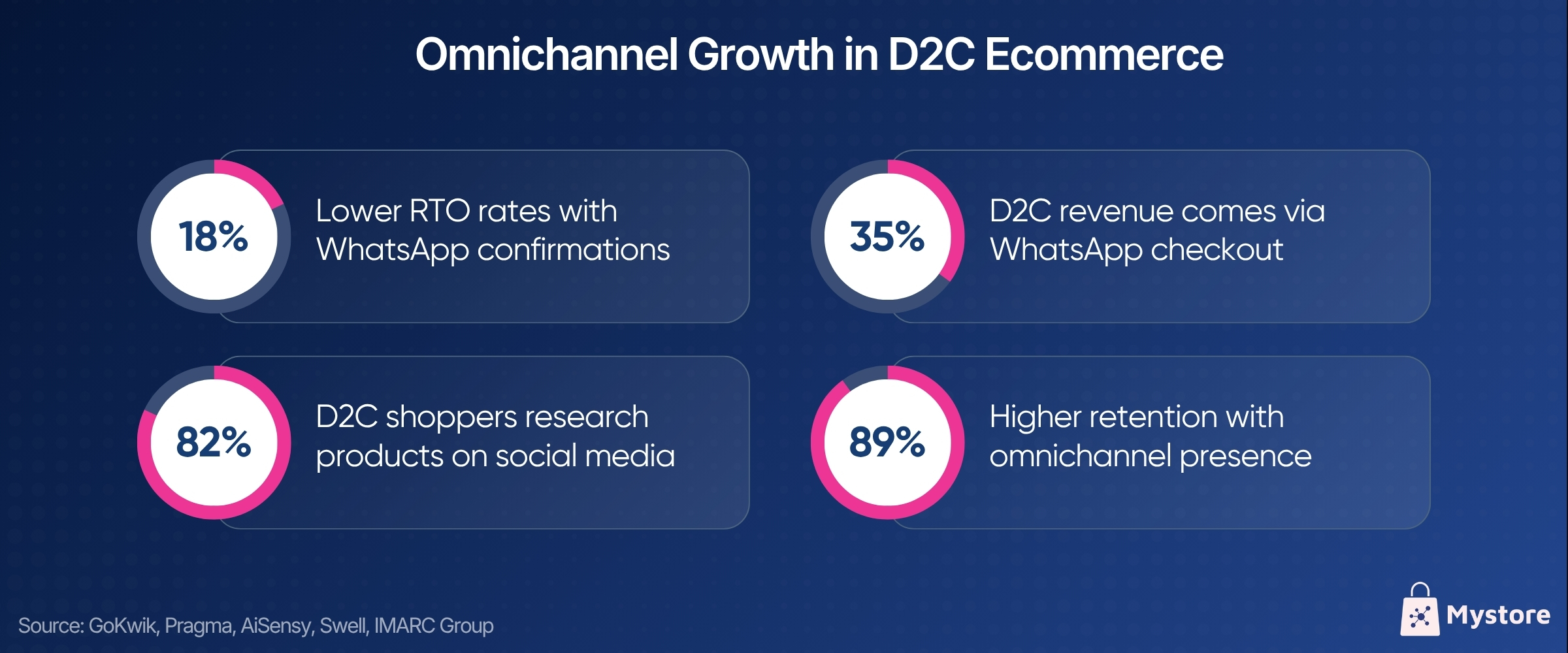
- 89% of customer retention rate for D2C brands with unified omnichannel presence
- 82% of D2C consumers use social media for product research.
- 20%-35% of D2C ecommerce revenue now comes through WhatsApp checkout flows
- 15%-18% lower RTO rates for D2C brands using automated WhatsApp confirmations
Source:GoKwik, Pragma, AiSensy, Swell, IMARC Group
Key takeaway: Customers interact with brands across multiple channels before making purchases. Enterprise D2C brands, therefore, need centralised systems that can manage inventory, customer engagement, marketing, and fulfilment across channels from one backend.
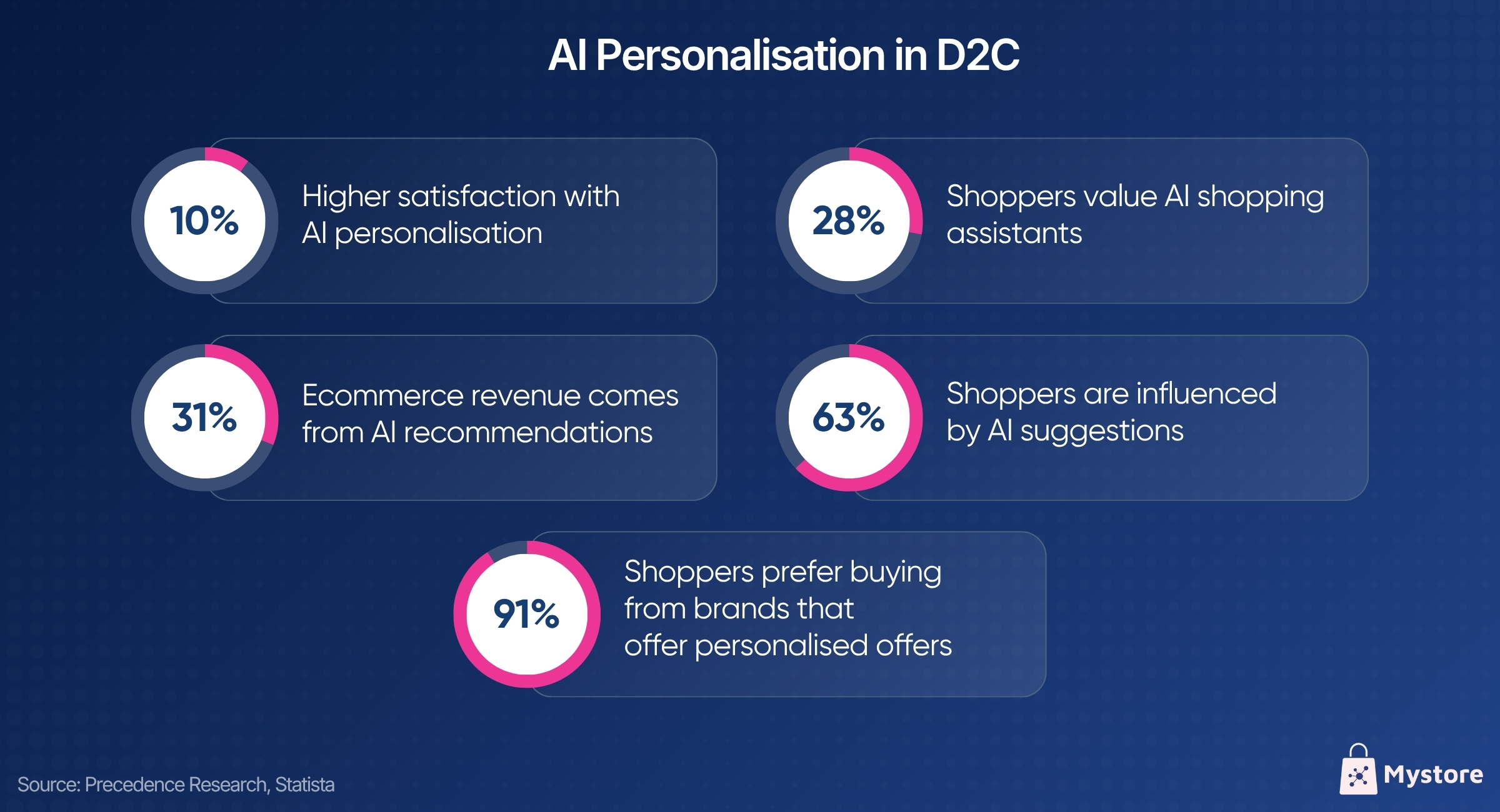
- 91% of shoppers prefer buying from brands that offer personalised offers
- 28% of shoppers now find AI shopping assistants valuable
- 31% of ecommerce revenue now comes from AI-driven product recommendations
- 5-10% higher customer satisfaction experienced by brands using AI for personalisation
- 63% of shoppers say AI-driven suggestions directly influence their buying decision
Source: Precedence Research, Statista
Key takeaway: AI has become the core driver for D2C growth. Personalised recommendations, AI-powered search, conversational shopping, automated catalogue management, etc., are now directly influencing customer conversion and retention.
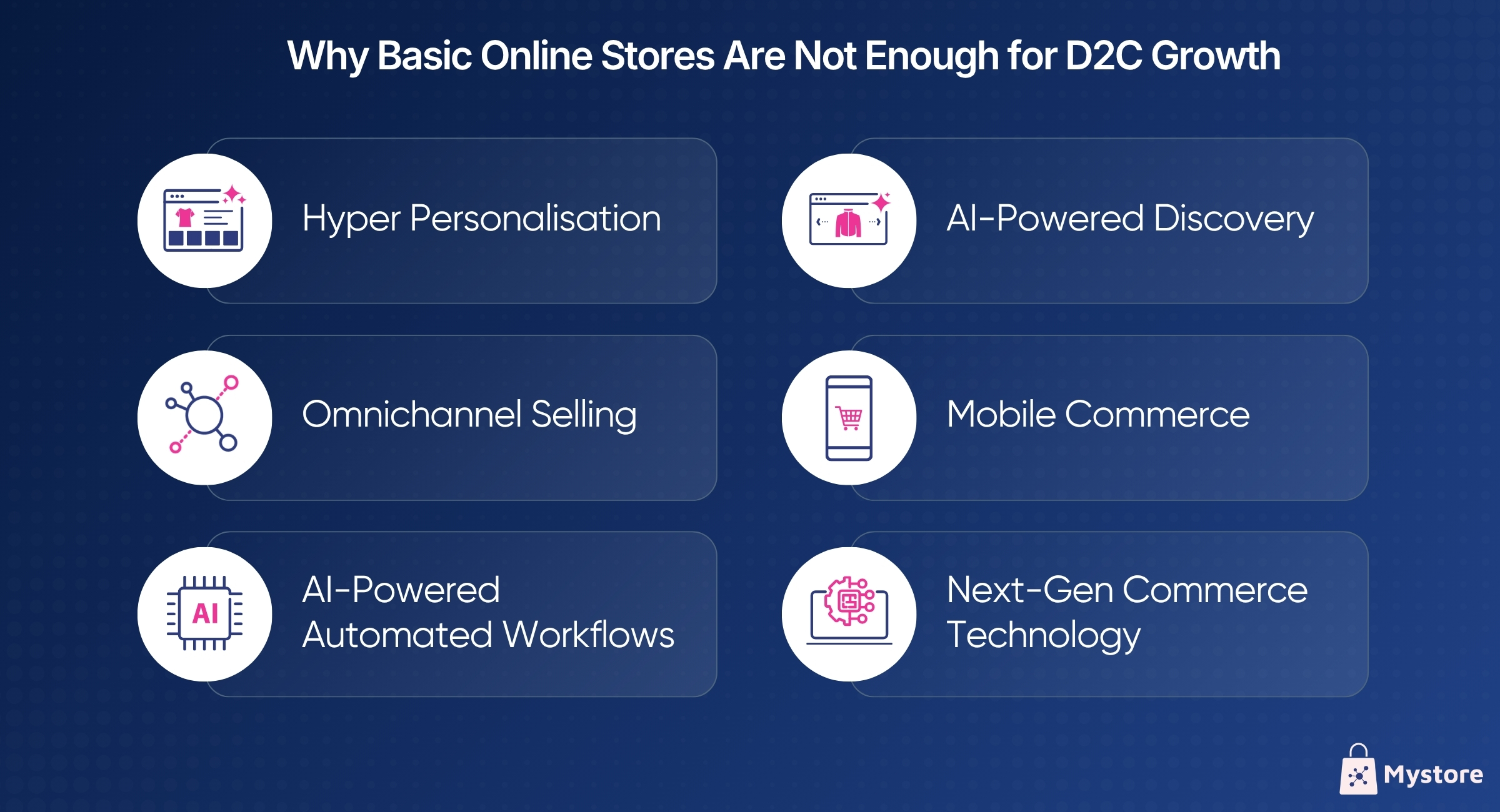
6 Key Reasons Why Enterprise D2C Ecommerce Brands Need More Than Basic Online Stores in 2027
Here are the key reasons why enterprise D2C brands need more than just a basic online store in 2027:
1. Customers Expect Hyper-Personalised Shopping Experiences Across Every Touchpoint
Enterprise D2C ecommerce is no longer about showing the same storefront to every customer. Buyers today expect brands to understand their preferences, shopping habits, language, location, and even buying intent across every interaction. Whether a customer discovers a product on a website, receives an offer on a mobile app, or browses through a WhatsApp business account, they expect a highly personalised experience throughout the journey.
This is where basic online stores start falling short. Traditional storefronts are built to display products, but modern enterprise commerce needs systems that can intelligently personalise customer journeys at scale. Brands now need AI-powered search and recommendations, multilingual storefronts, customer-specific offers, and personalised shopping flows that continuously adapt based on user behaviour.
For example, a fashion brand selling across India may cater to customers in different languages, regions, and festive markets simultaneously. Customers in Mumbai may respond to a premium workwear campaign, while customers in Tier-2 cities may engage more with festive ethnic collections. Managing such personalisation manually across channels becomes operationally impossible with a basic ecommerce setup.
Enterprise D2C brands, therefore, require unified commerce ecosystems that can utilise AI intelligence to automatically personalise experiences across channels in real time.
2. AI-Powered Product Discovery Is Becoming A Competitive Necessity
Modern customers don’t want to type exact product names or browse endlessly through categories to find what they need. In many cases, customers themselves are still exploring options and expect brands to guide them.
Today, people search more naturally and conversationally. They type queries like “best summer skincare for oily skin” or “comfortable office wear for travel” and expect instant, relevant suggestions.
This is where basic online storefronts start falling behind. Traditional search filters and manual browsing are no longer enough for modern D2C shopping experiences.
Enterprise D2C brands now need AI-powered product discovery that can understand customer intent, preferences, browsing patterns, and shopping behaviour in real time. AI helps brands make product discovery faster, smarter, and far more personalised.
For example, a beauty and cosmetic brand selling thousands of products cannot expect customers to manually explore every category or compare endless options. AI-powered discovery can quickly analyse customer behaviour, past purchases, and browsing history to recommend the most relevant products instantly.
This reduces shopping friction, improves customer experience, and helps brands increase conversions without overwhelming buyers with too many choices.
3. Brands Need To Sell Seamlessly Across Multiple Channels From One Backend
Today, customers do not shop only on brand websites. They move across multiple channels to compare products, explore offers, and shop in the most convenient way for them. A customer may browse products on a website, ask questions on WhatsApp, and finally complete the purchase through a mobile app.
D2C brands that rely only on a single online storefront can miss out on a large segment of potential customers who actively shop across channels.
However, managing multiple sales channels separately quickly becomes difficult as the business grows. Inventory becomes harder to track. Pricing may vary across channels. Orders get delayed. Customer experiences become inconsistent. Teams end up spending more time managing operations instead of focusing on growth.
This is why enterprise D2C brands now need one centralised system that can manage all sales channels together from a single backend.
For example, a consumer electronics brand may sell through its website, mobile app, and WhatsApp simultaneously. If inventory, orders, and customer data are managed separately across these channels, operational confusion increases very quickly.
Choosing an enterprise ecommerce platform with unified commerce capabilities helps brands manage inventory, catalogues, orders, promotions, and customer data from one centralised system. This not only simplifies operations but also creates a smoother and more consistent shopping experience across every channel.
4. Mobile Commerce Demands More Than Just A Mobile-Friendly Website
With over 95% of internet users in India accessing the internet through mobile phones, mobile has become the primary channel for online shopping. But that does not mean just having a mobile-friendly website is enough. Customers today expect fast loading, smooth browsing, easy checkout, instant notifications, personalised offers, and app-like shopping experiences.
Basic websites often struggle to deliver this consistently.
That is why enterprise D2C brands should have dedicated Android and iOS apps to offer better customer engagement, smoother shopping journeys, and faster repeat purchases.
For example, a grocery or wellness brand depends heavily on repeat purchases. Customers usually prefer reordering products through mobile apps because the experience feels faster and more convenient. Features like saved carts, push notifications, subscriptions, and one-click reorders help brands increase repeat purchases significantly.
Also, 57% of active internet users in India are from rural areas (Source: The Hindu. To offer them smooth, fast, and uninterrupted shopping experiences, brands should build PWA storefronts that deliver app-like experiences even in rural areas with low internet connectivity.
5. Scaling Operations Requires AI-Powered Catalogue, Content, And Workflow Automation
For a growing enterprise D2C brand, managing daily operations manually becomes increasingly difficult.
D2C enterprises with basic storefronts often struggle to manage large product catalogues, inventory updates, high order volumes, customer support, and daily activities continuously. What works for early-stage ecommerce businesses often starts breaking at the enterprise level.
Basic online stores are not built to handle this level of operational complexity.
That is why enterprise brands use AI-powered automation to manage repetitive ecommerce tasks more efficiently. This helps save time, reduce operational pressure, and scale faster without constantly increasing manual effort.
For example, a furniture brand managing thousands of products cannot manually update every product title, image, or description regularly. Enterprise ecommerce solutions with a built-in AI core can help brands automatically upload product content, enhance images, and automate daily operations more efficiently.
6. Enterprise Growth Requires Next Gen Tech And Workflow Automation
A basic online storefront may work well in the early stages of a D2C brand. It helps brands establish an online presence, start selling quickly, and manage initial operations with limited complexity.
But as the business grows, ecommerce operations become much more demanding. What once worked smoothly for a smaller business often starts creating operational bottlenecks at scale.
Customisation becomes slower. Adding new features takes longer. Integrations across payments, logistics, marketing, and customer engagement tools become difficult to manage. As traffic, orders, and customer expectations increase, performance issues also start affecting customer experience.
Enterprise D2C brands, therefore, need next-gen commerce technology that can scale and evolve with the business instead of limiting growth.
Modern commerce platforms built on headless and API-first architecture give brands the flexibility to customise experiences, integrate new tools easily, automate workflows, experiment with different business models and scale operations without rebuilding their entire commerce setup repeatedly.
Built-in capabilities for automation, AI-powered workflows, mobile commerce, multi-model support and omnichannel operations help enterprise brands grow faster while keeping operations manageable.
In 2027, enterprise D2C growth depends not just on having an online store, but on having flexible and future-ready commerce technology that can continuously support business expansion.
Why D2C eCommerce Brands Should Choose Mystore for a Future Ready Ecommerce Solutions in 2027
Mystore is designed as a future-ready enterprise ecommerce ecosystem built specifically for modern D2C brands that need scalability, operational efficiency, and intelligent commerce capabilities. Instead of depending on multiple fragmented tools and disconnected systems, Mystore ecommerce solutions brings everything together into one unified AI-powered commerce ecosystem.
From omnichannel selling and mobile commerce to AI-powered automation, catalogue management, customer engagement, and multi-model commerce operations, Mystore helps enterprise D2C brands manage and scale end-to-end ecommerce operations from a single platform.
Here's what Mystore offers:
1. Hyper-Personalised Shopping Experiences
Mystore helps enterprise D2C brands create personalised shopping journeys across every touchpoint. Businesses can launch multilingual storefronts, build unique brand experiences using ready themes and drag-and-drop tools, and adapt their storefronts for different customer segments without relying heavily on developers.
Personalisation goes beyond the storefront. With Mystore's built-in discount engine, brands can run targeted promotions, customer-specific offers, loyalty campaigns, and regional discounts from a single platform. AI-powered recommendations and semantic search further enhance discovery by helping shoppers find products that match their interests, browsing patterns, and purchase behaviour. The result is a shopping experience that feels more relevant, intuitive, and engaging for every customer.
2. Built-in AI Core
Mystore enables brands to address the challenge of running day-to-day operations smoothly and efficiently with built-in AI capabilities that simplify both buyer experiences and day-to-day operations. Its AI cataloguing tools can automatically generate product titles, descriptions, categories, and tags from product images, helping teams create and organise catalogues much faster while maintaining consistency.
For brands dealing with large product inventories, image quality is another common bottleneck. Mystore's AI-powered image optimisation tool, Magic Edit, helps transform basic product photos into professional, catalogue-ready images by improving backgrounds, lighting, framing, and aspect ratios. This enables brands to maintain a consistent visual identity across channels without investing significant time in manual editing.
By automating repetitive catalogue and image management tasks, Mystore ecommerce solutions help teams launch products faster, maintain better catalogue quality, and focus more on driving sales and customer engagement.
3. Built-in Mobile App Solutions
Mystore comes with a built-in no-code mobile app builder that enables D2C brands to launch Android and iOS shopping apps without complex development processes. This helps enterprises create stronger mobile shopping experiences while reducing dependency on separate app development teams.
Brands can also launch Progressive Web App (PWA) storefronts to deliver fast, lightweight, and app-like experiences across devices, especially in low-connectivity regions. With mobile commerce becoming central to D2C growth, Mystore helps brands engage customers more effectively across mobile channels.
4. Omnichannel Commerce
Mystore ecommerce solutions enable D2C brands to sell seamlessly across websites, mobile apps, marketplaces, WhatsApp, and other digital channels while managing operations through a centralised backend. Mystore omnichannel commerce capabilities help brands keep inventory, orders, pricing, and customer data synchronised across channels to reduce operational gaps and improve customer experience. Brands can also launch Android and iOS apps, create PWA storefronts, and enable conversational commerce through WhatsApp integrations and an AI-assisted shopping interface Mystore Genie. Genie helps buyers throughout their shopping journey, from product discovery and search to final checkout and post-purchase queries, making the buying experience faster and more intuitive.
5. Built on Next Gen Tech
Mystore is built on a decoupled headless architecture that enables enterprise D2C brands to scale faster, customise experiences easily, and launch new channels without operational limitations. Its API-first and cloud-native infrastructure helps brands manage high traffic, large catalogues, and complex enterprise operations efficiently. Mystore ecommerce solutions also come with a built-in AI core that automates daily ecommerce workflows like catalogue management, product discovery, recommendations, customer support, and operational tasks, helping enterprises improve efficiency while reducing manual dependency.
6. Support Multiple Business Models
Mystore enables enterprise brands to expand beyond traditional D2C and support multiple commerce models from a unified platform. Brands can run B2B commerce, multi-vendor marketplaces, hyperlocal delivery models, and quick commerce operations while managing everything from a single backend. This flexibility helps enterprises diversify revenue channels, reach different customer segments, and scale new business models without investing in separate systems.
Conclusion
Enterprise D2C growth in 2027 depends on much more than launching an online store. As brands scale, they need stronger control over customer experiences, operations, fulfilment, mobile commerce, and multi-channel selling without increasing operational complexity.
Basic storefronts may help brands start selling online, but they often struggle to support enterprise-level growth, personalisation, automation, and omnichannel operations in the long run.
This is why enterprise brands now need ecommerce ecosystems that combine AI-powered automation, unified operations, mobile-first commerce, and flexible technology infrastructure in one platform.
Mystore helps enterprise D2C brands build and scale future-ready commerce experiences with built-in AI capabilities, omnichannel ecommerce solutions, mobile app infrastructure, workflow automation, and enterprise-grade flexibility.
Want to explore how your brand can scale beyond traditional online storefronts in 2027?
Book a demo with Mystore ecommerce solutions today.