


 Contact Us
 Appliances
 Agri Inputs
 Auto Components & Accessories
 Beauty & Personal Care
 Electronics
 Fashion
 Grocery
 Gift Cards
 Home & kitchen
 Health & Wellness
 Vehicles & Automotives
 Books & Stationary
 Pet Care
 Toys & Games
How D2C Brands Can Build a Hyperlocal Brand Presence with Mystore and Drive Local Growth
ONDC Network for D2C Sellers
Key Takeaways
- Building a hyperlocal presence is no longer optional for D2C brands aiming to stay competitive in India’s fast-evolving ecommerce landscape.
- To succeed, brands need an enterprise ecommerce solution that can manage local inventory, enable fast fulfilment, and deliver personalised experiences across regions.
- Mystore’s fully integrated ecommerce ecosystem enables D2C brands to simplify hyperlocal operations, reduce dependency on multiple tools, and scale efficiently across cities and micro-markets.
- With native hyperlocal capabilities, AI-powered tools, and built-in logistics and marketing features, Mystore helps brands drive faster growth while delivering seamless local experiences.
The way consumers shop has fundamentally changed. With the rise of instant delivery platforms and location-based experiences, today’s buyers expect products to be available near them, delivered quickly, and tailored to their local needs.
For every D2C brand, this shift is more than just a change in preference, it is a shift in expectation. Customers are no longer willing to wait days for deliveries when they know similar products can reach them within hours.
This is where building a hyperlocal ecommerce brand becomes important. It is no longer a niche strategy but a core growth driver for brands aiming to scale across cities, regions, and micro-markets.
However, building a successful hyperlocal presence is not just about faster delivery. It requires real-time inventory visibility, local fulfilment capabilities, personalised engagement, and seamless omnichannel experiences.
To achieve this at scale, brands need more than a basic setup; they need a robust enterprise ecommerce solution designed for hyperlocal operations.
Table of Contents
Why Hyperlocal Ecommerce Is No Longer Optional for D2C Brands
Hyperlocal ecommerce isn’t just shaping buyer behaviour, it’s actively setting new benchmarks for speed, convenience, and local relevance. The data below highlights how quickly this shift is accelerating and why D2C brands can no longer afford to ignore it.
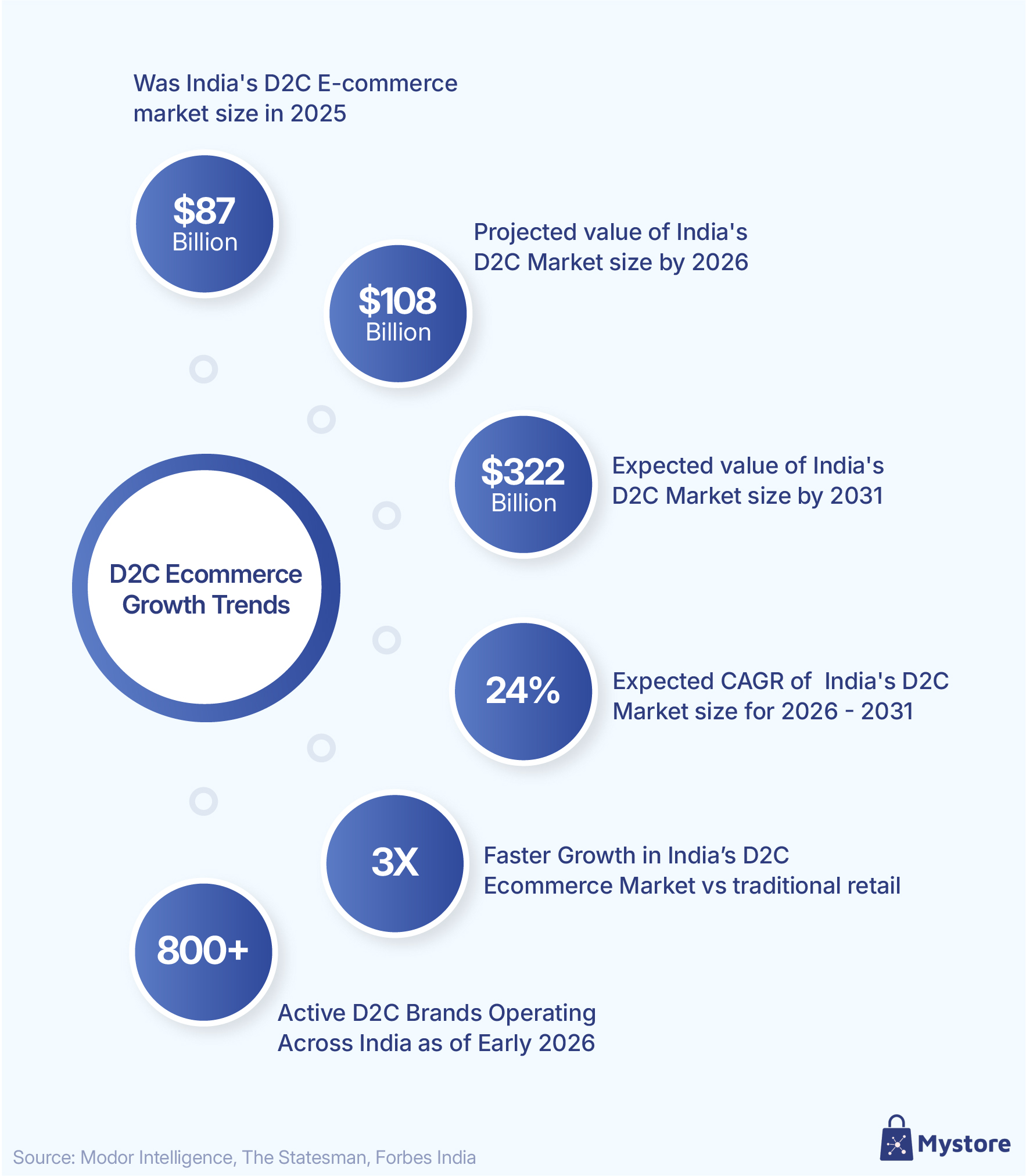
- $ 87.5 bn was India's D2C E-commerce market size in 2025
- $108.76 bn is the projected value of India's D2C Market size by 2026
- $322.1 bn is the expected value of India's D2C Market size by 2031
- 24.30% is the expected CAGR of India's D2C Market size for 2026 - 2031
- 3X Faster Growth in India’s D2C Ecommerce Market vs traditional retail
- 800+ Active D2C Brands Operating Across India as of Early 2026
Source Mordor Intelligence , The Statesman , Forbes India
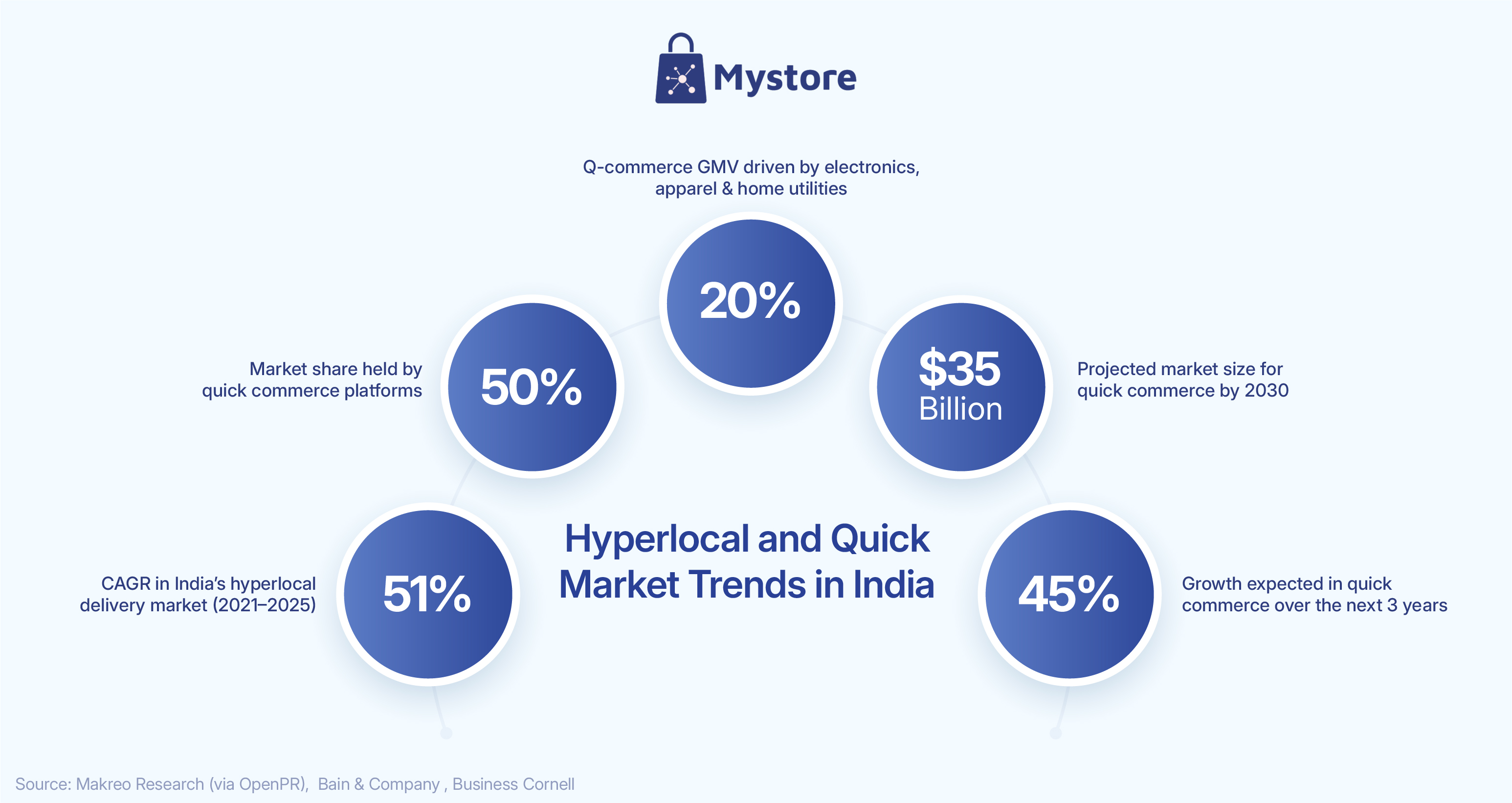
- 51.84% CAGR recorded for India’s hyperlocal delivery market between 2021-2025
- 50% of the hyperlocal market is now commanded by quick commerce platforms
- 40-45% expected growth for India’s quick commerce market over the next three years
- $35 billion is the projected quick commerce market size in India by 2030
- 15-20% of Q-commerce GMV in 2025 came from electronics, apparel, and home utilities
Source: Makreo Research (via OpenPR), Bain & Company , Business Cornell
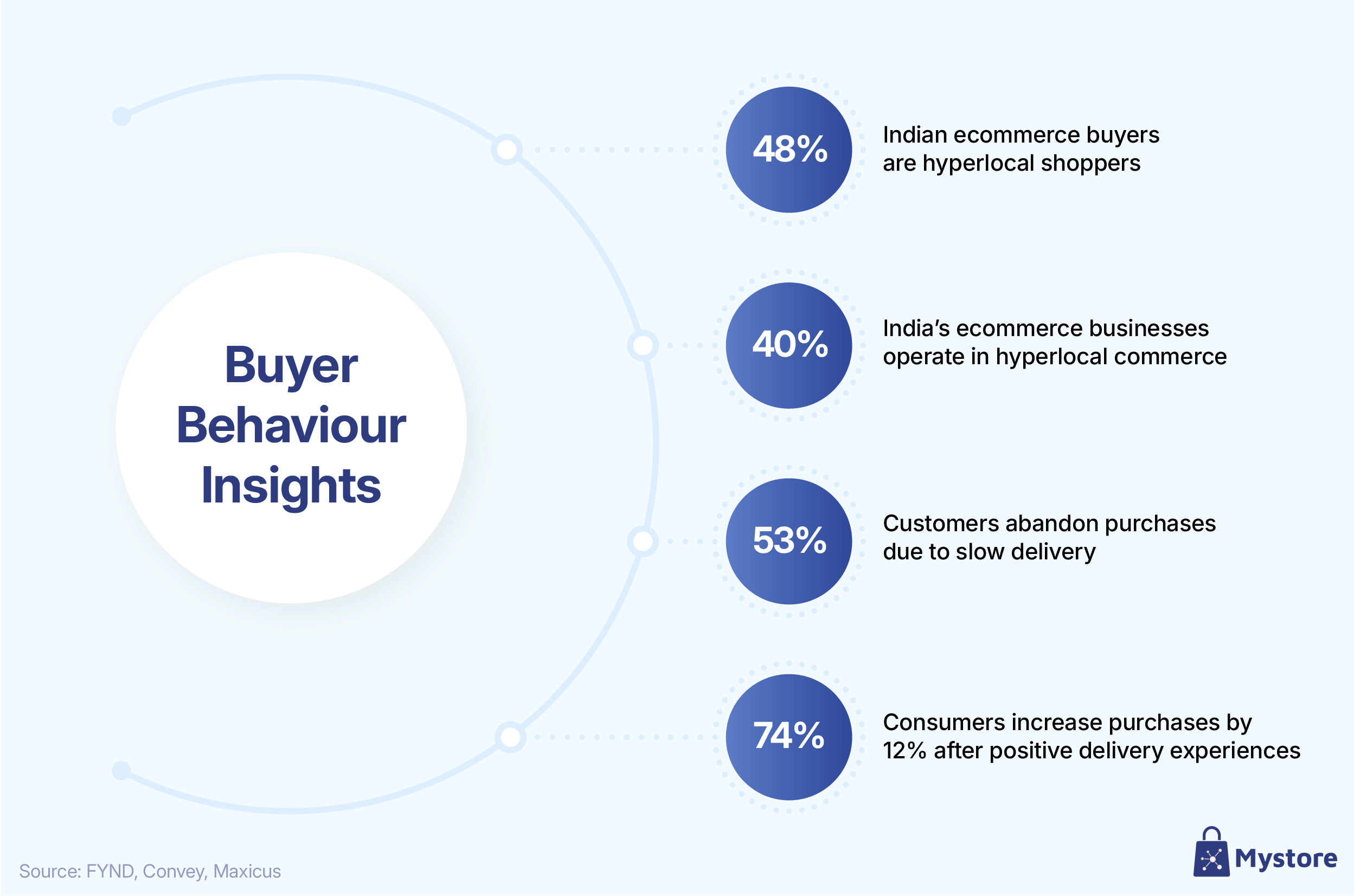
- 48% of all e-commerce buyers in India are hyperlocal shoppers
- 40% of India’s ecommerce businesses are involved in hyperlocal commerce.
- 53% of customers have abandoned a purchase because of slow delivery
- 74% of consumers increased their purchase rate by 12% for a positive delivery
Source: FYND, Convey, Maxicus
From the data, it’s clear that hyperlocal ecommerce is rapidly becoming the norm. As more brands experiment with hyperlocal business models to align with buyer expectations and experiences, those that fail to adapt risk falling behind.
For a D2C brand, this means shifting from a centralised fulfilment model to a distributed, local-first commerce strategy. But this transformation introduces new complexities like:
- Managing inventory across multiple locations
- Coordinating with local vendors or dealers
- Ensuring accurate delivery timelines
- Maintaining consistent branding across channels
- Running region-specific marketing campaigns
This is where most D2C brands struggle. Traditional ecommerce platforms are not designed to handle this level of localisation without heavy reliance on plugins, integrations, and manual effort.
Key Challenges D2C Brands Face in Building Hyperlocal Ecommerce
Before diving into the solution, it’s important to understand the real bottlenecks:
- Fragmented Technology Stack: Many platforms require multiple third-party tools for logistics, inventory segmentation, and local delivery. This leads to integration complexity and operational inefficiencies.
- Costly Multi-Channel Presence: Expanding across channels often requires separate tools, increasing cost and operational overhead.
- Slower Go-to-Market (GTM): Entering new cities or regions takes time due to setup dependencies and manual configurations.
- Lack of Real-Time Inventory Visibility: Without location-based inventory tracking, brands face order cancellations and poor customer experience.
- Inefficient Last-Mile Delivery: Meeting same-day or next-day delivery expectations becomes difficult without optimised logistics.
- Limited Localised Marketing Capabilities: Generic campaigns fail to connect with local audiences, impacting engagement and conversions.
- Difficulty Scaling Across Cities: What works in one city often becomes difficult to replicate across multiple markets without a scalable system.
To overcome these challenges, D2C brands need a platform where hyperlocal capabilities are built into the core, not added as an afterthought.
How Mystore Helps D2C Brands Build Hyperlocal Ecommerce at Scale
While the strategy is clear, execution depends entirely on the technology foundation. Many platforms offer ecommerce capabilities, but very few are designed specifically for hyperlocal operations.
This is where the Mystore fully integrated ecommerce ecosystem stands out.
Unlike traditional platforms that rely on plugins and third-party integrations, Mystore offers a native, unified system built specifically for hyperlocal ecommerce in India.
Heres how Mystore fully integrated ecommerce ecosystem empowers D2C brands to build, scale, and optimise hyperlocal operations seamlessly:
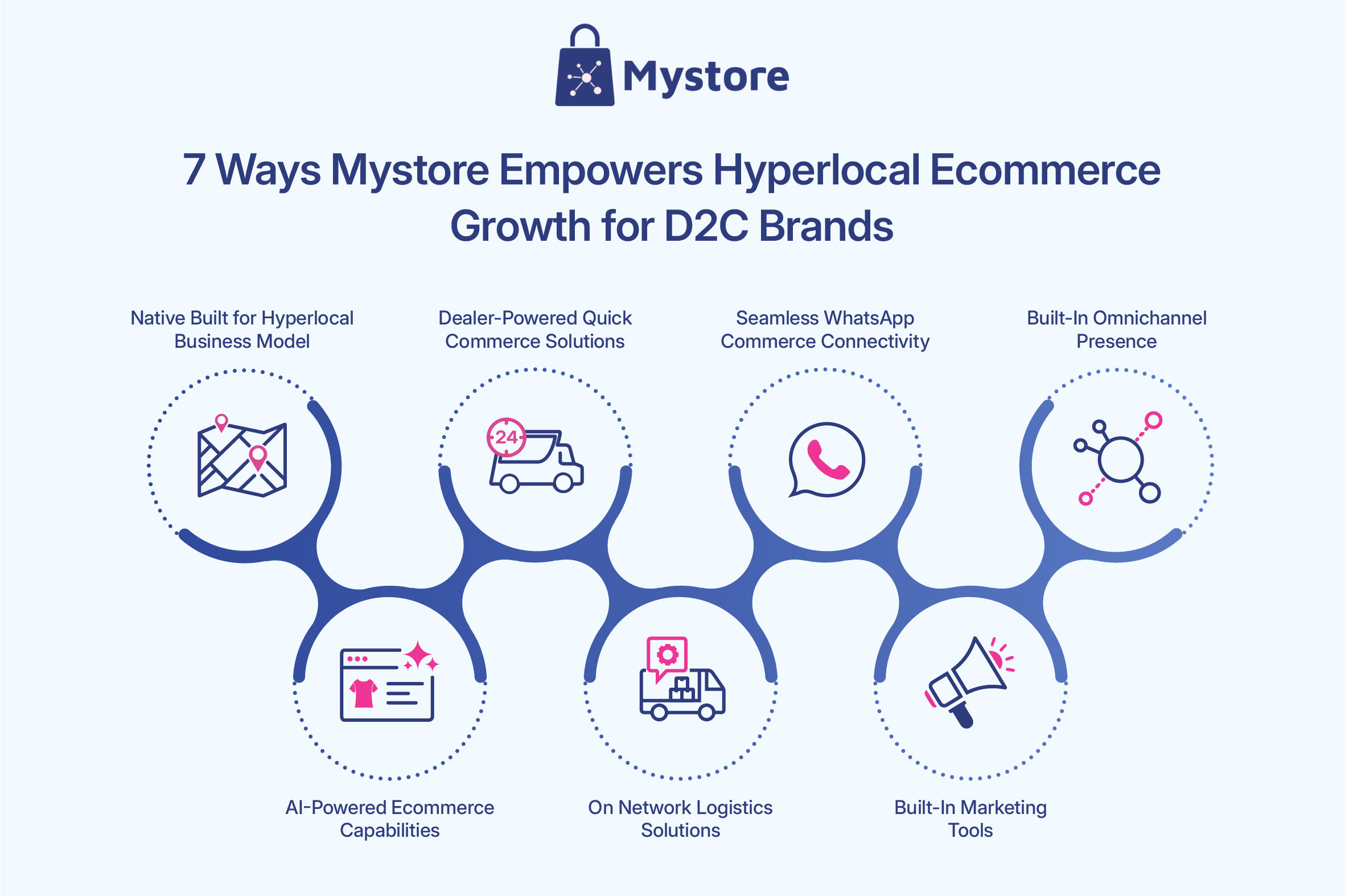
1. Native Built for Hyperlocal Business Model
Are you struggling to manage different cities, pin codes, and local demand patterns on a single ecommerce setup? Most traditional platforms are not designed for hyperlocal operations, forcing brands to depend on multiple plugins just to manage basic localisation.
Mystore eliminates this complexity with hyperlocal capabilities built directly into the core platform, not layered on as add-ons. It enables D2C brands to manage operations across various hyperlocal markets from a unified backend. From localised catalogues, pricing, and discounts to inventory and fulfilment, enterprises can manage everything without depending on multiple external tools. This makes scaling across regions far more convenient, as teams can focus on growth instead of constantly managing integrations.
With Mystore’s enterprise solution MystoreNEXT, brands can run hyperlocal campaigns, adjust inventory based on local demand, and enable faster deliveries in a more structured way.
2. Dealer-Powered Quick Commerce Solutions
Struggling to meet rising expectations for same-day or instant delivery? As speed becomes a key buying factor, relying only on central warehouses can slow you down and limit how far you can reach.
While D2C is often seen as cutting out middlemen, many growing D2C brands are actually evolving the model, bringing their existing dealer and distributor networks into the experience instead of replacing them.
Mystore fully integrated ecommerce ecosystem enables this shift with dealer-powered quick commerce fulfilment. Brands can fulfil orders through nearby dealers or local partners, using their existing inventory and delivery capabilities. Once an order is placed, it is intelligently routed to the nearest available partner for faster fulfilment.
This approach lets D2C brands grow without disrupting their partner ecosystem. It reduces delivery timelines, improves serviceability across cities, and removes the need to build complex logistics from scratch, making it easier to scale across hyperlocal markets while keeping partners in the loop.
3. Seamless WhatsApp Commerce Connectivity
Reaching customers across their preferred shopping channels often requires businesses to manage multiple storefronts and customer touchpoints. Many brands struggle to turn conversations on familiar channels into actual product discovery and purchases without adding more tools or manual work.
Mystore enterprise ecommerce solution simplifies this with seamless WhatsApp Commerce capabilities, allowing businesses to bring their products closer to customers on a channel they already use every day. Brands can share product information, catalogues and shopping links directly through WhatsApp, helping customers discover products, explore options and continue their purchase journey with less friction.
This makes it easier for brands to turn existing customer conversations into sales opportunities while extending their digital storefront beyond the website and app. By integrating WhatsApp into their commerce strategy, brands can strengthen customer engagement, support hyperlocal discovery and create more convenient shopping journeys without adding unnecessary operational complexity.
4. Built-In Omnichannel Presence
Are your customers interacting with your brand across multiple platforms, but your systems are unable to keep up? Managing separate channels often leads to inconsistent experiences, unsynchronised inventory, and missed opportunities.
Mystore addresses this by enabling a built-in omnichannel presence from the start. D2C brands can seamlessly sell across their online store, ONDC Network buyer apps, mobile applications, WhatsApp, and conversational interfaces. With its built-in mobile app builder, brands can create Android and iOS apps directly from the admin dashboard, without requiring coding or a dedicated technical team. It also supports PWA webstores, helping brands extend their hyperlocal services to low-connectivity areas.
Additionally, with Mystore Genie, an agentic AI-powered chat interface, brands can offer personalised shopping experiences through chat or voice interactions. All these channels are connected through a unified backend, ensuring consistent branding, real-time inventory synchronisation, and seamless customer journeys across every touchpoint.
5. AI-Powered Ecommerce Capabilities
Struggling to personalise customer experiences or optimise catalogues at scale? Manual processes often slow down operations and limit how effectively brands can engage local buyers. AI has become a key growth driver. It not only speeds up everyday tasks but also helps brands make smarter decisions and create more personalised shopping experiences that actually convert.
Mystore fully integrated ecommerce ecosystem comes with an AI-core which eliminates the need of connecting with multiple AI tools. Mystore fully integrated ecommerce ecosystem offers a host of AI-powered tools to simplify and enhance daily business operations. With AI-powered semantic search, customers can quickly find relevant products, while personalised recommendations improve engagement and conversions by understanding buyer’s intent, browsing history and past purchase. Features like AI cataloguing simplify product listing by allowing brands to upload product images, after which AI identifies the product, assigns the relevant category, generates product titles, descriptions and attributes, and fetches the appropriate HSN code. This helps brands turn basic product images into structured, marketplace-ready listings with much less manual effort. Magic Edit further helps brands enhance product visuals and create cleaner, more professional images for their storefronts. Mystore’s AI capabilities also extend to customer conversations, it brings customer interactions across channels including WhatsApp, web, voice, email and other connected channels into one unified, AI-powered conversation dashboard.
The multilingual AI shopping assistant, Mystore Genie, makes product discovery more conversational. Customers can ask what they need in natural language, and Genie understands their intent, helps them discover relevant products, answers product-related questions and guides them through the shopping journey, making it easier to move from product discovery to purchase.
Additionally Mystore also offer no code AI bot builder, leveraging which D2C brands can build custom AI agents like Genie which is trained on their business data for customer support, seller assistance and operational automation
Together, these AI capabilities make hyperlocal ecommerce smarter, faster, and more responsive for D2C brands.
6. On Network Hyperlocal Logistics Solutions
Is managing multiple delivery partners for various locations becoming a challenge as you expand to the hyperlocal ecommerce model? Coordinating logistics manually can lead to delays, higher costs, and inconsistent delivery experiences.
Mystore addresses this with on-network hyperlocal logistics solutions that simplify fulfilment operations. D2C Brands can manage deliveries across regions through 40+ on network logistics options while they also have the flexibility to add their preferred off-network delivery partners. With features like WhatsApp fulfilment, managing order fulfilment becomes faster and more efficient. This ensures that D2C brands can meet delivery expectations without operational bottlenecks.
7. Built-In Marketing Tools
Running the same campaigns across all regions and not seeing results? Hyperlocal markets require targeted engagement, but many brands lack the tools to execute region-specific marketing effectively.
Mystore enterprise ecommerce solution provides built-in marketing tools designed specifically for local growth. With a built-in discount engine, D2C brands can run localised promotions and create personalised offers. Brands can also create downloadable digital catalogues with clickable links and QR codes. Customers can download the catalogues in PDF format and click on links or scan QR codes to directly see or buy the products. You can share digital catalogues across various online channels to increase your reach and also get a printout to share across offline channels. Features like QR codes, loyalty programs, and flexible storefront customisation help brands connect with local audiences more effectively. By eliminating dependency on multiple marketing tools, Mystore enables D2C brands to drive engagement and conversions while maintaining consistency across regions.
Conclusion
Hyperlocal ecommerce is no longer optional for a D2C brand looking to grow in today’s competitive landscape. It is a strategic necessity driven by changing customer expectations for speed, convenience, and local relevance.
However, building a hyperlocal presence requires more than intent. It demands the right combination of technology, operations, and customer experience.
By adopting a structured approach and leveraging a robust enterprise ecommerce solution, brands can transform their operations, unlock new markets, and deliver superior customer experiences.
The Mystore fully integrated ecommerce ecosystem empowers D2C brands to achieve exactly that, by providing a unified, scalable, and hyperlocal-first platform designed for the realities of modern commerce.
Ready to move beyond traditional ecommerce and embrace hyperlocal growth?
Book your personalised demo today.
FAQs
1. How can hyperlocal ecommerce help D2C brands grow and reach more local customers?
Hyperlocal ecommerce helps D2C brands reach local customers by connecting them with nearby inventory, faster delivery options, and location-relevant offers. By understanding demand across different areas, brands can tailor their products, promotions, and fulfilment strategies to each market. This improves customer convenience, increases product visibility, reduces delivery time, and helps D2C brands build stronger relationships with customers across cities and regions.
2. How can D2C brands manage inventory across multiple cities and fulfilment locations?
D2C brands can manage distributed inventory by using a centralised system that provides real-time visibility into stock across warehouses, stores, dealers, and fulfilment locations. Location-based inventory tracking helps brands identify the nearest available stock when an order is placed. This reduces stockouts, prevents unnecessary transfers, improves order allocation, and enables more accurate delivery commitments across different markets.
3. What are the biggest challenges D2C brands face when expanding into hyperlocal markets?
The biggest challenges D2C brands may face when expanding into hyperlocal markets include managing inventory across multiple locations, coordinating local fulfilment, maintaining accurate product availability, and meeting faster delivery expectations. D2C brands also need to handle regional pricing, promotions, customer preferences, and consistent brand experiences across channels. Without the right technology and operational processes, these complexities can increase costs, create inefficiencies, and make expansion into new hyperlocal markets harder.
4. How can D2C brands offer faster delivery without setting up warehouses in every city?
D2C brands can offer faster delivery by using existing local infrastructure such as dealers, distributors, retail stores, and third-party fulfilment partners. Orders can be routed to the nearest location with available inventory, reducing delivery distances and fulfilment time. This distributed fulfilment approach helps brands improve delivery speed, expand local serviceability, and meet customer expectations without investing heavily in warehouses across every city.
5. How does hyperlocal ecommerce help D2C brands personalise shopping experiences for local customers?
Hyperlocal ecommerce helps D2C brands personalise shopping experiences by using location-based data to tailor product availability, promotions, pricing, and delivery options. Brands can showcase products stocked nearby, highlight relevant local offers, and provide accurate delivery timelines based on the customer’s location. This makes product discovery more relevant, reduces purchase friction, and helps brands create convenient experiences that encourage engagement and repeat purchases.
6. What role does AI play in scaling hyperlocal ecommerce for D2C brands?
AI helps D2C brands scale hyperlocal ecommerce by automating catalogue management, improving product discovery, personalising recommendations, and understanding customer intent. It can also support conversational shopping, customer assistance, and operational workflows. By reducing manual effort and delivering more relevant experiences, AI enables brands to manage growing product catalogues, serve diverse local markets, and scale operations efficiently without proportionally increasing resources.
7. How can D2C brands create a unified omnichannel experience across local markets?
D2C brands can create a unified omnichannel experience by connecting their website, mobile app, marketplaces, WhatsApp, social channels, and offline touchpoints through a centralised commerce system. Synchronising catalogues, inventory, pricing, orders, and customer data ensures consistent experiences across channels. Brands can still adapt product availability, promotions, and fulfilment based on local demand while maintaining a consistent brand experience.
8. What logistics capabilities do D2C brands need to succeed with hyperlocal ecommerce?
D2C brands need real-time inventory visibility, location-based order routing, multiple delivery options, serviceability management, and reliable last-mile fulfilment to succeed with hyperlocal ecommerce. They should also be able to connect warehouses, stores, dealers, and logistics partners while providing accurate delivery estimates and order tracking. These capabilities help brands fulfil orders faster, improve delivery reliability, and expand local coverage efficiently.
9. How can D2C brands scale their hyperlocal presence across cities without increasing operational complexity?
D2C brands can scale their hyperlocal presence by centralising catalogues, inventory, orders, fulfilment, marketing, and customer management on an integrated commerce system. Standardised workflows and automated processes make it easier to replicate operations across new cities while connecting local fulfilment points and delivery partners. This reduces manual coordination, improves operational visibility, and enables faster expansion without creating separate systems for every market.