


 Contact Us
 Appliances
 Agri Inputs
 Auto Components & Accessories
 Beauty & Personal Care
 Electronics
 Fashion
 Grocery
 Gift Cards
 Home & kitchen
 Health & Wellness
 Vehicles & Automotives
 Books & Stationary
 Pet Care
 Toys & Games
7 WooCommerce Painpoints and How Mystore Enterprise Ecommerce Solutions Fixes Them
ONDC Network for Enterprises
Key Takeaways
Running a WooCommerce store at enterprise scale comes with plugin chaos, scalability challenges, and fragmented operations. This blog explores 7 key WooCommerce pain points and how Mystore enterprise solutions MystoreNEXT solve them and empower WooCommerce sellers to scale smarter, streamline operations, and unlock growth efficiently. Discover why WooCommerce vs Mystore makes all the difference.
If you’re an enterprise seller running your online store on WooCommerce, you’ve probably noticed how things get complicated as your business grows. What starts as a flexible platform soon turns into a patchwork of plugins, manual updates, and mounting maintenance costs. Managing everything, from marketing to logistics becomes a juggling act, leaving you spending more time fixing issues than focusing on growth.
That’s where Mystore enterprise solutions MystoreNEXT, come in. Designed for scalability, security, and automation, Mystore brings you a fully integrated ecommerce ecosystem. It eliminates the plugin chaos, unifies your operations, and gives you enterprise-grade tools to run the business and a quick setup to go live in days, all without plugin mayhem.
In this blog, we’ll dive into the 7 WooCommerce pain points and how Mystore enterprise ecommerce solutions fix them, offering a clear picture of WooCommerce vs Mystore in real-world scenarios.
You’ll discover how Mystore helps modern enterprises sell smarter, scale faster, and stay future-ready in an increasingly competitive digital landscape
Table of Contents
7 WooCommerce Painpoints and how Mystore Enterprise Ecommerce Solutions Fixes Them
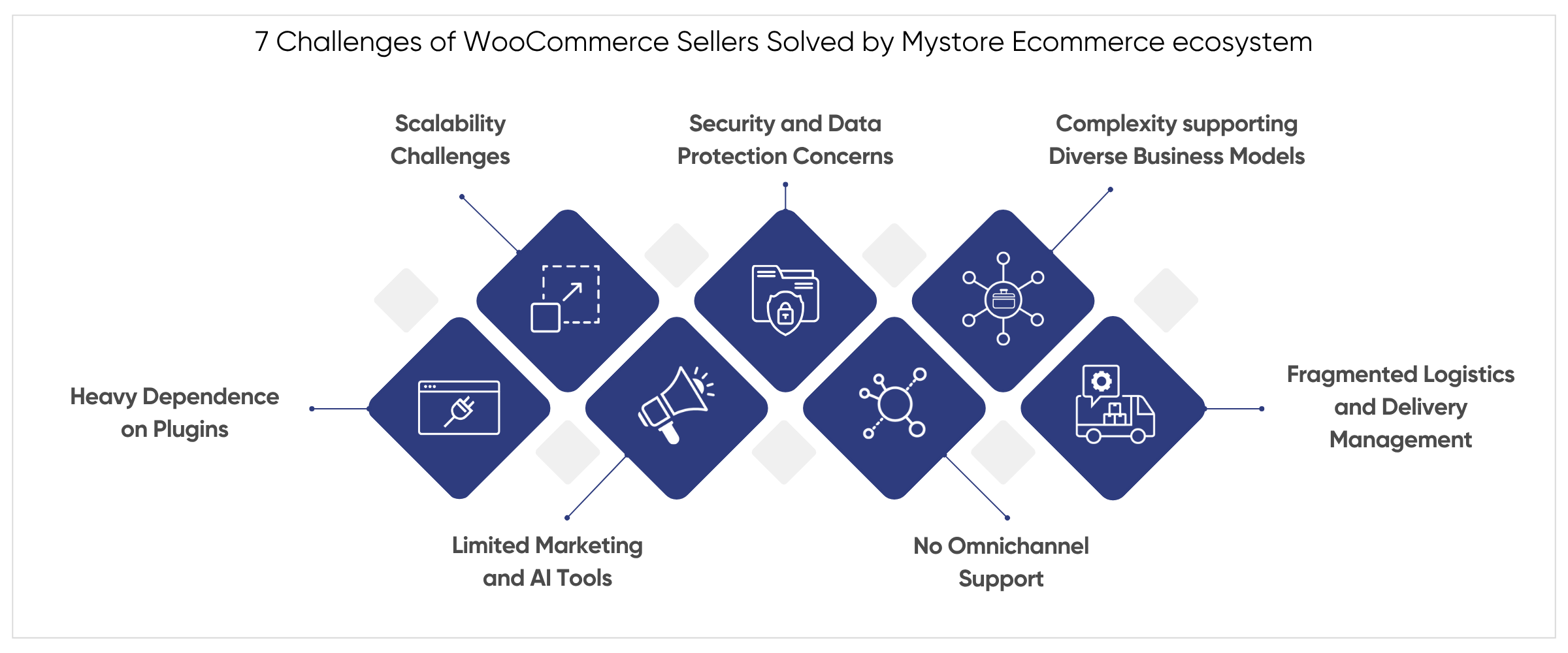
WooCommerce offers a strong start for many businesses, but growing enterprises often need more integrated capabilities. Here’s where Mystore enterprise ecommerce solutions step in, and this WooCommerce vs Mystore comparison shows how Mystore simplifies and scales operations seamlessly.
1. Heavy Dependence on Plugins
If you’re a WooCommerce seller, you’ve probably felt pain. The platform’s plugin flexibility looks great in the beginning. But as your store grows, that same flexibility starts to work against you. Suddenly, you’re managing a pile of plugins just to keep things running, one for SEO, another for shipping, a few for payments and analytics. Then come the constant updates, version conflicts, and performance issues. And if a single plugin breaks after a WooCommerce or WordPress update? Your checkout might stop working altogether, taking your sales (and customer trust) down with it.
That’s where Mystore changes everything. Mystore ecommerce ecosystem gives you everything you need right out of the box, secure payments, on-network logistics, AI-powered tools, and advanced marketing features, all built to work together seamlessly. No juggling plugins. No worrying about compatibility. Just one powerful, unified platform that helps you scale smoothly, cut costs, and deliver a flawless shopping experience across every channel.
2. Scalability Challenges
WooCommerce works fine when your business is small, but once you start scaling, the cracks begin to show. As your product catalog expands or your traffic spikes, the platform tends to slow down. Adding multiple storefronts or expanding into new regions often requires costly hosting upgrades and constant developer support. Many enterprises hit a wall here, forced to spend more on infrastructure than on growth.
Mystore enterprise solutions MystoreNEXT changes that equation.
Built on a modern MACH architecture ( Microservices, API-first, Cloud-native, and Headless), it’s designed from the ground up for performance and scalability. Whether you want to launch new storefronts, build custom workflows, or expand into new geographies, Mystore lets you do it seamlessly. The result? Fast performance, limitless flexibility, and the freedom to scale your ecommerce business exactly the way you want.
3. Limited Marketing and AI Tools
When it comes to marketing, WooCommerce often leaves sellers juggling multiple tools. It doesn’t have advanced automation or analytics built in, so managing campaigns, promotions, and customer engagement usually means relying on a bunch of third-party plugins. The result? Fragmented marketing efforts and higher costs to keep everything running smoothly.
Mystore changes that completely. Its enterprise ecommerce solutions come packed with smart marketing tools like PDF cataloguing, shareable QR codes, and a robust discount engine, all designed to simplify promotions and enhance visibility. Beyond that, Mystore integrates next-generation AI capabilities right into its core, helping sellers save time and create product descriptions and image enhancements effortlessly. The AI-powered cataloguing tool can instantly generate product titles, categories, HSN codes, and SEO-rich descriptions, while the Magic Edit image enhancer turns everyday product photos into professional, market-ready visuals with balanced lighting and crisp clarity.
What makes Mystore even more powerful is its ability to personalise the entire shopping journey. With AI recommendations, buyers automatically see products that match their browsing and purchase behaviour, while AI semantic search understands the context behind every query to deliver accurate results. And for the ultimate customer experience, Mystore’s Agentic AI chat interface, Mystore Genie, guides shoppers in real time, from searching for products to completing their orders with ease.
4. Security and Data Protection Concerns
WooCommerce’s open-source nature means security largely depends on your hosting provider and how regularly you update plugins. A single outdated plugin or unpatched vulnerability can expose customer data or payment information. For enterprises handling thousands of transactions, that’s a risk you can’t afford.
Mystore ecommerce ecosystem eliminates that worry from day one. The platform comes with multi-level, enterprise-grade security and compliance built right in, no extra setup or third-party tools required. Mystore is both PCI DSS and ISO certified, ensuring adherence to global and Indian data protection standards.
Everything from encrypted payments and regular system updates to role-based access controls is handled centrally, so your business is always protected against evolving cyber threats.
Take, for instance, a large electronics brand using Mystore. They don’t need to worry about managing SSL certificates or coordinating separate security configurations, Mystore handles it all automatically. The result? A safer, faster, and fully compliant ecommerce experience that builds confidence for both your business and your customers.
5. No Omnichannel Support
WooCommerce doesn’t natively support omnichannel commerce. You’ll need multiple extensions or expensive custom development to connect your web store, mobile app, and third-party marketplaces. The result? Disconnected systems, inconsistent experiences, and frustrated customers who expect to shop seamlessly across channels.
Mystore enterprise ecommerce solution, MystoreNEXT, changes that completely. It comes with built-in omnichannel capabilities, so you can connect with your buyers wherever they are through your web store, Android and iOS mobile apps, WhatsApp commerce, or even across 20+ ONDC Network buyer apps.
And that's not all!
Mystore enterprise solutions MystoreNEXT, supports emerging channels like voice commerce and conversational shopping through Mystore Genie, an intelligent AI assistant that helps customers browse, compare, and buy, all through natural conversation.
6. Complexity supporting Diverse Business Models
WooCommerce was originally built for B2C selling, and while it does that well, things get complicated the moment you try to branch out. Pivoting to models like B2B, B2B2C, or hyperlocal commerce often means adding multiple plugins, doing custom setups, and managing endless updates. For growing enterprises, that kind of patchwork setup quickly becomes rigid, expensive, and tough to scale.
Mystore enterprise ecommerce solutions take a smarter approach. They’re natively built to support multiple business models, no external extensions, no extra hassle. Whether you sell D2C, B2B, B2B2C, hyperlocal, or other hybrid or disruptive models, Mystore lets you run them all effortlessly from a single backend.
Imagine you’re a grocery brand that sells directly to customers (B2C) online but also supplies local retail shops B2B. With Mystore, you can manage both models seamlessly. And the best part? As your business evolves, you can easily switch or add new models anytime without replatforming or rewriting your store. This level of adaptability gives enterprises the freedom to innovate, pivot, and scale fast, without the technical roadblocks that come with WooCommerce’s plugin-heavy setup.
7. Fragmented Logistics and Delivery Management
Logistics is where most WooCommerce sellers hit a wall. Managing deliveries often means juggling multiple third-party shipping plugins that work in isolation. There’s no unified view of inventory, no real-time tracking, and no analytics, leading to delays, higher shipping costs, and poor customer satisfaction.
That’s exactly where Mystore Mystore ecommerce ecosystem steps in to simplify the chaos. With 40+ on-network logistics providers, Mystore gives you complete control over your deliveries, without needing a single extra plugin. You can easily compare and choose the provider that offers the best shipping rates and fastest delivery timelines.
What’s more.
Real-time rate tracking and pin-code level serviceability mapping help you optimise fulfilment across intercity, intracity, and hyperlocal deliveries.
Whether your order needs to reach a remote hinterland or a nearby customer, Mystore’s pre-integrated logistics partners ensure smooth and reliable dispatch every time. And if you already work with trusted third-party couriers or dealer delivery networks, Mystore gives you the flexibility to integrate them too.
You can easily switch between on-network and off-network logistics providers based on delivery type, ensuring maximum efficiency and cost control, without compromising on speed or customer experience.
Conclusion
WooCommerce can be a starting point, but it wasn’t built for enterprise-level scale, flexibility, or automation. Managing multiple plugins, handling fragmented logistics, or patching together security and marketing tools only takes you so far before it becomes overwhelming and expensive.
Mystore enterprise solutions offer a smarter, future-ready alternative. With MystoreNEXT, you get a complete Mystore ecommerce ecosystem built to handle everything from AI-driven marketing, omnichannel selling, to secure payments and integrated logistics. It’s not just about managing ecommerce anymore; it’s about mastering it.
So, if you’re ready to move beyond plugin chaos and unlock true scalability, innovation, and control, the WooCommerce vs Mystore debate ends here. Mystore’s enterprise ecommerce solutions are built to empower your business to sell smarter, grow faster, and stay ahead in an ever-evolving digital world.
Want to explore by yourself?
Book your free demo with Mystore enterprise solutions MystoreNEXT today.